
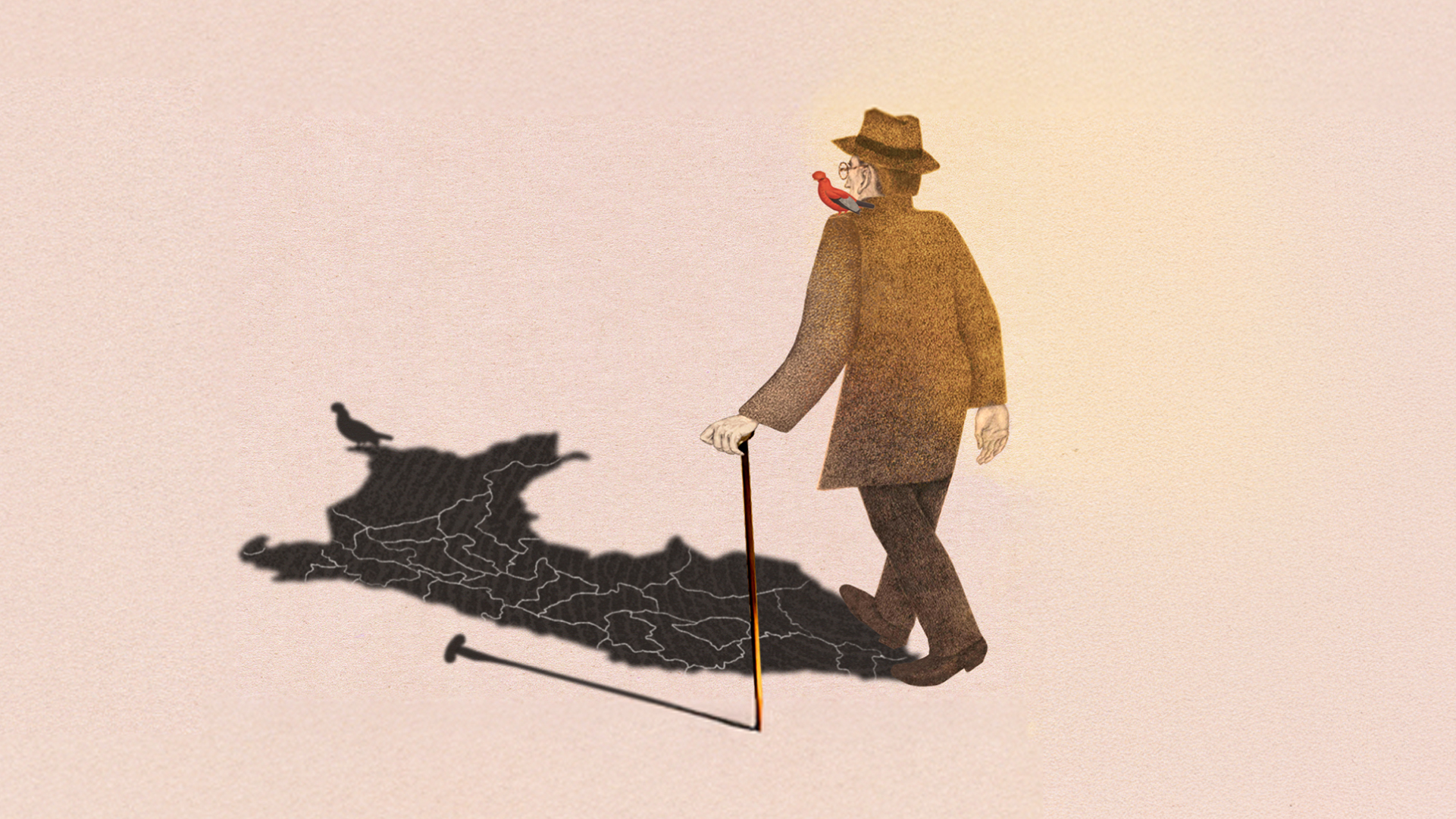
The Unbearable Lightness of Being Peruvian | Translation
Share:
► Click here to return to the episode official page, or here to see all the episodes.
♥ We live in difficult times. We are a non-profit media, and our permanence depends on listeners like you. If you value our work, join Deambulantes, our membership. Help us elevate Latino voices and tell the story of our communities. Your contribution is directly invested in our journalistic work and makes all the difference.
►Do you listen Radio Ambulante to improve your Spanish? We have something extra for you: try our app, designed for Spanish learners who want to study with our episodes.
This podcast is the property of Radio Ambulante Studios. Any copy, distribution, or adaptation is expressly prohibited without prior authorization.
The following English translation was generated with the assistance of artificial intelligence.
[Daniel Alarcón]: This is Radio Ambulante. I’m Daniel Alarcón.
And this… Is Bernardo.
[Bernardo Haour Hartman]: In Peru they call me Bernardo Haour Hartman because my mother is Hartman. I was born in Paris, near the Eiffel Tower, in a comfortable district. In 1935.
[Daniel A.]: 1935. So he’s 90 years old. His childhood was marked by the German occupation.
[Bernardo H.]: The Paris I remember is a very, very sad Paris. First, there were German troops everywhere. Second, there were Nazi symbols everywhere. And third, there was hunger, much cold, and much fear. At night there was no light. No light at all.
[Daniel A.]: So planes couldn’t bomb the city.
Despite this gloomy context, the war that marked his childhood, and then the postwar period of his adolescence, Bernardo was a dreamer. He had three ideas for the future he imagined. Actually, when Bernardo speaks, it always seems he thinks in groups of three. It’s his idiosyncrasy.
[Bernardo H.]: My first idea was to be an architect, the second was perhaps literary, the third was to be a monk.
[Daniel A.]: And he went with this third idea, to become a monk. In 1952 he entered the Jesuit novitiate.
[Bernardo H.]: My father was happy, I think. My mother, not at all. My mother thought it was totally stupid, totally premature. I remember that on the platform of the station where we took the train to my novitiate 300 kilometers from Paris, she put fifty francs in my pants pocket in case I wanted to return.
[Daniel A.]: But he never used that return ticket to Paris. He liked the intellectual life of the Jesuits, an open life, full of ideas and valuable conversations. Ideas that, for Bernardo, are fundamental.
If you had to explain the life of a Jesuit to someone who knows nothing about it, how would you explain it.
[Bernardo H.]: I’ve explained it as… the request that the Pope regularly makes to the Jesuits is on the frontiers, not in the maintenance of the Church, but in the somewhat difficult things that need to be addressed and that can help the Church better understand the world it inhabits.
[Daniel A.]: Understanding the world. Working for people. In Bernardo’s case, he devoted himself to studying economics and history, teaching classes. About Marxism. About economics. He also learned a lot in Algeria, where they sent him to do his military service. He lost his best friend there, in the war.
Then he returned to France, to work at the school where he himself had studied, trying to sensitize his French students to the problems of the world beyond Europe. And that was his life, for years, until one day, as if to put his studies into practice, some Jesuit friends invited him to Peru. Without thinking much about it, Bernardo accepted. He saw it as an adventure. It was 1986 and he was 51 years old.
[Daniel A.]: What did you know about Peru before coming for the first time?
[Bernardo H.]: Little, except that it’s a great civilization. For a Frenchman it’s like Mexico and Peru. Peruvian is much broader than the French, so to speak.
[Daniel A.]: Breadth… It’s not a word used much to describe a culture or a country. And of course, I understand that Bernardo refers to geography, certainly—the grandeur of the Andes is something that has never ceased to amaze me… But he doesn’t just refer to that. Also to something more.
Let’s see… I remember that when I was a child, some relatives would come visit us in the United States, where we moved when I was three years old, and well, that visit always brought some absolutely implausible story from Peru, and you’d hear, like a refrain, this phrase… Land of wonders. With a tone between ironic and affectionate. Peru is a country where inexplicable things happen daily, in politics, on the street, in families. A tendency toward the unexpected and the illogical that I mention only because I think that’s also what Bernardo means when he says we’re a broad country. In other words, complex. Intriguing. Unfathomable.
A country where everything happens. We have breadth.
I think it’s clear that what I mean is that there was something about Peru that really caught Bernardo’s attention.
So Bernardo arrived first in Piura—he pronounces it like that. Piurá. A coastal region in the north of the country, not far from the border with Ecuador. He works as an advisor for development projects in the rural areas of this immense Peruvian province. He supported the creation of gardens, irrigation in areas with little water, and working with peasant collectives. That’s why he traveled long distances, to the most remote areas of the country. He traveled through Alto Piura, a region near the highlands, which reminded him of some of the mountainous areas of France. He also went to Bajo Piura…
[Bernardo H.]: Bajo Piura is totally the opposite, it’s a kind of oasis.
[Daniel A.]: An oasis beside the Piura River, with cotton fields and lush, tropical vegetation. To his surprise, there was one detail that reminded him of his childhood during the war.
[Bernardo H.]: I’m with a Jesuit in a truck in a very, very vast rural landscape, extended, and there’s no electricity. That brings me back to thinking about occupied Paris.
[Daniel A.]: That same darkness that had accompanied him as a child. But otherwise, everything was new.
[Bernardo H.]: I come from a country that is la douce France… sweet France… Everything is very moderate.
[Daniel A.]: On the other hand, Peru… well… I can attest that it’s a country where nothing is moderate. Not even the landscapes…
[Bernardo H.]: The landscape I’ve seen in Piura… They initiated me into another somewhat more rugged country, with things that stimulate more, right?
[Daniel A.]: And the people he met—open, joyful, generous, endearing, easy to love. And resilient. People who faced daily difficulties that would sink others, circumstances they overcame. And they did it with dignity. With care. Even with humor.
For years he worked in rural areas, until a spinal injury forced him to move to Lima, where he ended up dedicating himself to teaching. And it was there, already with the years, that he realized he felt at home. But really at home, that he was no longer passing through Peru. He identified with the people, with their humor, with the landscape, with this broad land more than ten thousand kilometers from where he was born.
Bernardo felt more Peruvian than French. A powerful, unappealable feeling.
But nationality isn’t just a matter of feelings.
It’s several other things, some ambiguous and difficult to define. When I heard Bernardo’s story, a question came to my mind that I’ve asked myself at various stages of my life as a Peruvian in the United States: what makes us belong to a place?
We’ll be right back.
[Daniel A.]: We’re back on Radio Ambulante. I’m Daniel Alarcón.
Bernardo was already over 80 years old, late in life to have doubts about his identity. By that point, he had been living in Peru for more than thirty years. It was 2019, and he traveled to France for the first time in several years, with a question spinning in his head.
[Bernardo H.]: In a way, the question comes from knowing whether I’m going to return to France.
[Daniel A.]: To live his last years there…
[Bernardo H.]: Of course I have to go because I’m not from a family that’s well-off at all. I would be a burden for the people in Lima at some point. So then I have to decide to go back, but what I wanted to know is whether I could get Peruvian nationality.
[Daniel A.]: Because for years he hadn’t needed to ask himself this question. Hadn’t needed a document to validate how he felt. But when thinking about where he should go at the end of his life, toward the final chapter, it became more urgent. And in fact, the more he thought about the idea of returning to France, the less attractive it seemed to him.
[Bernardo H.]: France I don’t know anymore. I don’t know the French anymore.
[Daniel A.]: That’s to say, he had spent almost 40 years outside France. He was another person. A person who had learned to see and understand the world from this Peruvian perspective.
[Bernardo H.]: And it’s in Peru that I really became what I am now.
[Daniel A.]: What are you now?
[Bernardo H.]: Joyful and… quite simple, I would say. I mean the fact that… I try to put myself, I try to think about things from… from the other’s place, okay, I mean, which I don’t think is a bad choice. I think the Jesuits’ invitation to try to imagine the world from the place of the poor, well that seems decisive to me. Peru taught me that—it’s the diversity and the ability to, to learn to look at. Peru gave me much, and not only Peru, but Peruvians.
[Daniel A.]: Yes… Peru and the Peruvians.
It’s not just the landscapes and the food. Or the customs. It’s also the people.
[Bernardo H.]: And that’s where I discovered the smile of the Peruvians, which for me is totally fundamental. I think I never smiled so much, which is for me a beautiful experience. So simple, right?
[Daniel A.]: But it’s not really that simple. Making the decision to settle somewhere can be as complex as the question of belonging itself. For Bernardo, a foreigner in Peru, without family in this country, with no one to sponsor him, there was an obstacle.
[Bernardo H.]: In Peru they made clear to me that I can’t really be legally Peruvian, because the condition is that you have to be married to a Peruvian or have parents or grandparents born in Peru.
[Daniel A.]: So then, since 2019, Bernardo has been on his quest. A pilgrimage of his own. A via crucis… And everything, if we’re honest, with an uncertain outcome.
[Bernardo H.]: I went to the embassy, to officials, but that didn’t lead to anything. I spoke with lawyers. Fundamentally, for me, Peru has been where I lived, where I learned.
[Daniel A.]: The exception to nationality by marriage, Bernardo says, is when it’s naturalization by special law, which Peru has granted in the past, for example, to a former president of Argentina, Alejandro Toledo, and a few athletes who played for Peru’s national team. In other words, to celebrities.
[Bernardo H.]: Celebrities.
[Daniel A.]: And Bernardo is not one of them. He’s a retired Jesuit priest and educator. His desire to be Peruvian wasn’t an ambitious one; he wasn’t asking out of opportunism. It was an intimate desire.
[Bernardo H.]: I always ask myself: how should I say this? Is it too personal? Should I keep it to myself? But there’s a moment when I want to say it, so… What I want to ask for is to be granted grace. That’s what it was for me.
[Daniel A.]: Grace. It’s an important word for him, grace. It’s about gratitude. About acceptance. About the life he created for himself, even if he never imagined himself in Peru. A life he was grateful for. A life he was grateful for to such a degree that, well, he wanted the nationality of that country.
[Bernardo H.]: I realized, I said to myself, ‘Well, if they don’t give it to me, I’m still Peruvian.’ So I talked with someone from the embassy and I said to him, ‘If you never give it to me, I don’t think it will change much for me.’ But there are people who prefer, and I belong to that school, I prefer to be given it, I prefer to be recognized, in short.
[Daniel A.]: Yes.
[Bernardo H.]: To feel like I was adopted by my favorite country. So that the country would say to me, you’re welcome.
[Daniel A.]: Finally, Bernardo wrote a column in La República, a Peruvian newspaper, explaining his attachment to Peru, his love for the country, and his frustration.
[Bernardo H.]: And I think that touched many people.
[Daniel A.]: The story went somewhat viral, and support came from various groups and associations. And that public pressure worked, and in 2024, finally, finally, the Peruvian Congress voted on the law. Eighty-eight voted in favor, and six against. The current president, Dina Boluarte, signed it into law.
[Bernardo H.]: Of course it’s, it’s pleasant and it gives you a lot of, how to say, it gives you a lot of, of gratitude or a lot of… I don’t know what to say anymore… Something very powerful.
[Daniel A.]: After years of trying, he finally got his documents. His Peruvian passport. Bernardo was also given a Peruvian national identity card, and what’s symbolic about this, what he likes, is that his identity card has his fingerprint on it.
[Bernardo H.]: Because they did the whole process, with the eye. They’re looking to see if you’re, if you’re you, right?
[Daniel A.]: The biometric recognition. The state is saying, yes, you’re one of us.
[Bernardo H.]: So I have a Peruvian identity card like all Peruvians, which for me is wonderful. And when I go back to France to see my relatives, I’ll tell them my adventure has come full circle. And after all, I was fine, right? I was… I was… I didn’t have such a bad time. I had a good journey.
[Daniel A.]: Shortly before we recorded this conversation, something happened that Bernardo wanted to share with us. Something that also has a bit to do with the themes of belonging and identity that we’ve been talking about.
At a press conference in Rome in March 2025, Pope Francis announced his resignation. The resignation was immediate.
[Bernardo H.]: The cardinals have to meet and vote. The conclave, the conclave.
[Daniel A.]: The cardinals are locked inside the Sistine Chapel. They pray and vote. And they do this repeatedly until one of them receives the required votes to become the new pope. When a decision has been made, they send white smoke through the chimney of the Sistine Chapel, visible to all those gathered in St. Peter’s Square. That’s exactly what happened on March 29, 2025, shortly after the conclave began.
This story was told to me by Paola Ugaz and Pedro Salinas.
[Paola Ugaz]: And of course, you say, ‘Okay, there’s white smoke, there’s a new pope.’ But in the middle of that, there’s another part of the event that is what takes the longest, which is when white smoke comes out and while they officially present him. The person who’s going to be pope is inside praying and saying, ‘Well, I’m going to be pope,’ right, which is a crazy thing.
[Daniel A.]: These are Paola Ugaz and Pedro Salinas, journalists from Peru. They had traveled to Rome to cover the conclave and the election of the new pope.
[Pedro Salinas]: We were there in the plaza when precisely that white smoke appeared. What was interesting is that we sat next to a group of journalists who didn’t seem to be very… what do I say, I mean, they weren’t very interested or they had been there all day. I don’t know if they were tired, but almost as soon as white smoke appeared, we were obviously taking notes, recording, and there was a group behind us who were still sitting chatting about I don’t know what. Totally disconnected, I mean, and then the cardinal comes out, the protodeacon, and he presents, he says the phrase in Latin.
Cardinal Tauran… I’m just playing around here… I don’t know who it was.
[Cardinal Tauran]: Annuntio vobis gaudium magnum: habemus papam!
Translation: I announce to you great joy: we have a pope.
[Cardinal Tauran]: Eminentissimum ac Reverendissimum Dominum, Dominum Robertum, Sanctae Romanae Ecclesiae Cardinalem Prevost.
Translation: The Most Eminent and Most Reverend Lord, Lord Robert, Cardinal of the Holy Roman Church Prevost.
[Pedro S.]: And he says Cardinal Prevost, and he says Bishop of Chiclayo.
[Paola U.]: And he starts saying, ‘obispo de,’ and I say, ‘Wait, that’s Spanish,’ and I say to Pedro, ‘Did they just say Chiclayo?’ Chiclayo is a city in Peru, on the northern coast.
[Pedro S.]: We had no expectations that a pope would emerge who had anything to do with Peru or Latin America in general, right?
[Paola U.]: So I turn around and say, ‘It’s Prevost. He’s Peruvian. He’s naturalized Peruvian. He’s Chiclayo’s bishop.’ And then they, like a thousand journalists from all over the world, stood up and surrounded us and started asking us: What? Where? Prevost? Chiclayo? Where’s that? Chicago? Tell us. And then you have to, in one minute, say, ‘Chiclayo, Peru, northern Peru, coast, desert, chiclayana food, Robert Prevost, naturalized Peruvian.’
[Daniel A.]: The new pope, Leo XIV, was born in the United States, in Chicago, but even so, in the announcement, they said he was the bishop of Chiclayo. So then, was he Peruvian or not?
[Pedro S.]: It’s a more complex or richer question, right? On the one hand, of course, he was born in Chicago, United States. But on the other hand, the designation, so to speak, that he has is as bishop of Chiclayo. He arrived in 1986, just like Bernardo, and just like Bernardo, he spent practically his entire life in Peru. And at the end of 2024, he applied for Peruvian nationality. They gave him his documents in January of this year, 2025.
[Paola U.]: Robert Prevost’s Peruvian identity card, for us at least, was the most important thing. Well, literally, he is a Peruvian pope. Naturalized Peruvian.
[Daniel A.]: Now, Pao and Pedro had exploded with emotion at the announcement… not just out of nationalism… No, no. They actually knew Prevost well. They knew the relationship he had with the country. And here’s a bit of context: if you’ve listened to Radio Ambulante for years, you know a bit of Pao and Pedro’s story, and their long struggle to unmask an extremist sect affiliated with the Catholic Church in Peru: The Sodalitium. In that struggle, which culminated with Pope Francis expelling the Sodalitium from the Church, Prevost had been a key ally. When others didn’t want to help Pao and Pedro, Prevost did.
[Paola U.]: If there’s anyone who has seen how a curia moves in Latin America, it’s him. But I feel that what he’s learned in Peru has given him a vision of how things can be better if you do things that unfortunately aren’t always done in our countries.
[Daniel A.]: And so… That’s why they got so emotional. Not only because he was Peruvian, nor because he was known, but because they knew exactly the type of person he is. Pao had seen, for example, how he connected with people in Chiclayo.
[Paola U.]: He organized people for children’s literacy issues. He organized women for malnutrition issues.
[Daniel A.]: And he did it not only in the city of Chiclayo, but in the most distant places.
[Paola U.]: So he traveled through, let’s say, the areas, especially the areas where there are no roads. In Lambayeque or in all of Chiclayo there are no roads because of corruption, not because of lack of money. And he traveled through this on horseback, on donkey, but he got there.
[Paola U.]: I mean, it’s incredible, but if you see him, let’s say, at Christmas, he sings as if he were Peruvian and not American, because he sings on the Spanish side and he sings on the English side.
[Daniel A.]: Would you say that as a foreign bishop, he’s more identified with the people than some bishops who are Peruvian?
[Paola U.]: Totally. Because being empathetic in a country where so many terrible things happen makes the difference, always.
[Daniel A.]: So, now… Going back to Rome, to that day of the so unexpected announcement, that emotion, that enthusiasm that Pao and Pedro demonstrated in the middle of the tumult made them the center of attention of the other journalists. Because no one else seemed to have much idea who this gentleman was.
[Paola U.]: Chicago? Chiclayo? No, Chiclayo. Everyone asked what it was.
And in fact a Polish journalist comes up to me and tells me, ‘It was like that in my time when John Paul II was around.’ They surrounded us and asked us things and we were like, yes, but we already felt like winners of something I can’t explain to you what. But we were very happy telling them where Chiclayo is located, where Peru is located, because obviously there were people who had no idea where Peru was. So, explaining your country, explaining where it comes from, even though, of course, in theory he was born in Chicago, but he’s in Chiclayo, was really, it was very important for everyone.
[Daniel A.]: Between the white smoke and the presentation of the new pope to the public, an hour and a half passed.
[Paola U.]: In that moment is when Robert Prevost already knows he’s going to be Leo XIV. He knows what he’s going to say. He perfectly chooses Diocese of Chiclayo. He chooses to speak in Spanish and he chooses to say what he said.
[Robert Prevost]: To all those, and in a particular way to my beloved diocese of Chiclayo in Peru… Where a faithful people who have accompanied their bishop, have shared their faith, and have given so much so much to continue being the faithful church of Jesus Christ…
[Paola U.]: In fact, in the delivery, which we saw, he was crying. He’s very emotional, but he had perfectly chosen to give a symbolic gift to Chiclayo by saying what he said.
What I feel, that Peru, what it does with people who know it, is… you have, you start a complex relationship, not a relationship that at times you feel is toxic, but also at times it gives you, it gives you things that other relationships don’t give you.
I think there’s no one more Peruvian than him. No one is more Chiclayano than him.
[Daniel A.]: And I’d dare to say that at that moment many Peruvians felt the same.
For some in the United States, the happiness over the appointment of an American pope didn’t last long. And it was soon replaced by consternation. Why?
Because in his first speech, the pope spoke Italian, by protocol, and then, as we already heard, in Spanish, with that very special and affectionate greeting to the diocese of Chiclayo… But he didn’t say a word in English. That is, the fact that he greeted Chiclayo but not Chicago offended some people.
Imagine.
I’ve been thinking a lot about this issue of nationality. Which is a feeling, of course, but also an accident of geography. Being born in a certain place, let’s say, and not another, is a matter of chance.
For example, I was born in Lima. To Peruvian parents. With four Peruvian grandparents and eight Peruvian great-grandparents. But I grew up in the United States from a very young age, and therefore, I’m also culturally very American. I speak English. I read a lot in English. I consume American culture because it belongs to me. That’s normal for so many immigrants who arrive as children. In my case, I had to decide at some point in my adolescence that I wanted to be Peruvian too. That I wanted to connect with a country that, beyond family visits, I barely knew.
I chose it. For reasons I didn’t even understand well at the time. For a connection. For a feeling. Maybe I wanted a geographical accident to make sense.
[Paola U.]: Something can change in this country. Those who choose to be Peruvian… they all have that. It’s like, I don’t know… It’s a chip. It enriches your experience a lot, choosing to be Peruvian.
[Daniel A.]: I can attest to that. I mention all this because in the United States there’s a lot of talk about nationalism these days, about what it means to love and belong to a country. There’s debate about who can belong, who has rights, and who doesn’t. But if I’m honest, the nationalism I’m seeing seems to me less like a love for the country and more like a hatred of foreigners, or the idea of foreigners… Whether because of their racial characteristics, their clothing, their tattoos, the language they speak, their religion.
For someone like me, who came to the United States as a foreigner, who grew up speaking another language at home, it’s not easy to accept. That type of nationalism seems to me a betrayal of the idea of the United States they sold me as a child. I think everyone knows what I’m referring to. I don’t doubt for an instant that one can love and belong to two countries. I don’t doubt it because that has been my life. But now this basic notion is in danger.
It’s as if the most authentic expression of this new patriotism were cruelty. Exclusion. The celebration of others’ misfortune, laughing at their bad luck and their pain.
So I’m left with that contrast… Between the patriotism I just described and that broad and generous patriotism that, say, Bernardo or the new pope feel toward Peru. That broad country they adopted. That broad country that adopted them.
The difference couldn’t be clearer.
[Daniel A.]: This story was produced by me, with the help of Natalia Sánchez Loayza. It was edited by Camila Segura and Luis Fernando Vargas. Bruno Scelza did the fact-checking. Sound design and music are by Andrés Azpiri.
The rest of the Radio Ambulante team includes Paola Alean, Adriana Bernal, Aneris Casassus, Diego Corzo, Emilia Erbetta, Camilo Jiménez Santofimio, Germán Montoya, Sara Selva Ortiz, Samantha Proaño, Natalia Ramírez, Lina Rincón, David Trujillo, and Elsa Liliana Ulloa.
Carolina Guerrero is the CEO.
Radio Ambulante is a podcast by Radio Ambulante Estudios, produced and mixed in Hindenburg PRO.
Do you have a friend who’s learning Spanish? Tell them about Jiveworld, our app for practicing Spanish with Radio Ambulante stories. Real voices. Real accents. Real stories. The Spanish that’s actually spoken in Latin America. Go to jiveworld.app and pass it along. Do them that favor.
If you liked this episode and want us to continue doing independent journalism about Latin America, support us through Deambulantes, our membership program. Visit radioambulante.org/donar and help us continue narrating the region.
Radio Ambulante tells the stories of Latin America. I’m Daniel Alarcón. Thanks for listening.