
The City of Sol | Translation
Share:
► Click here to return to the episode official page, or here to see all the episodes.
♥ We live in difficult times. We are a non-profit media, and our permanence depends on listeners like you. If you value our work, join Deambulantes, our membership. Help us elevate Latino voices and tell the story of our communities. Your contribution is directly invested in our journalistic work and makes all the difference.
►Do you listen Radio Ambulante to improve your Spanish? We have something extra for you: try our app, designed for Spanish learners who want to study with our episodes.
This podcast is the property of Radio Ambulante Studios. Any copy, distribution, or adaptation is expressly prohibited without prior authorization.
The following English translation was generated with the assistance of artificial intelligence .
[Daniel Alarcón]: This is Radio Ambulante. I’m Daniel Alarcón.
The apartment was on the sixth floor. At number 46, Alcalde Sainz de Baranda Street. Just a few yards from Retiro Park, in Madrid.
On September 3, 1956, the door opened and in walked the Abascal family: the father, the mother, the son and the daughter, Maricarmen, who was 17.
What they saw when they walked in… whether it was empty or furnished, the color of the walls, how the light came in through the windows… we can’t know.
What we do know is that only the father signed the lease. Back then, women didn’t have that right. It was typewritten and bore the seal of the Franco dictatorship: an eagle.
At some point, the sofa upholstered in a floral fabric arrived. The mirror in the entryway. And the wooden furniture in the kitchen. Family photos appeared on the walls and shelves. The porcelain cats in the living room. The souvenirs from trips to Argentina, Mexico and Venezuela.
And the memories of an entire lifetime.
The apartment saw the father die and, years later, the mother. The apartment and Maricarmen were left alone.
They grew old together while the city and the neighborhood changed. The hardware stores, the butcher shops, the churro shops and the movie theaters gradually disappeared.
In their place: specialty coffee shops, bars and restaurants, cookie shops. And with them came the tourists, of course. And people with money are looking to invest in Madrid. The same thing has happened in so many other cities, from Buenos Aires to Mexico City. From São Paulo to Bogotá.
Around 2018, when Maricarmen was almost 80, she received a letter. An investment fund had bought the entire building, including her apartment.
And then… the nightmare began: the fight over who would keep the home Maricarmen had been renting her whole life.
The investment fund gave her the option to buy the apartment for about 250,000 euros. But with a pension of 1,450 euros, she couldn’t. Who was going to give a loan to an 80-year-old woman, she would say.
And of course, in a real estate market as ruthless as Madrid’s, there’s always someone with more money ready to pounce.
Another company bought the apartment. And in 2020, it raised her rent. It tripled. From 500 to 1,600 euros. It was that or leave. Maricarmen couldn’t pay that much. It was impossible. But she wasn’t willing to leave her home either. A legal battle began. Four years went by. And then she joined the Tenants’ Union, which helps people facing eviction…
[Maricarmen Abascal]: This is my home, this is my neighborhood, and I’ve still got plenty of fight left in me.
[Daniel A.]: The union helped her bring her case into the public eye. The interviews started, the protests…
[Maricarmen A.]: I’ve been coming to this home for sixty-nine years, and I’m absolutely certain they’re not going to kick me out. They’re not going to kick me out because I have a right, because to me, my home isn’t just the walls. My home is my life.
[Daniel A.]: And little by little, she became a symbol of the right to housing in a country where buying, renting or simply finding a place to live is getting harder and harder.
[Maricarmen A.]: I’ll say it again: I’m not leaving. The fight will go on, because we are absolutely going to win this, because we’re going to win with all of your support.
[Daniel A.]: But they wanted Maricarmen out, no matter what. They wanted her to stop buying her fruit at Saúl’s shop. And her fish at Tomás’s. To change orthopedists and swimming pools. To start her life over, basically, at 87.
[Maricarmen A.]: They’re inhuman. You can’t make a person live through what I’ve been living through for seven years.
[Daniel A.]: She started losing her voice; she looked weaker and weaker. Going out alone and taking the bus, making herself breakfast, getting up from her nap… she couldn’t do any of it anymore.
[Maricarmen A.]: Fight. Don’t stay home.
The cane gave way to a walker, and the walker to a wheelchair. But Maricarmen didn’t stop.
[Maricarmen A.]: Fight for your housing, because we have a right to it.
[Daniel A.]: She managed to mobilize hundreds of people.
That didn’t stop the police, acting on a judge’s order, from pushing their way through the crowd gathered outside number 46, Alcalde Sainz de Baranda Street on September 23, 2026… and forcing their way into Maricarmen’s home.
Seventy years after she arrived at that apartment, Maricarmen was carried out on a stretcher, straight to the hospital.
[Alicia del Río]: They’ve evicted Maricarmen. We’re going to fill the streets with the rage and outrage we feel. We’ll see you at seven in Madrid and in cities across the country. Valencia, Málaga, Sevilla, Barcelona.
[News anchor]: Valencia, Sevilla, Oviedo, Toledo and Palma have joined the protests against Maricarmen’s eviction since seven this evening.
[Alicia del Río]: We’re furious, and we’re not going to stop until we change this. We’re not going to stop until this never happens to another Maricarmen.
[Protesters]: We are all Maricarmen!
[Daniel A.]: In Madrid, the protests led people to gather in the city’s main square, the Puerta del Sol.
[Valeria Racu]: Comrades, they’re telling me there are people camping out in Sol. They’re telling me there are people!
[Daniel A.]: There, on Saturday, September 26, dozens of people began pitching their tents to keep the protest going.
[Protesters]: This is for Maricarmen!
[Daniel A.]: For Maricarmen. And from the hospital, she sent them a message.
[Maricarmen A.]: I’d love to be there with you, to join you in your camp, but I’m not so lucky. So, from here, I ask all of you to be brave. Fight, defend what’s yours, and please, be careful. Stay camped out, for as long as your bodies hold out and as long as you want to.
[Daniel A.]: “Stay camped out, for as long as your bodies hold out and as long as you want to.”
There, in the Puerta del Sol, among those tents, is where the story we’re about to tell you begins.
The story of an ephemeral city. Of its ambitions and its fears. Of its inhabitants. The story of how that city was born, grew and disappeared — but not before changing Spain.
Our producers Pablo Argüelles and Sara Selva Ortiz were there documenting it all. Here they are.
[Sara Selva Ortiz]: How’s it going, Pablo?
[Pablo Argüelles]: Hi, Sara.
[Sara S.]: Let’s start this story with the first day we went to the Puerta del Sol to see what was going on.
[Pablo A.]: It was a Tuesday, September 29, around five in the afternoon. Three days after the first campers arrived.
Okay, okay. So, for people who don’t know where we are. You — since this is your country — where are we?
[Sara S.]: We’re at Kilometer Zero of Spain, in what’s known as the Puerta del Sol, which is the seat of the regional government of Madrid. It’s an iconic spot in Madrid that’s usually full of tourists, uh, well, and souvenir shops.
[Pablo A.]: And it’s a square surrounded by very elegant pastel-colored buildings, and, well, suddenly, on this huge stone esplanade — there isn’t a single tree here…
[Sara S.]: Which gets a lot of criticism, by the way.
[Pablo A.]: Suddenly there’s a sea of tents. I mean, how many are there now? A hundred? Hundreds?
[Sara S.]: Way more. Like five hundred?
[Pablo A.]: You think?
And, well, obviously we went in to explore.
[Sara S.]: Okay, come on, let’s go in…
Without really knowing what was inside.
Hi, hello.
[Pablo A.]: Hi.
[Sara S.]: Shall we go this way? Sorry, eh.
[Camper]: No worries — right down the red carpet…
[Sara S.]: With so many tents… It was hard to make our way through.
[Pablo A.]: Really, picture a city with tents and tents and tents packed incredibly tight. I mean, there isn’t a single inch between one tent and the next.
[Camper]: Right, what I’m saying is, that one needs to be moved…
[Sara S.]: Here you can see them setting up some tents that are kind of crashing into each other because there’s no room left.
[Camper]: And the opening has to face the other way, because otherwise…
[Sara S.]: There’s a cockroach walking around over there, too.
[Pablo A.]: We were still on the outskirts of that huge camp. And it already felt like it was turning into some kind of city.
So we can go further.
[Sara S.]: Yes, we can go a lot further.
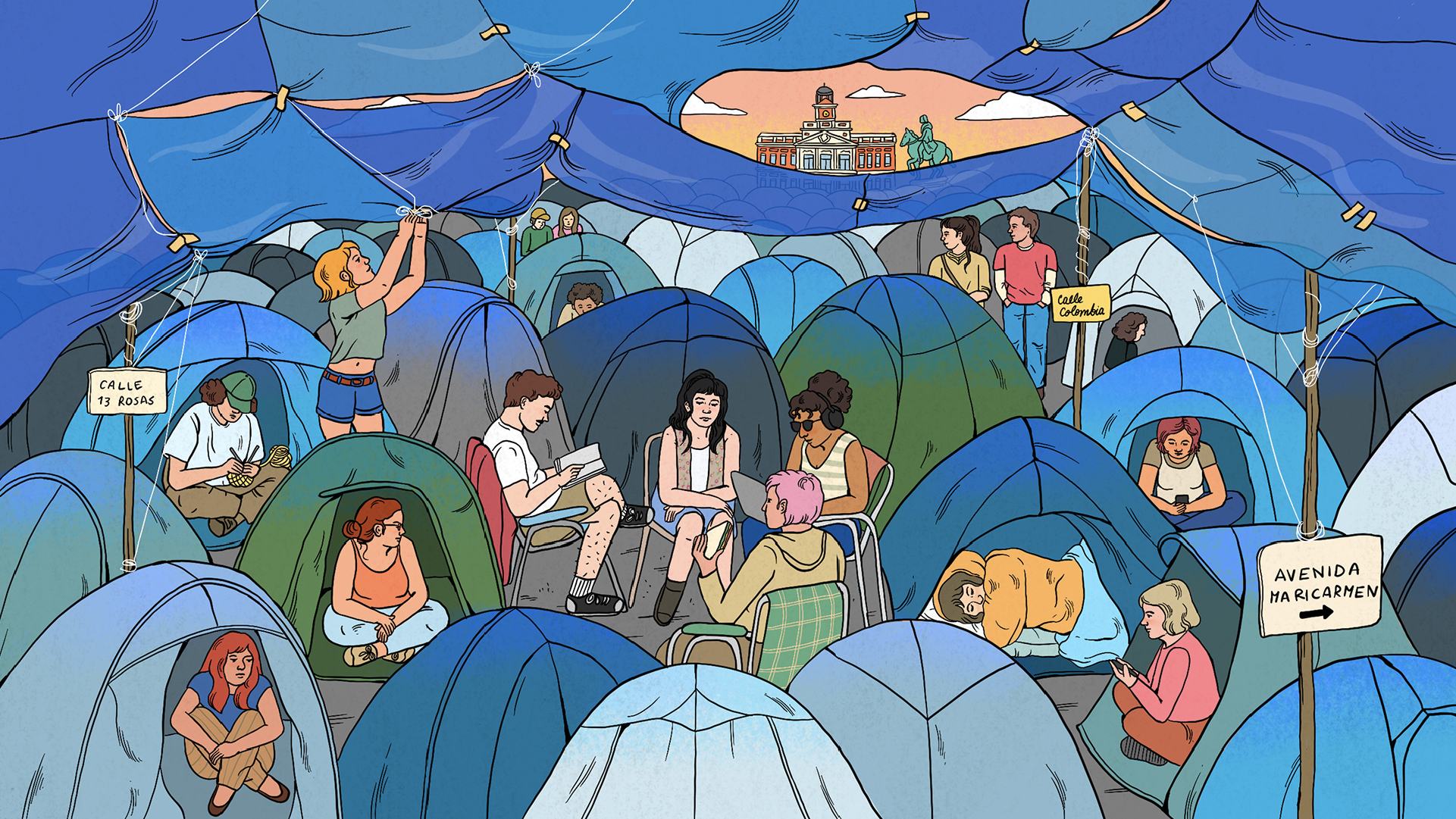
[Pablo A.]: In fact, since there was no room to get through so many tents, the inhabitants started making spaces that worked like streets and squares. And giving them names.
[Sara S.]: So, we’re going to enter Confederation of Assemblies Square.
[Pablo A.]: They wrote the names in marker on pieces of cardboard. And put them up on makeshift columns.
[Sara S.]: Made from broomsticks or cardboard tubes.
[Pablo A.]: And those columns held up the tarps that were starting to cover the camp.
I mean, imagine big tarps, most of them blue, joined to one another with tape. So they look like the huge sails of a ship that the wind lifts up, and it creates a kind of internal air current that cools everything down, and then this whole sea of tarps suddenly drops and rises up again. So it’s like you’re underneath a sea.
[Sara S.]: Walking around the camp, we figured most of the people there were Spanish.
[Pablo A.]: But since this is Radio Ambulante, they weren’t the only people we wanted to chat with.
[Sara S.]: We suspect there may also be people from Latin America, because there are a million Latin Americans living in Madrid, right?
[Pablo A.]: A bit more, I think.
[Sara S.]: Even more.
[Pablo A.]: Actually, there are one million one hundred thousand.
[Sara S.]: And so, uh, one of our goals is to see how they’re experiencing this social crisis.
[Pablo A.]: Right, because the housing issue, well, it affects everyone.
So that’s why we’re here.
[Sara S.]: So, to talk to more people, we split up.
[Pablo A.]: Okay, I’m in the center of the camp and I found out there’s a street called Colombia.
[Sara S.]: And you got obsessed with that street.
[Pablo A.]: Yeah… pretty much.
[Pablo A.]: Bakunin Square, Street of the Does, Miguel Hernández Street… Colombia Street must be around here somewhere…
[Sara S.]: Hey, listen, have you seen other compañeros, like, Latin Americans and such? Yes?
[Sara S.]: In a little square in the city, I came across Clara, a young Brazilian woman.
[Clara]: You want to hear a podcast of me talking? Come on, then, sit down.
[Sara S.]: She was sitting in a tiny circle of folding chairs, surrounded by other young people.
[Clara]: And honestly, I don’t know these people at all, but they’re super nice.
[Young man]: Like we’ve known each other forever.
[Clara]: I think it’s kind of the vibe here: at the end of the day you don’t really know who’s next to you, but since everyone is here for the same purpose, you don’t really care.
[Pablo A.]: Meanwhile, I was still looking for Colombia Street…
Okay. I mean, I imagine I’m close, because I saw a map. Hi! I saw you had a map with a street called…
[Camper]: It’s confidential.
[Pablo A.]: It’s confidential. Okay.
They told me they couldn’t show me the map for security reasons.
[Camper]: There are threats that organized far-right groups are coming.
[Sara S.]: That afternoon a rumor was spreading through the whole city: that far-right groups opposed to the camp were going to come and attack it.
[Pablo A.]: So while I was still looking with Colombia Street…
[Sara S.]: I went to one end of the square, because a huge crowd was gathering there…
[Sara S.]: I’m going to head toward the noise to see what’s going on.
They wanted to prevent a possible attack.
[Protesters]: Madrid will be the grave of fascism! Madrid will be the grave of fascism!
[Pablo A.]: An attack that didn’t happen.
[Sara S.]: No… not that day.
[Pablo A.]: Okay, let’s not get ahead of ourselves.
I’m looking for Colombia Street. Do you know it?
[Camper]: We changed it. This was it.
[Pablo A.]: I got to Colombia Street too late, by the way…
[Camper]: It’s called Naty Camacho now.
[Pablo A.]: But I did meet Elsa, a Chilean woman who had been living in Spain for more than two decades.
[Pablo A.]: Could I ask you to tell us why you’re here?
[Elsa]: Well, because I was affected by the mortgage crisis. In 2015 I had a problem. I started out paying a mortgage of three hundred euros and ended up paying a mortgage of one thousand five hundred euros. I had five years left to pay it off, and Blackstone took it.
[Sara S.]: Blackstone is an American investment fund. And it’s also one of the biggest residential landlords in Spain.
[Elsa]: I had a good job and could keep paying the mortgage, but there came a point when I couldn’t.
[Pablo A.]: Elsa told me her story even made it to the big screen, in a film called On the Fringe, starring Penélope Cruz.
[Elsa]: The story Penélope tells is my case.
[Pablo A.]: She sounded very proud. If anyone had a reason to pitch her little tent in that city, it was her.
[Elsa]: There — that tiny one over there, the gray one. That’s where I sleep.
[Pablo A.]: All by yourself.
[Elsa]: Yes, because it’s so small. The thing is, if I stay home alone doing nothing, I think I’ll go crazy.
[Pablo A.]: Being there and showing her outrage mattered more than being comfortable.
Elsa, thank you so much for your time. We’ll see you around. We’ll be around. Thanks.
[Sara S.]: By then, I had already walked through almost the entire city…
Can I squeeze through here? Sorry to bother you.
[Camper]: Yes, yes, go ahead, go ahead.
[Sara S.]: Getting pretty lost.
Thanks.
[Someone]: It’s supposed to be a walkway.
[Sara S.]: No, no, sorry, okay?
[Pablo A.]: And we met up in the center of the camp, at the intersection of the city’s two main streets: Maricarmen Avenue and September 26 Avenue.
[Sara S.]: Okay, so now we’re sort of in the center of the camp. This is like the Kilometer Zero of Kilometer Zero.
Let’s say it was like the operations center. There was a field kitchen with volunteers making sandwiches and taking in donations brought from all over Madrid. I mean, it was like the city’s lungs.
[Pablo A.]: The energy was incredible. We were in the perfect spot to meet people and ask them what had brought them there…
[Sara S.]: And we heard all sorts of things.
[Daniela]: Housing is tied to a whole chain of problems that have to be solved now, right now. I mean, no, we can’t wait any longer, because we’re fed up, we’re exhausted.
[Pablo A.]: There was an activist so committed that she cut her vacation short.
[Daniela]: My friend and I said, “Let’s cancel the trip and go back.”
[Sara S.]: There were young people who had been there since the very beginning.
[Camper]: Even more people started arriving, and we could tell that the seed of something much bigger had been planted.
[Pablo A.]: There were curious retirees. Confused tourists. Students.
[Sara S.]: Parents with their kids, old folks in wheelchairs, young couples. Workers, too: waiters, artists, geographers, psychologists…
[Pablo A.]: And people who were just passing by and admired them.
[Woman]: There’s strength in unity, and Madrid really does have strength. Olé, olé! Plain and simple.
[Woman]: I’m really proud of young people, I truly mean it. I think it’s incredible. This is going to work out.
[Sara S.]: Hey!
[Pablo A.]: There were friends of yours there, too!
[Sara S.]: What’s up?
[Pablo A.]: Sara runs into a friend.
[Sara S.]: Even newly arrived migrants. Like Marcos, from the Dominican Republic.
[Marcos]: Look, I’ve… I got here this morning.
[Pablo A.]: Who stumbled upon the camp by chance.
What do you expect from your life here in Spain?
[Marcos]: Hey, to give it a shot. I know good things are coming.
[Sara S.]: There was also Marta, a Colombian woman, a survivor of human trafficking.
[Marta]: I’m from Santiago de Cali.
[Pablo A.]: When was the last time you were there?
[Marta]: Well, I left thirty years ago now. I don’t even have the taste of my roots anymore.
[Sara S.]: And they were all worried about the same thing.
[Pablo A.]: What did you feel that made you have to come?
[Young person]: Mostly outrage. I think that’s what drives us.
[Pablo A.]: How incredibly expensive housing is in Spain.
[Fernando]: Right now, young people’s dream is to someday have a home, to someday be able to live on their own. But that shouldn’t be a dream.
[Sonia]: They ask you for almost, almost your entire salary. So, you tell me, where are we supposed to get that money from?
[Michael]: We spent about three months looking for an apartment and didn’t find one. It’s impossible to find an apartment right now.
[Sabrina]: In my case, I’m an actress, and what happened to me was that if I called about an apartment with my Mexican accent, they wouldn’t rent to me. But if I suddenly switched to a neutral accent, all of a sudden everyone was offering me viewings and wanted to know what part of Spain I was from. And then people here say, like, “No, we’re not racist in Madrid.” And it’s like, “Geez.”
[Sara S.]: And among all the inhabitants of this city… There was also Santiago.
[Santiago]: I come from a country where at 13 you go out into the streets in a hood to protest as a high schooler.
[Pablo A.]: Santiago, a 22-year-old Chilean with pink hair. We found him on the outskirts of the city, in an area that wasn’t even covered with tarps yet.
[Sara S.]: He was studying art. And he told us he’d come to the camp alone.
[Santiago]: It was hard. I was wandering around Madrid, but I was scared to come closer. Since I don’t know a lot of people… until I finally went in. I started looking around; I spent many hours just watching, observing.
[Sara S.]: Until, in the middle of all those tents, he saw a Mapuche flag belonging to a group of Chileans.
[Santiago]: And I talked and talked and talked and talked and talked, and they listened to me and let me stay with them. They said something like, “Hey, we need someone to cover for us.”
[Pablo A.]: Meaning, to watch their tent when they couldn’t.
[Santiago]: And I said yes.
[Sara S.]: He stayed.
[Santiago]: For days, this whole camp thing had been on my mind, but I came officially because just two days ago we were also told we have to leave our apartment.
[Sara S.]: Santiago lived with his mother and his two siblings in an apartment on the outskirts of Madrid.
[Pablo A.]: But the landlord was going to kick them out in just over a month. So they were looking for another option, all while his mom worked as a cleaner.
[Santiago]: My mom has been working double shifts all week, starting at five or six and getting off at ten at night, so she can have a cushion in case anything happens.
[Sara S.]: That’s why Santiago was there. For his mother.
[Santiago]: Because in her I see Maricarmen, because in her I see so many migrant mothers who know what it’s like to work twice as hard off the books to earn a wage that maybe doesn’t even cover a room, and to have to sleep in one room with your four kids.
[Pablo A.]: Okay, I think it’s important to say that his mom has already migrated twice, right? First from Peru to Chile, where she had Santiago. And then she left again, but this time for Spain. In 2023.
[Sara S.]: Santiago and his siblings arrived a little later. And he was really shaken to discover the conditions his mother was living in, sharing a tiny little room with another woman.
[Santiago]: One woman slept on the sofa and the other slept in the bed, and they took turns. That’s the reality of a migrant. When my mom says to me, like, “I hope I never see you camping out there like all those bums,” it makes me angry, but then I think: how do I get a woman like her not to see us as bums, when she’s a woman who doesn’t have time to even think about stopping for a bit? People like my mom are people who don’t have… I don’t know who’s never been able to afford that. Her time to stop is lying down in bed after work, because she’s so tired, taking a cold shower and lying down to watch Netflix until her body gives out, which is fifteen minutes later. Her time to stop is listening to music on the train while she’s thinking about how she’s going to make it to the end of the month. Or her time to stop is, on a weekend, being able to have a little drink — but not get drunk, because the next day she has to be okay, because she’s going to work the next day.
[Pablo A.]: Santi, sorry to interrupt, but does your mom know you’re here?
[Santiago]: No, my mom is so busy we don’t even have time for her to ask me that. She only asks me if I’ve eaten. Like, she says, “Have you eaten, hijo?” And I tell her yes. I left home yesterday and haven’t been back. And she asked me if I’d gone back home to sleep. I told her no…
[Pablo A.]: We talked with Santiago for a little over an hour. And as time went on, he got more and more emotional. As if the city had given him back a hope he’d lost. And that’s why it was so important to be there now, and nowhere else.
[Santiago]: I’m no longer the Santiago who left Chile, and I’m not the Santiago who arrived in Spain. But what I can say is that I think I am, I can be, the Santiago who has a lot to shout about and fight for, just as he has a lot to give.
[Sara S.]: He’d been at the camp for barely a day, helping with whatever was needed, even the things that seem simplest, like singing and making signs to hang all over the city.
[Santiago]: I just wrote one — it was the first one I wrote — and I hung it on the post over there, uh, at the entrance to the Sol metro station. It says: “The students won’t let you sleep if you don’t let them dream.” The only thing that’s going to save us from all this, from this, all this danger, from all this evil, is dreaming. The moment we stop dreaming, there’s no turning back.
[Sara S.]: It’s midnight, but it feels like two in the afternoon, because this place is packed with people full of life, and it doesn’t look like anyone is going to bed… right?
[Pablo A.]: No. I mean, this is going to keep going.
[Daniel A.]: Hours after getting lost among all those tents, Sara and Pablo realized that the city — the City of Sol — already had a life of its own.
[Sara S.]: We’re going to go to sleep…
[Pablo A.]: And we’ll see each other early tomorrow.
[Sara S.]: Once the sun is up.
[Pablo A.]: Okay, bye.
[Daniel A.]: We’ll be right back.
[Daniel A.]: Okay, we’re back in the City of Sol with Sara and Pablo.
And what we’re about to hear… let’s say it’s like watching a city grow in fast-forward. So close your eyes and enjoy the ride.
[Pablo A.]: Seven in the morning, the chimes of the Sol clock.
[Sara S.]: Two, three, four, five, six, seven, eight. Okay.
[Pablo A.]: It’s 10:04.
[Sara S.]: It’s sort of dawn; it’s still dark out.
[Pablo A.]: It’s about 5:40 in the afternoon. I’m here at the camp.
It’s ten in the morning on September 30.
[Sara S.]: It’s grown so much. None of these tents were here.
[Pablo A.]: It’s almost seven at night. Well, evening. It’s…
[Lola]: Nine-thirty in the morning, could that be right? I stayed here until four in the morning. I went back home — I don’t live very far — uh, took a nap, made a thermos of coffee to bring to the campers here, and now I’m going to go to work. And after I get off work, I’ll come back here.
This looks like a neighborhood.
I’m telling you, this doesn’t, doesn’t look like an improvised protest. This really has turned into… just look at the streets they’ve put together.
[Alejandro]: Gloria Fuertes Street, Diverti-Street.
[Pablo A.]: Some streets even have numbers already.
[Sara S.]: One, two, three, four, five, six, seven, eight. Okay.
[Alejandro]: Assembly Road.
[Lola]: Look at the streets they’ve put together.
[Alejandro]: Hooded Love Street, Sparrow Alley…
[Pablo A.]: Do you want to go into the streets?
[Sara S.]: Yes, yes.
[Lola]: Just look at the streets they’ve put together.
[Alejandro]: Avenue of the Precarious, Freedom Road, Ruckus Street.
[Lola]: This is just incredible. There are even maps. I don’t know if you got to see them.
[Sara S.]: Oh, so you made the map?
[Alejandro]: Yes.
[Sara S.]: Can I record you?
He’s the map guy.
[Sara S.]: Seriously? Can you tell me a bit about this?
[Alejandro]: Sure. I got here yesterday…
[Sara S.]: Okay.
[Alejandro]: Around four in the afternoon. And when I go to festivals or things like this, I like to make a sort of map of the place — I usually make it for myself. So I started making one. There are two key streets. One is Maricarmen Avenue and the other is September 26 Avenue.
So, the intersection of Maricarmen Avenue and September 26 is where the center is. The rules are: streets are named by the committee that’s coming up with street names, and squares are named by the neighbors who live next to the square. So, things we’re told are really hard to organize turn out to just take the enthusiasm to do them.
[Sara S.]: It’s a pleasure, so nice to have met the cartographer. What do you do for a living?
[Alejandro]: I’m a psychologist. Nothing to do with it.
[Pablo A.]: Hello, hello, hello, hello. It’s 7:45 in the evening on Friday, October 2.
[Sara S.]: I think about three more rows of tents have been added.
[Pablo A.]: Hi, Marta, how are you?
[Marta]: Hi.
[Sara S.]: Or four.
[Marta]: I’m still around. We’re going to keep fighting, fighting. Because there’s love here, pure love.
[Pablo A.]: Sol is packed with people.
[Sara S.]: Way too many people, huh?
[Pablo A.]: It’s Saturday, October 3, at twelve-thirty in the afternoon.
[Sara S.]: It’s really super overwhelming, huh?
[Camper]: I don’t mind bumping into people, going back and forth, because it’s such a joy to see this. And more and more people keep joining. And people go: “How can I help? What can I do?”
[Sara S.]: And you ended up sort of on the outskirts of this city that’s been built.
[Martín]: Yeah, honestly, right now it’s really hard to find a spot inside the space, inside the square.
[Pablo A.]: All the tarps lift up and then drop, and lift up and then drop. And they’re trying to tie them together with rope, with tape.
[Alonso]: There are builders going around here, going to the neighborhoods that need them, whose only job is to build.
[Quico]: We’ve got surveyors, cartographers, architects.
[Sara S.]: So right now, for example, they need lights, flashlights.
[Quico]: Surveyors, cartographers, architects.
[Alonso]: Whose only job is to build.
[Sara S.]: Tarps, cardboard, broomsticks.
[Alonso]: Whose only job is to build.
[Pablo A.]: I can’t… tell me how… What’s happened since… since you saw Sara.
[Alejandro]: Look, since I saw Sara, we finished the maps, and now I’m suddenly the spokesperson for Urban Planning. We went to a general assembly, and after the general assembly, a young woman grabbed everyone who had made maps or done anything related to that, sat us down and said: “You are the Urban Planning Committee.”
[Alejandro]: And I was like, “Okay, great.” There’s a public tent stock that we just created today — since the government can’t manage to create a public housing stock, well, we’ll show them how to do it here. There are one thousand eight hundred tents, and managing them is hard, hard work.
[Pablo A.]: How does it feel?
[Daniela]: Really good. We’ve already found a place right in the center for the modest price of zero euros, so that’s great. We’re finally homeowners in central Madrid.
[Pablo A.]: Okay, the sound of a home’s zipper being opened. One, two, and…
[Jose]: Okay, so this, this is my humble abode, across from the Tío Pepe sign — a very sought-after area right now, or so they say.
[Pablo A.]: It’s… I don’t even remember what day it is anymore. It’s…
[Sara S.]: Sunday, October 4, at three in the afternoon.
[Pablo A.]: Okay. We’re in the camp’s public library.
[Sara S.]: They’ve set up a hardware store.
[Pablo A.]: There’s a barbershop, too. Were you satisfied with the service?
[Customer]: Very satisfied.
[Pablo A.]: It’s 2:06 in the afternoon.
[Sara S.]: It’s Monday, October 5.
[Pablo A.]: It’s almost eight in the morning. It’s starting to rain, and the camp is waking up very slowly. There’s a stand in the center of the camp that’s starting to serve breakfast, instant coffee.
[Camper]: This is super good.
[Volunteer]: Whatever you’d like, it’s all for you, folks.
[Volunteer]: Gluten-free.
[Sara S.]: The food looks amazing. There’s a kind of couscous with chickpeas, and they’re adding a little mint and a little garlic.
[Pablo A.]: It smells like bleach. They’re cleaning the ground with bleach and water.
[Camper]: Hi, do you know where Urban Planning is?
[Pablo A.]: It’s been several days since we talked. Everything in the camp has changed so much.
[Alejandro]: Well, I don’t even remember what day I talked to you, because the days pass strangely here. And now there are neighborhoods that are completely self-managed. La Perra neighborhood, uh, has its own committees, its own organization and so on.
[Pablo A.]: Hi, Santiago.
[Santiago]: Hi, how are you?
[Pablo A.]: Do you remember me?
[Santiago]: Of course I remember you.
[Pablo A.]: How’s everything going?
[Santiago]: Good. Cold.
[Pablo A.]: Have you talked to your mother?
[Santiago]: Yes. She just told me: “Thank you, hijo, and I’m, uh, proud.”
[Pablo A.]: Sara, almost two weeks have passed since Maricarmen’s eviction, and the protests and this city of thousands of inhabitants have achieved things no one expected.
[Valeria Racu]: Maricarmen is going to be able to go back home.
[Sara S.]: The company that evicted Maricarmen backed down. Something historic: an eviction had never been reversed before.
[Tenants’ Union]: Fighting works. There’s hope. We can build better things if we fight for them.
[Pablo A.]: And she got the news in the hospital. She’ll go back as soon as she’s discharged.
[Elma Saiz]: Today the Council of Ministers has adopted one of the most important measures having to do with…
[Pablo A.]: Then Pedro Sánchez’s government tried to pass several measures to ease the housing crisis.
[Sara S.]: Like banning evictions of vulnerable people, or preventing investment funds from buying homes.
(Archival sound bite)
[Congress of Deputies – Pedro Sánchez]: What lies behind these decrees today is the desire to bring order and humanity to a market that, if we don’t regulate it…
[Sara S.]: But the right-wing parties in Congress voted down every one of those measures.
[Francina Armengol]: Thank you very much, and the session is adjourned.
[Pablo A.]: After that defeat, Pedro Sánchez decided to call early general elections for November 29.
[Pedro Sánchez]: The time has therefore come for the people of Spain to decide what future you want for yourselves and for your country.
[Sara S.]: Elections that, according to the polls, the right is more than likely to win.
[Pedro Sánchez]: Now it’s up to you.
[Sara S.]: And all of this as Spain’s main labor unions join the movement and call a general strike for the right to housing.
[Pablo A.]: Phew.
[Protesters]: General strike, general strike, general strike, general strike.
[Daniel A.]: We’ll be right back.
[Daniel A.]: We’re back with Radio Ambulante. Almost two weeks have passed since the City of Sol was born.
[Pablo A.]: Okay, another day at the Sol camp. It’s a Tuesday, a little after noon, and I’m here with…
[Sara S.]: Hi.
[Pablo A.]: Sara.
[Sara S.]: Here we are. It’s getting windy; the tarps are starting to move a lot.
[Pablo A.]: Um… and, well, I wanted you to tell me a story you’ve mentioned to me in passing, but that I feel has everything to do with this camp and why we’re here.
[Sara S.]: It’s the story of Adolfo. I think I’ve mentioned it to you at some point while walking around the streets of this city, but I’ve never really told it to you properly. So, Adolfo is a 67-year-old Peruvian man who has lived in Madrid for fifteen years with his daughter and his four-year-old grandson.
[Pablo A.]: Tell me how you met him.
[Sara S.]: So, I met him one day at the end of June.
[Pablo A.]: Of this year.
[Sara S.]: Of 2026.
[Adolfo]: We’re getting ready to be able to stop this, this eviction.
[Sara S.]: He had just been through an eviction attempt, and a new eviction date had been set for July 1. In other words, there were only a few days left.
[Adolfo]: I can go sleep under a bridge — under the bridge, that’s fine. But there’s a child, there’s a daughter, there’s a family. So you’re out there looking for solutions.
[Sara S.]: And he was in the thick of organizing to stop the eviction with the PAH.
[Pablo A.]: What’s the PAH? P, A, H.
[Sara S.]: P, A, H, for Plataforma de Afectados por la Hipoteca — the Platform for People Affected by Mortgages — a grassroots organization that mobilizes neighbors to fight housing speculation and, above all, to stop evictions.
[Sara S.]: In this case, it was the PAH in Vallecas, a neighborhood in the south of Madrid, a traditionally working-class neighborhood. So I met up with Adolfo at a community center to hand out flyers around the neighborhood.
[Adolfo]: Hello, how are you? Good morning. They’re going to evict us here in Vallecas, and they’re throwing everyone in Vallecas out on the street. So I hope we can stop this and that you’ll join us. Thank you.
[Sara S.]: So he was walking around, around Vallecas talking to people.
[Adolfo]: Hello, paisano. Come on, let’s see if you’ll support us.
[Sara S.]: Telling them about his case.
[Adolfo]: They’re going to evict me, they’re going to throw me out of my home.
[Pablo A.]: And you got every kind of reaction. There were people who ignored him.
[Sara S.]: Well, they weren’t very nice.
[Adolfo]: Yeah, not many.
[Sara S.]: And there were people who stopped to talk with him.
[Adolfo]: Wednesday…
[Neighbor]: What a shame. You know what’s going on…
[Sara S.]: Who chatted with him, who told him about their own situation.
[Neighbor]: The most painful thing here in Madrid — well, because we live here — is that rent has gone up so much that people can’t afford it.
[Sara S.]: He had been living in that apartment since 2017. He paid his rent, but the owner had stopped paying the mortgage to the bank. So they were going to throw him out.
[Adolfo]: I got a notice from the court to vacate the apartment, and that’s when they offered to sell me the apartment — but on the condition that I buy ten apartments.
[Pablo A.]: I mean, ten apartments, I don’t know, that’s…
[Sara S.]: Ten apartments. It makes no sense.
[Adolfo]: I don’t want ten apartments. I just want one. And where am I supposed to come up with ten apartments?
[Sara S.]: So he tried to stop the eviction. He managed it twice with a lawyer, and on the third attempt, Adolfo was already organizing with the PAH, and so he managed to stop it with the help of his neighbors. What he achieved was getting it postponed for a week.
[Pablo A.]: Okay, so July 1 arrived and you were there.
[Sara S.]: I got there around six-thirty in the morning. There were about fifty people at the door, uh, holding hands, ready, forming a kind of human wall, blocking the door, in silence…
[Sara S.]: Is Adolfo inside?
Adolfo was inside his home. Uh, they split up, right? Some of the PAH activists stay outside guarding the building entrance and others stay inside, protecting the apartment from within. What they do is sort of seal the door so it’s much harder for the police to get in from outside. And since Adolfo’s apartment is on the ground floor, I mean, it’s at street level, every now and then he would raise the blind, lean out the window, and we could talk to him.
[Sara S.]: How are you?
[Adolfo]: Hanging in there. Hanging in there, Sarita. Good morning, good morning.
[Sara S.]: How was your night?
[Adolfo]: Well… At least I got two hours of sleep, which did me good.
[Pablo A.]: Okay, so everyone was ready and waiting for the police.
[Sara S.]: And as soon as they arrived…
[Protesters]: We won’t tolerate… not one more eviction.
[Sara S.]: The chanting started, and it didn’t stop all morning.
[Protesters]: Neighbor, wake up, they’re evicting at your door! Water, power and a roof are our right!
[Sara S.]: The police know that at any moment they’re going to have to clear out that human wall, because they have to make way for the court commission, which arrives at nine-thirty.
[Pablo A.]: What’s the court commission?
[Sara S.]: The court commission is sort of the court’s representatives — the ones who actually carry out the eviction, and who act a bit like mediators between the owners and the tenants. At one point the riot police show up — those are the officers whose job is to, to break up protests — and they come with helmets, shields and batons.
[PAH activist]: But it looks like they’re getting ready…
[Sara S.]: And that’s when the police put on their helmets, when the anger and outrage grow, and the shouting and chanting get louder.
[PAH activist]: Remember why we came, okay? Adolfo is not alone! We’re with you! Adolfo is not alone! We’re with you!
[Pablo A.]: And Adolfo?
[Sara S.]: Adolfo was still inside the apartment, and the whole time he would sort of lean out every now and then and ask questions.
[Adolfo]: Is there, is there another van that just pulled up over there?
[Sara S.]: And he looked more and more frightened and worried.
[Adolfo]: Because it’s psychological intimidation they use on you, with the lights, the vans…
[Sara S.]: And what happens? The police don’t want journalists at a scene like that. So they kicked us out.
[Pablo A.]: And what did you do?
[Sara S.]: Well, we rang the buzzer at the building across from Adolfo’s. An old lady opened the door of her apartment for us and let us watch from the window.
[Activist]: Thugs!
[Pablo A.]: Okay, and what did you see?
[Activist]: Pigs! Bastards!
[Sara S.]: Well, that’s when the police, with no journalists in front of them anymore, started charging at the protesters.
[Activist]: Sons of bitches! Shame on you!
[Sara S.]: They started breaking up that human wall by grabbing, grabbing each person, one by one, and dragging them along the ground — because part of the act of civil disobedience is going limp, right? Dropping to the ground so the police can’t pick you up.
[Activist]: And, well, you can see it right now, how they’re throwing a compañera to the ground, uh, to evict a family.
[Sara S.]: Hitting, dragging, and finally, well, clearing the entrance.
[Pablo A.]: And did they manage it?
[Sara S.]: They did.
[Protesters]: Court commission, criminal commission!
[Sara S.]: The court commission arrives, and it’s always supposed to negotiate. So what the PAH does is appoint two activists whose job is to talk with the court commission and try to stop the eviction right then and there, at the door.
[PAH protester]: The court commission refuses to talk; it refuses to honor what was agreed. They didn’t even want to talk to us. They’d rather knock the door down.
[Protesters]: Shame on you!
[Pablo A.]: So they’re going to break down Adolfo’s door.
[Sara S.]: They have no other choice, because the door is basically sealed from the inside. In fact, it was so well sealed that they had to bring out an angle grinder — which is like a power saw — to cut through it.
[Pablo A.]: So the police go into the apartment, and I imagine they tell him, “Adolfo, you have to come out.”
[Sara S.]: And from this lady’s window, we watch Adolfo walk out of his home for the last time, and another group of journalists who were there and I ran out to meet him on the street.
[Protesters]: Adolfo, you’re not alone, we’re with you!
[Pablo A.]: So, Adolfo is outside his home; they’ve just thrown him out.
[Neighbors]: Stay strong, Adolfo! Yes, yes, yes. Stay strong! Thank you. If you need anything, count on us, okay?
[Pablo A.]: How did he look?
[Sara S.]: Inside, I’m sure he was distraught, but at least that psychological torture that had been hounding him for months — at least that was over. And above all, he seemed very aware that this wasn’t just about him. It was much, much bigger.
[Adolfo]: We have to protest, we have to fight. Down with the vulture funds! Thank you. Thank you so much.
[Protesters]: Adolfo, you’re not alone, we’re with you!
[Pablo A.]: And that’s why we’re here in Sol.
[Sara S.]: Because shortly after that, they evicted Maricarmen, and everything finally exploded.
[Daniel A.]: But then, on October 7…
[News anchor]: How are you all? Good evening. Maricarmen has just died at Gregorio Marañón Hospital in Madrid.
[Daniel A.]: Maricarmen died two weeks after she was evicted, just when everyone was expecting her to return home…
[Reporter]: Her health had deteriorated over recent months, after seven years fighting that eviction.
[Reporter]: The Madrid Tenants’ Union reported that Maricarmen died after fifteen days in the hospital.
[Alicía del Río, Tenants Union]: “Speculation is costing us our lives, and today, racism has finished killing our compañera Maricarmen.”
[Daniel A.]: And that same night, hundreds of people went to pay tribute to her outside her home in Madrid.
[Coro de Canción Protesta de Madrid]: “En el pozo María Luisa”
[Daniel A.]: We’ll be right back.
[Daniel A.]: We’re back with Radio Ambulante. Here are Sara and Pablo.
[Pablo A.]: It’s eleven-thirty at night on October 7. About three hours ago, Maricarmen’s death was announced. We’re in Sol, a couple of yards from the edge of the camp, and a small altar has been set up in Maricarmen’s honor. On top of a couple of stools and a plastic crate, there’s a piece of cardboard with a hand-drawn portrait of Maricarmen and the words: “You can’t evict a memory.” And at the foot of the altar there are several little red and white candles.
[Sara S.]: That night there were tributes and moments of silence. Protests, too. Pablo and I wanted to talk to Santiago, the Chilean dreamer, the one with pink hair we met on the first day.
Let’s see if we can find Santiago again. If they let us in, that is, because now it seems there’s a sort of guard controlling the entrances to the camp to respect the privacy and rest of the people who live here.
[Pablo A.]: The guards didn’t let us in. They went to get Santiago. And a couple of minutes later, he came out to talk with us.
[Sara S.]: Hey, how have you all been handling what happened to Maricarmen?
[Santiago]: I was just chopping onions with my friend, and, well, we heard this guy say something like, “Hey, listen, the news just came in that, well, Maricarmen has passed away at the hospital.” So my friend starts crying, I start crying. I’m pretty shaken up, because one of the things that affects me most is thinking that I don’t want to, I don’t want it to take my mother dying for me to be able to enjoy something with her. At least I know she didn’t die alone; she died with the whole camp by her side.
[Sara S.]: Santiago seemed off that night. Not just because of Maricarmen’s death. He seemed irritated with communal living. With the smallest things, like non-vegans asking for vegan food as if the kitchen were a buffet.
[Santiago]: People show up and grab the meat dishes, then they go to the vegan section thinking the vegan section is the meat-eaters’ salad bar. And not only that — they go and stick their hands in the celiac section, which is made separately from everything else so there’s no cross-contamination. So what do I have to do? Start yelling: “Guys, I don’t care about being liked, I’m fine with being hated, so if I see you take vegan food and eat meat, I’m going to ban you.”
[Sara S.]: But there was something else.
[Pablo A.]: It seemed to us that the utopian city Santiago dreamed of was running up against an old enemy: hierarchy.
[Santiago]: I feel like things are getting cloudy and a pyramid is forming again.
[Sara S.]: How’s your mom? How is she taking it?
[Santiago]: My mom is totally freaking out, guys. I’ll play you a voice message.
[Pablo A.]: Let’s hear it.
[Santiago]: You’re going to be stunned. Let’s see if it plays.
[Santiago’s mom]: Answer the phone, Santiago, I’m calling you.
[Santiago]: See? And then my mom sends me voice messages like this, so you can see: “You’re fighting for, for your ideals, and I’m not going to question that or anything. It’s just that I’m afraid something will happen to you, that they’ll do something to you, because then I really would go crazy and… and I don’t know. Just take care of yourself, please, eat well, bundle up, don’t let yourself get cold or anything, please. And always check in. Always, always, always, please, check in.”
[Sara S.]: Over the following days, the mourning for Maricarmen kept the city alive. It was as if the best way to remember her was like this: by existing, by carrying on life in its streets.
[Pablo A.]: Meanwhile, outside… the general elections were approaching — the ones Pedro Sánchez called after his attempts to improve the housing situation in Spain failed.
[Sara S.]: The country went into election mode. And the camp became an easy target for the right. A symbol of the left that had to be criminalized and destroyed. The city’s inhabitants were recast as criminals, dirty people with no jobs and no ambitions.
[Pablo A.]: And that brings us to October 12. Spain’s National Day.
[Spanish national anthem]
[Pablo A.]: What some call the Día de la Hispanidad, because it’s the day Columbus arrived in the Americas. Whether it should be called that… is debatable… but we’re not going to get into that story…
[Sara S.]: The point is, it’s a public holiday, and in Madrid there’s a huge military parade that’s broadcast on TV. The king and queen attend, along with the government, the opposition leaders… and thousands of people. It was the perfect day for the polarization Spain is living through to reach the City of Sol.
[News anchor]: We’re live at five to two. This is what’s happening right now in the Puerta del Sol, where the camp is still standing and where groups have been arriving with Nazi salutes, a heavy police presence…
[Reporter]: They’re approaching, hurling insults. They’re all carrying flags. They’ve just come from watching the military parade and came straight here, they tell us…
[Pablo A.]: A group of about 200 people approached the square.
[Sara S.]: Some were emboldened far-right extremists. Fascists. Others were young right-wingers with Spanish flags tied around their waists or necks.
[Pablo A.]: It was pretty obvious they’d come to provoke. But the police formed a cordon and didn’t let them reach the camp. I was watching it on TV… and that afternoon I decided to go down there.
[Sara S.]: I couldn’t go… but I asked you to send me voice memos telling me everything you saw.
[Pablo A.]: Hi, Sara. Okay, a little postcard from Sol. I got here and literally two seconds later I ran into Santiago.
[Pablo A.]: How are you? What’s up?
[Santiago]: How are you? Good, and you?
[Pablo A.]: Great vibes, as always.
[Pablo A.]: How’s everything going?
[Santiago]: Good, how about you?
[Pablo A.]: They were playing “Llorarás” by Oscar D’León on a speaker, right at the edge of the camp, and we chatted for a while.
[Santiago]: Well… lots of tension, but I’ve learned to… These people who have no love — they’re missing love. So what am I going to give them? Joy. And that’ll make them even angrier. Seeing us happy gets to them… it bothers them more than seeing us angry.
[Pablo A.]: And look, after what happened today, with this far-right group showing up — I mean, you look at the edge of the camp and there’s a sort of, a line of campers surrounding the whole camp. I mean, they’re like a human wall. Honestly, I don’t know if I can get into the camp today.
[Camper]: Let’s stay calm, okay? Everybody stay calm.
[Pablo A.]: From Arenal Street you can hear really loud bangs. I honestly don’t know what they are. There were several National Police officers there.
Hi, uh, suddenly the tension went way up. I feel like you’d say nothing especially dangerous is happening, but I’m, I’m a little bit scared.
[Camper]: The antifascists are here!
[Pablo A.]: The city’s inhabitants were trying to organize to block their way.
[Camper]: Guys, backup at Whale!
[Pablo A.]: The tension reached a sort of standstill; the two sides just stared at each other from a distance, with the police in the middle.
[Pablo A.]: I’m going home, because there was this constant tension. And let’s see what happens.
In the end, there was no clash. But something changed in the camp that day.
[Sara S.]: The energy changed. After October 12, the inhabitants closed several of the city’s gates, the ones that opened onto the square. They also covered the whole perimeter with tarps, so no one could see what was happening inside. But something else happened, too, something nobody had foreseen. The city started attracting new inhabitants.
[Pablo A.]: How long were you living on the street?
[Sonia]: Since June. In that doorway, there, where it’s empty, there. I used to sleep there on some cardboard, like this.
[Sara S.]: It became a refuge for people experiencing homelessness.
[Pablo A.]: How did you end up at the camp?
[Moisés]: Well, I came here to the camp because of my friend, because he and I are literally living on the street.
[Sara S.]: People who used to fill Madrid’s shelters, benches and doorways. And who were now there, in the City of Sol, occupying some of its thousands of tents. Many were migrants with no resources.
[Pablo A.]: Tell me, where are you from?
[Geidy]: I’m from Peru.
[Pablo A.]: One day I came across Geidy.
[Geidy]: I came here to this beautiful country because my country is full of crime, corruption, and it’s sadder than here, I think. But what really surprises me is that rooms here in this country are way too expensive.
[Pablo A.]: What do you do for work?
[Geidy]: Well, I found a way. I didn’t come here to do harm, but to get ahead.
[Pablo A.]: She’d been in Spain for barely four months. She had a nine-year-old son. And no matter how hard she worked, at whatever job came up each morning… She could barely afford to rent a room.
[Geidy]: You’d like to live with dignity, but you can’t. Unfortunately, you have to settle for whatever your pocket can afford. It’s painful. I ended up sleeping two days on the street with my little boy. Just now I scraped together my 600 euros and rented myself a room, because winter is coming and I don’t want my boy to suffer.
[Pablo A.]: What’s your son’s name?
[Geidy]: Itan. His name is Itan Malaver. Itan, I love you so much, Itan. You’re going to grow up here. He tells me: Mom, I want to talk like the Spaniards.
[Pablo A.]: What else does he tell you?
[Geidy]: I really like this country, Mom. That’s what he tells me. It’s pretty, and I want to get wet in the rain. He wants to stand still and let all the rain fall on him. He gets so excited, because in Peru it doesn’t rain like that.
[Pablo A.]: Geidy used to sell water and candy on the metro. And since Sol is in the center of Madrid, it’s an area she passed through a lot as she came and went. One day, a friend asked her why she didn’t take a look around the camp, since there was free food there. And that’s how I met her, next to the kitchen.
And what would you like for the coming months, to be in a better situation here?
[Geidy]: I would like — please, I’m asking with all my heart — I would like to work, for someone to give me a job and a decent room to live in with my little boy.
[Sara S.]: By then, the camp had been going for almost three weeks. And Santiago was still there.
[Pablo A.]: How have these days been?
[Santiago]: Hectic. But, well, I’m better. But really hectic, honestly, like… I’m really tired. I’m really tired. I kind of want to go home.
[Sara S.]: A few things had happened to him. He’d had to move. Not out of his apartment, his mother’s — they still hadn’t found a new one. He’d had to move out of his tent, at the camp. Now he lives on Travesti Lane, next to Queers for Maricarmen Square.
[Pablo A.]: That’s where we met up and started chatting. And it was obvious Santiago was already a little fed up with his new neighborhood. And with his new neighbors.
[Santiago]: There are a lot of people who haven’t been, who haven’t been, who haven’t even been here a day and are completely disconnected from fucking reality. And that affects me a lot emotionally, like…
[Pablo A.]: You could tell he was uncomfortable.
Hey, will you come with me real quick to find my friend?
So I made up an excuse for us to step away a bit…
Do you want to keep talking over here? Because I felt like you were a little, a little tense back there…
[Santiago]: Way too tense, because the thing is, uh, well, if we’re in a community, there are always people who come along and disrupt the community a bit. It’s living together with a lot of people, and very different people. There are a lot of people from the street here. Yes, we’re worried about what’s going to happen to the people from the street after this, we are worried, yes, but at the same time, we’re not the ones in charge of that, guys.
[Sara S.]: He was worried. Above all, about the unhoused people with mental health problems. He was trying to learn how to live alongside them, how to help them. But he felt he wasn’t prepared.
[Santiago]: There are people whose job it is to handle this — organizations, foundations — who have experience, who know how to manage this, who know how to approach it from sociology, from social work, from psychology, from mediation. But we’re not trained for this. We’re not trained to have three hundred people without homes here. Hey, you can’t film here, man, please.
[Onlooker]: This is a public street, and I’ll film whatever I want.
[Santiago]: Fine, then don’t show my face, please.
[Pablo A.]: Santiago forgot we were talking and went straight over to argue with a guy who was walking by, filming with his phone. It was a few tense seconds… But then he came back as if nothing had happened, to keep venting.
[Santiago]: I’m not going to put up with them filming this like we’re some fucking circus, because we’re busting our asses here, people, so this can keep standing.
[Sara S.]: He was torn. Part of him wanted it all to be over already. To go get some rest. But he also wanted to protect what they had built.
[Santiago]: There are people declaring neighborhoods independent, who are deciding to secede from here.
[Pablo A.]: From here?
[Santiago]: From here. I mean, secede from what, guys?
[Pablo A.]: How does that work?
[Santiago]: They decide to make their own camp inside the camp.
[Pablo A.]: In other words, independence movements had sprung up in the city. Neighborhoods that wanted to govern themselves within a space that was already self-governed.
[Santiago]: So, in the end, I’m like, it’s the inconsistency — the inconsistency of politics, the inconsistency of the collective. It’s tiring, it’s exhausting, because it’s the same fifty people keeping the kitchen running, the same ten people or fifty people keeping urban planning running. So in the end it turns into a kind of toxic cycle, where it’s really accomplishing a lot, but also nothing at all.
[Pablo A.]: The same day I saw Santiago… I ran into Elsa. The Chilean woman from the Penélope Cruz movie
[Pablo A.]: Hi, Elsa! How have you been?
[Elsa]: A little under the weather…
[Pablo A.]: She was leaving. For her, the camp had already fulfilled its mission.
[Elsa]: That’s why. I’m not going to stay any longer, because, no, the cold nights are starting, so it’s hard for me. That’s why I’m taking my things. And, well, let the younger ones stay.
[Pablo A.]: So now you’re leaving this little city and going back.
[Elsa]: Yes, yes, to the neighborhood, because now the work in the neighborhood is organizing the people we’re bringing back to the neighborhood, the ones who, who want to get organized.
[Sara S.]: And this is where the question comes in. How much longer will it be worth staying here?
[Sara S.]: Hi, Pablo. Hey, I don’t know if you’ve seen, but they’ve announced an assembly scheduled for October 15 to discuss, for the first time, the possibility of ending the camp. I’m still going to be out of Madrid… Do you think you’ll be able to go? Let me know.
[Pablo A.]: The camp’s extraordinary assembly is about to start.
[Sara S.]: Okay, so. Extraordinary assembly. Synonym for a whole lot of people gathered to talk. With no time limit.
[Pablo A.]: Two hundred people, I’d estimate, sitting in a semicircle around, around a speaker. And there are lots and lots of smiles; you can tell there’s a lot of excitement.
[Sara S.]: It’s eight in the evening on October 15.
The city’s inhabitants are going to decide whether what they’ve built continues to exist or disappears.
[Spokesperson]: How do we leave here?
[Sara S.]: The plan is to vote by a show of hands. In full view of everyone, something very horizontal, with nothing hidden. But before that moment, they have to talk and gather the opinions of all the inhabitants present.
[Facilitator]: Anyone want to speak?
[Sara S.]: So they gather in circles, sitting on the ground. And there are thousands of opinions…
[Pablo A.]: Someone is saying that the camp has turned into a place to go drinking.
[Sara S.]: But, to simplify… we can boil them down to two positions:
[Pablo A.]: I hear someone say that leaving is a mistake.
[Sara S.]: The enthusiasts who want to keep going.
[Pablo A.]: A young woman saying, well, what’s the point of staying and dragging this out.
[Sara S.]: And those who are exhausted and would rather leave.
[Pablo A.]: You see people talking, people nodding, people really making an effort to listen to each other.
[Sara S.]: And there’s a lot of listening to be done.
[Assembly member]: For me, it would be kind of, kind of a loss if we packed up the camp while there were still people who — I’m very sorry — don’t have a home. Because I sleep on a sofa, but I have a home. And there are a lot of people sleeping on the street.
[Sara S.]: And that’s how almost three hours go by.
[Facilitator]: A three-hour assembly, for example, seems a bit much to me.
[Pablo A.]: It’s 4 p.m.…
As you can hear, by that point I was a little lost. And I wasn’t the only one.
People are starting to look tired; many are starting to leave. Santiago is around here — I saw him listening and, above all, clapping… How do you think the assembly is going?
[Santiago]: I’m not going to weigh in. No, honestly, at this point I’d rather not give my opinion anymore, so…
[Pablo A.]: What are you going to do? Are you going to get some rest?
[Santiago]: Yes, I’m going to go lie down in my tent for a while and sleep.
[Pablo A.]: Okay, see you later.
If you come by, come find me. Thanks, Santi. Bye.
[Sara S.]: Santiago leaves. Just before the vote begins.
[Facilitator]: Okay, so what’s the verdict?
[Sara S.]: They vote once.
[Facilitator]: Who’s in favor of the first option?
[Pablo A.]: And again.
[Sara S.]: And — surprise — one more time.
[Facilitator]: And who’s in favor of the second option?
[Pablo A.]: There’s such a longing for consensus that it seems like they’re afraid of reaching precisely that: a conclusion. Like… Are we sure we want to stay? Seriously? But again and again, the same result comes up:
Most hands go up to continue the camp.
[Sara S.]: The city carried on after that day.
Food kept being served, though with fewer and fewer volunteers.
[Pablo A.]: The most vulnerable kept coming to the camp looking for a tent to spend the night. Those who used to be on the margins were now at the center.
[Sara S.]: When the camp turned one month old, the city’s newspaper, La Lona — The Tarp — celebrated with a special issue.
[Pablo A.]: A month in which surely everything that could happen in a city happened.
[Sara S.]: Falling in love.
[Pablo A.]: Making friends.
[Sara S.]: Moving.
[Pablo A.]: Quitting your job and finding a new one.
[Sara S.]: Staying up all night.
[Pablo A.]: Getting drunk.
[Sara S.]: Realizing that the life you have maybe isn’t the one you dreamed of…
[Pablo A.]: We went back to the city several times.
[Sara S.]: Hi, excuse me, how are you all? Hey, I don’t know if you’ve seen Santiago…
Mostly, to look for Santiago.
And do you know when you last saw him?
[Camper]: No…
[Pablo A.]: No, okay…
[Sara S.]: No idea…
But he wasn’t there anymore. Neither were many of the people we’d met in those first days. The streets were emptier and dirtier. The tarps sagged more and more. November arrived, and the cold, the rain, and then a message from the national government: the right of assembly that had allowed the inhabitants to be there had expired…
[Pablo A.]: Their time was running out. But the few who were still there didn’t want to leave.
[Sara S.]: In the early hours of November 3, the police entered the City of Sol.
[Pablo A.]: They pulled the campers out of their tents. The campers say it was done by force. With shouting and blows, with mockery and pepper spray.
[Sara S.]: Bulldozers tore down the tents, the tarps, the signs. Within a few hours, city sanitation workers had erased every trace of the city with high-pressure hoses.
That afternoon, we went back to Sol.
[Pablo A.]: And there’s no sign of tents, of tarps, of streets or squares.
[Sara S.]: There are no more signs, no graffiti, no trace of the people who were here occupying this square and building that ephemeral city.
[Pablo A.]: I mean, as if the last month never happened.
[Sara S.]: As if it had never existed. The square is back to what it was before: a stage for tourists and a place people pass through.
The protests over Maricarmen Abascal’s eviction and the encampment in the Puerta del Sol achieved a great deal.
For the first time, social mobilization managed to reverse an eviction — Maricarmen’s — even though it came too late.
The protests and the camp also led to a general strike being called in Spain: the first in 14 years, and the first ever for the right to housing.
They even triggered early elections. The elections will be held this coming Sunday, November 29. And the big question is whether the far right will come to power. It would be the first time that has happened since the Franco dictatorship.
This story was produced by Pablo Argüelles and Sara Selva Ortiz. Pablo is a producer for Central, and Sara for Radio Ambulante. Both of them live — as renters — in Madrid. It was edited by Camila Segura. Bruno Scelza did the fact-checking. Sound design is by Pablo, Sara and Andrés Azpiri, with music by Elías González, Rémy Lozano and Andrés.
The song we heard after Maricarmen’s death is called “En el pozo María Luisa,” and it was performed by the Coro de Canción Protesta de Madrid.
The rest of the Radio Ambulante team includes Paola Alean, Adriana Bernal, Aneris Casassus, Diego Corzo, Emilia Erbetta, Camilo Jiménez Santofimio, Germán Montoya, Samantha Proaño, Natalia Ramírez, Maira Reina, Juan Pablo Santos, David Trujillo, Elsa Liliana Ulloa, Luis Fernando Vargas, Franklin Villavicencio, Desirée Yepez and Mariana Zúñiga.
Carolina Guerrero is the CEO.
Radio Ambulante is a podcast by Radio Ambulante Studios, and it’s produced and mixed on Hindenburg PRO.
If you liked this episode and want us to keep doing independent journalism about Latin America, support us through Deambulantes, our membership program. Visit radioambulante.org/donar and help us keep telling the region’s stories.
Radio Ambulante tells the stories of Latin America. I’m Daniel Alarcón. Thanks for listening.