
Destination: Unknown | Translation
Share:
► Click here to return to the episode official page, or here to see all the episodes.
♥ We live in difficult times. We are a non-profit media, and our permanence depends on listeners like you. If you value our work, join Deambulantes, our membership. Help us elevate Latino voices and tell the story of our communities. Your contribution is directly invested in our journalistic work and makes all the difference.
►Do you listen Radio Ambulante to improve your Spanish? We have something extra for you: try our app, designed for Spanish learners who want to study with our episodes.
This podcast is the property of Radio Ambulante Studios. Any copy, distribution, or adaptation is expressly prohibited without prior authorization.
The following English translation was generated with the assistance of artificial intelligence
[Daniel Alarcón]: A warning: this episode contains descriptions of violence. Listener discretion is advised.
This is Radio Ambulante, I’m Daniel Alarcón.
María, a 27-year-old Colombian woman, traveled to Mexico on January 31, 2024, certain that the only way to move forward with her life was to cross the border into the United States.
[María]: For me it was important to be able to live a calm, safe life, to be able to stabilize myself again, to study, to move forward in many areas of my life.
[Daniel A.]: To be able to do everything she hadn’t managed to do in Colombia.
But for María, this trip was about much more than looking for a better life. In her case, it was about survival. María was fleeing.
[María]: It was very difficult, because I had a life I’d built, a very organized life. I lived in Colombia with my mom, my sister, my brother, and my daughter. I had a stable job, I had a stable place to live. Everything was fine.
[Daniel A.]: More than four years earlier, she’d started a relationship with a man who wasn’t her daughter’s father.
[María]: At first everything was fine, everything was great, but over time it got more complicated.
[Daniel A.]: He worked for the government, but at the same time he had ties to an armed group. An illegal one, of course.
[María]: And he decided to leave the group. So these people said he couldn’t leave, and that if he did, there would be consequences. And among other things, they started with his son, then they attacked his mother, and then they kidnapped me.
[Daniel A.]: María was released a few months later. Physically she was fine, but she lived in fear. Not only of being kidnapped again, or of the retaliation continuing to get more aggressive. She was also afraid of her partner, who had started to become violent with her.
[María]: I suffered a lot of abuse and mistreatment and domestic violence from this person.
[Daniel A.]: And since this man worked for the government…
[María]: The constant threats included that I couldn’t report him, because he always told me: if you report me, I’ll find out, and the consequences will be worse.
[Daniel A.]: And they were. The day she dared to report him was the same day he threw hot water on her.
That’s when María understood that the authorities weren’t going to save her, and that this man wasn’t going to stop torturing her. So she had to get herself to safety in another country and leave her seven-year-old daughter with the girl’s father while she sorted out what she needed to bring her along. The only place where she had someone who could take her in and help her was the United States.
[María]: It was the easiest and fastest option. It was more a question of speed — I needed to leave soon, no matter what. So my life changed completely, from one moment to the next. I had to pack a bag, buy a plane ticket, and say goodbye.
[Daniel A.]: She had already tried to cross the border between Mexico and the United States once before, a few months earlier. She didn’t have a visa, and although she turned herself in to immigration authorities and tried to request asylum, they detained her while they reviewed her application, and a month later they deported her back to Colombia because they didn’t find sufficient grounds to grant it. But they also never brought her case before an immigration judge to review the decision and, if there were grounds, stop it. She wasn’t given the chance to explain anything. María had to go back to Colombia, where her abuser was waiting — he already knew she’d tried to flee, and he became violent with her again. The situation had reached a very dangerous point.
[María]: I feel like he would have killed me, because the beatings he gave me left me… uh, from all the blows, I was in a coma for a while.
[Daniel A.]: So she decided to leave again, but with a different strategy. Before crossing the border, she registered with CBP One. That app doesn’t work anymore, but it was used to manage immigration procedures, including scheduling an appointment at a border crossing to request asylum. It might not have been the fastest way into the United States, but it was better to follow the official process than risk being denied asylum a second time. María was hopeful that this time, she’d finally have a different life.
The app notified her that she had an appointment for September 19, 2024, at the port of entry in Nogales, between the state of Sonora, in Mexico, and Arizona, in the United States.
[María]: I show up for that appointment right on time. They put me through the whole protocol — photos, fingerprints — and the process was supposed to be that, since I’d entered with legal permission through a port of entry, they’d ask me for some paperwork, ask me a few questions, and then tell me I was free to go. That on a certain day I’d have to show up to court or a hearing to have my case reviewed.
[Daniel A.]: Well, that was the scenario she’d imagined. The best-case one. The one that was supposed to happen with the CBP One process. But immigration reality is hard to predict. Right away they told her that, since she’d already been deported once before, they couldn’t release her in the United States. If she wanted to enter the country, she’d first have to go to an ICE detention center — Immigration and Customs Enforcement — and continue her immigration process while detained.
They also told her that because she’d entered through CBP One, she’d be held for 30 days, and that at that point she’d have her first court date.
Well, she could wait those 30 days… just 30. They repeated it to her again and again. And she accepted.
[María]: I swear those were the most endless 30 days of my life. I mean, I couldn’t wait for day 30 to come.
[Daniel A.]: But 30 days passed, and her release never came. In fact, instead of a clear, efficient process, María kept getting one surprise after another, each one pulling her further away from the calm life she was searching for.
Our senior producer, David Trujillo, brings us this story.
[David Trujillo]: María was taken in handcuffs from the port of entry in Nogales to a detention center in Arizona. She had no one to advise her, no one to explain what might happen or what her rights were. ICE took her phone, her suitcase, and her passport. They gave her a uniform and made her spend the night in a kind of container with four bunks, where seven other detained women were sleeping. The next day, another surprise: they moved her again, this time to the Eloy Detention Center, in the same state. They told her this was the final place from which she’d continue her immigration process.
Even though María had never been in a prison, this place made her feel like she was in one.
[María]: For everything, I had to ask permission. I couldn’t do anything on my own. They were two-person cells. The toilet and the sink were inside each cell.
[David T.]: They also gave her a green uniform with an orange jacket and four pieces of underwear.
There were about 50 women with her, of different ages, nationalities, and languages… Some were sick and could barely walk. They all helped each other with basic tasks. María tried to get through the detention during those 30 days.
[María]: The routine was very boring.
[David T.]: They’d wake them up for breakfast between 3 and 4 in the morning. They’d take them out of their cells and lead them to the dining hall in another building. To get there they had to walk through open hallways no matter the weather: María remembers a lot of cold and rain. But there was also intense heat, and even sandstorms.
When they finished breakfast, they’d go back to their cells to make their beds and tidy up. Then, a shower.
[María]: Then, at 8 in the morning, they’d lock us back in our cells. The officers would do a count, then come back and open the cells at 10, and at 11 it was lunch.
[David T.]: Back to the dining hall again, no matter the weather, the mood, physical condition, illness. At 1 in the afternoon they’d lock them up again.
[María]: At 3 they’d let you out. If you wanted to go to the yard, you could, and at 4:30 it was dinner again. And after dinner they’d lock us back in our cells at 6.
[David T.]: Between 6 and 9 at night, they were allowed to make calls from the few phones in the facility, which they’d take turns using. For María, that was the one good thing about the day. She’d call her family, talk to her daughter — though without telling them she was detained. They found out later.
She also talked a lot with the friend who had encouraged her to go to the United States. Although we tried to speak with him for this story, he’s no longer in touch with María.
But at that time, he was the only person who knew everything she was going through. From a distance, of course, since he lived in North Carolina, very far from there, and since he hadn’t resolved his own immigration status, he wasn’t going to risk visiting her either. But at least those calls were a breath of air amid the mistreatment María endured all the time.
[María]: There were officers — I don’t know how to put it — with huge egos, very racist, who would treat you badly, say ugly things, like: so why are you even here? You should have just stayed in your country. Don’t cry, because you’re here because you want to be. If you don’t want to be here, get deported, go back to your country. You’re an immigrant here. You have no rights here. All you have here are obligations, and you have to meet them.
[David T.]: If they didn’t follow an order, they’d isolate them. They’d handcuff them and put them for days in a cold, dark room they called The Hole. It was the worst punishment.
[María]: Unfortunately, I was sent to that place because I was punished for disagreeing with an order an officer gave me. They call other officers, they grab you by force, put handcuffs on you, and take you away. And it was very, very hard, because it’s isolated. It’s a dark room. They cranked the air conditioning up as high as it would go and left me for two days without clothes in that cold room. I had no contact with any of the other women. I was completely isolated in that place.
[David T.]: She wasn’t the only one who received this kind of mistreatment. María also saw how badly other women there were suffering.
[María]: There were a lot of people there who came in sane, level-headed, in full possession of their senses, and at some point they’d just drown in depression — crying, screaming, pulling out their hair, hitting their heads against the walls. A lot of girls there tried to take their own lives. And it wasn’t just hard for the women living through it, but for the rest of us too, watching all of that. It filled us with sorrow and grief to see it.
[David T.]: One woman in particular left a mark on her…
[María]: It broke my heart to see a fellow detainee suffering, crying, on her knees on the floor screaming, because she’d gone into detention pregnant, and inside that detention center, she lost her baby.
[David T.]: And so the 30 days she was supposedly going to spend detained went by. On the last day, she appeared in court.
[María]: And in that court they tell me: this is your intake hearing. I need you to tell me your name, and so on, why you’re requesting asylum in this country. We’re going to give you the documents — the asylum papers. You’re going to fill out the form, and at your next hearing you’ll turn it in to me. And the next hearing was set for November.
[David T.]: That meant she was going to have to stay detained for another month. Hard, but she told herself yes, she could handle it.
[María]: Okay, in November I have my second hearing, I turn in these documents, and I’m hopeful they’ll tell me yes, you can go — and that at least I’ll get to spend December with the person I love. I’ll get to spend December being able to at least video call my daughter and tell her I’m out, I’m okay, everything’s fine and everything’s going to be fine.
[David T.]: That month went by, and she showed up again. She had to stay detained, because she was going to have to go back to court a third time: January 10, 2025, two months later, to present evidence for why she needed asylum… photos, medical records, videos… evidence she had to gather with the help of other people, because it was on the phone ICE had taken from her when she was detained.
As if that weren’t enough, just days after her new court date was set, the United States would have a new administration.
(Archival soundbite)
[Donald Trump]: Biden’s conduct on our border is, by any definition, a conspiracy to overthrow the United States of America…
[David T.]: A second Trump administration, which said President Biden’s conduct on the border was a conspiracy to overthrow the United States. A second Trump administration, which called immigrants animals.
(Archival soundbite)
[Donald Trump]: The Democrats say please don’t call them animals. They’re humans. I said, no, they’re not humans. They’re not humans. They’re animals.
[David T.]: A second administration that was clearly going to make immigration policy much harsher.
After spending four months detained, and knowing that the anti-immigration promises were going to become reality under the new administration, María just wanted her situation to be settled. She’d reached the point where she was going to accept, with resignation, whatever happened.
[María]: The judge is going to make one of two decisions: either tell me I don’t believe you, and you’re going back to Colombia deported, or tell me I believe you, and you get to stay in the United States. That’s it. My mind was completely clear that I had fought as much as I possibly could, and I said, okay.
[David T.]: But that day… nothing was resolved either.
[María]: And when I show up to that hearing, the immigration judge tells me: your evidence wasn’t enough, and I need you to gather more evidence. You’ll have your next hearing on June 5th.
[David T.]: Six more months. Ten months detained in total.
The option of going back to Colombia, of accepting deportation, was always on the table. But for María the risk was so high that she preferred to hold on a little longer. After all, the door to asylum wasn’t completely closed. And if she thought about it, being there was protecting her life.
[María]: I think what made me hold on and endure it was either I put up with this, or I put up with what’s going to happen to me in my country when I go back. There weren’t many options. So I said, okay, I’m living through this situation and it’s very hard, very difficult, but I’m safe, as much as I can be.
[David T.]: Because she was far from her abuser, and at least she wasn’t sick — because she saw that the medical care there was terrible. Especially for people with terminal illnesses.
[María]: There’s a fellow detainee who’s unfortunately still there, and she’s dying of cancer and isn’t getting the proper treatment. So that was my fear too, and that’s what I most asked God for — that if I had to die, please don’t let it be in this detention center, that I at least be allowed to spend time with my daughter.
[David T.]: María decided to wait out the six months. She had no way to pay for a lawyer, and even though she signed up several times with pro bono organizations that defend immigrants, none of them ever took her case. What they did do was recommend she request bond so she could continue the process while free. She could do that without a lawyer. María tried, but she was told it wasn’t possible, because she’d entered the country through the regular process, through CBP One, and bond, they explained, was only for people who’d entered illegally.
María couldn’t believe that her abuser was free in Colombia, planning to hurt her if she went back, while she was locked up.
[María]: I kept saying, this isn’t fair. I mean, I know that a lot of things in life are unfair, but I felt like I didn’t deserve this, that I wasn’t doing anything wrong, that on the contrary, I was trying to protect my life. Because even so, despite all the awful things I’d been through, I never once thought I want to die, I want to take my own life. No, I loved my life, because my daughter also depends on me. So it felt very unfair to me, honestly. But there wasn’t much I could do about it.
[David T.]: In mid-2025, María appeared in court again to answer all the questions about her case. She submitted more evidence, and the judge reviewed it in detail. After about four or five hours, they announced the decision.
[María]: And the judge tells me, I’m granting you a protection called the Convention Against Torture.
Finally, some good news: they were granting her asylum based on that international treaty.
[María]: You’ve shown me that if you go back to your country, there’s more than a 50% chance you’ll be tortured again. For that reason, I’m granting you this protection. I was overjoyed — I’d finally won, I was leaving, all of it. I go back to my cell, I pack my things, because I’m thinking, any minute now they’re going to tell me: you’re free to go.
[David T.]: But one day passed, two, three, and María still wasn’t released. So she went up to an ICE officer to remind them of the judge’s decision and ask why she was still detained.
[María]: And the ICE officer tells me, no, you have to wait 90 days — three more months — for an ICE officer to find another country that will take you.
[David T.]: María didn’t understand why another country. She’d requested asylum in the United States, not anywhere else. It made no sense to her.
[María]: It really doesn’t make any sense at all, but that was the process they were following.
[David T.]: A process the Trump administration had put in place. Since his campaign, he’d promised mass deportations, and he was following through. The law allowed it. When he began his second term, in early 2025, he leaned on something in the Immigration and Nationality Act. It says the Department of Homeland Security can send immigrants to third countries when, and I quote, deporting them to their countries of origin “is impracticable, inadvisable, or impossible.” Although it was a legal measure, previous administrations hadn’t used that provision much, because they considered it could put people in danger by sending them to unfamiliar places, or to be detained in dangerous conditions. But now, the Trump administration was negotiating what are known as Asylum Cooperative Agreements with other countries. Under these, countries agreed to take in foreign immigrants in exchange for improved diplomatic and economic relations with the United States.
María didn’t know all these details about the agreements, but her case fit right into it: because she’d requested asylum in the United States precisely because she couldn’t live in Colombia, she landed on the government’s list to be sent to who knows where… to the first country willing to take her. The news devastated her.
[María]: I got really discouraged, it hit me really hard. It sent me into a deep depression, because I felt like my life was on pause, that I wasn’t moving forward at all.
[Daniel A.]: But not everything was lost. Sometimes she found comfort thinking that if, within three months, the Trump administration didn’t find that other country to take her, María would finally be free in the United States.
We’ll be right back.
[Daniel A.]: We’re back on Radio Ambulante. David continues the story.
[David T.]: Waiting. That was the only thing María had done this whole time. It had been nine months since she’d first presented herself to immigration authorities at the border. To her, it didn’t seem like a coincidence that they’d promise her a release date, then push it back, and on top of that add the possibility of sending her to a third country she’d never even heard of. She felt it was a strategy by the immigration system to pressure her, wear her down, until she saw no option left but to go back to Colombia.
[María]: They really mess with your head. It wears you down a lot mentally.
[David T.]: But she felt she didn’t have many options…
[María]: I thought, if I already waited six months, seven months without winning anything, how am I not going to wait three more months now that I’ve actually won?
[David T.]: Those three months were up in September 2025, by which point she’d already been detained for a year. But by then, she wasn’t even surprised anymore when they didn’t let her go this time either. They told her they were going to make her wait another three months. Detained, of course. Following the same routine — getting up before dawn, going to the dining hall, then to the showers, making the bed, lunch at 11, getting a bit of sun, dinner at 4:30, and from 6 to 9, talking with her family, who still believed she was free in the United States. She didn’t feel ready to explain her situation to them. She didn’t want them to worry.
[María]: My family didn’t find out until, I don’t know, maybe a few months later, when it started seeming strange to them — like, where is she, what’s going on? Why doesn’t she call us? Why doesn’t she video call? Well, a lot of “whys.” So I finally had to explain to them what was happening.
[David T.]: Her mom got worried, but María tried to calm her down, telling her that this was just the process, that she was doing everything right. That she just needed to wait a bit longer, and that she could handle it.
The only person who always knew everything was the friend who had encouraged her to leave in the first place.
[María]: He was my support through all of it. We were friends, but over time it turned into something more than a friendship. We decided to give it a shot as a couple and all of that, and it became the unconditional support I received the whole time.
[David T.]: Thanks to him, and to research he did online, María learned there was a legal remedy called habeas corpus. It’s a legal action that protects people from arbitrary detention, or from being held longer than legally allowed. Best of all, María could request that protection without needing a lawyer. Her partner explained it to her.
[María]: And he walks me through it and tells me: look, this is how the process works, this is how you do it, it’s a federal court. You send in the form, you say you’re being unjustly detained. They review your case, and if they find you’re right, they order ICE to release you, and ICE has to comply with that order, because it’s a federal court. It ranks above ICE. So I said, okay, perfect, let’s do it.
[David T.]: She requested the very long form, and it was sent to her. She had to fill it out in English, a language that, even though she’d been practicing it in detention, wasn’t good enough yet to fill out this kind of legal document. But she did everything she could to fill it out correctly, then sent it to the court, and a few days later they responded, ordering ICE to release her within 72 hours. Finally, in February 2026, almost a year and a half after being deprived of her freedom without having committed any crime, María walked out of the detention center. Her partner had moved much closer to be there when she got out. At last, after so long, they were reunited.
[María]: I swear I felt like the happiest woman in the world. I mean, I felt like the wait had been worth it. Now, finally, my life was coming together. Now I could finally organize everything I wanted, all my plans. I felt like… like the bad times were finally over and the blessings were finally coming.
[David T.]: It was her first time free in the United States. She was finally going to have the calm life she’d been searching for. María’s next goal now was to finish regularizing her paperwork so she could bring her daughter over. Because even though she was no longer detained, that didn’t mean she was free of ICE. She was released with an Order of Supervision, a temporary document allowing her to be in the United States until she had legal immigration status. That let María apply for a work permit and a Social Security number, on the condition that she report if she left the state, that she permanently wear an ankle monitor to track her movements, and that she commit to showing up at immigration offices on whatever dates she was told.
María didn’t see a problem with any of it. Even with those restrictions, the situation was better than being locked up. She just had to follow the rules.
[María]: I mean, they assured me I wouldn’t be detained again unless I did something, unless I behaved badly.
[David T.]: It was easy to keep up her end of that deal. María went to live with her partner, who was going to help support her while she waited for her work permit. Everything was fine.
[María]: Really good. Really calm. I’d go out to see things, go out to eat, I talked to my daughter every single day on video calls now. It was such a huge joy… for however many hours I wanted, whenever I wanted, as many times, as many days as I wanted. I was living a very calm life. My partner and I did a lot of things together: we’d go out to eat, to parks. We had a lot of plans. Later on, we were going to move to a bigger apartment.
[David T.]: But the dream only lasted a month.
At the end of March 2026, María went to the ICE office, as required. They checked her ankle monitor, asked her if everything was fine, where she was living, with whom, how she was supporting herself while waiting for her work permit. María answered everything calmly, and afterward they let her go without any issue.
María was already leaving the office and calling an Uber to go home when the person who’d helped her asked her to wait. He told her the ICE officer handling her case had called and wanted to speak with María.
[María]: Could you please go to the offices right across the way? And I get nervous and I ask him: do you know why ICE would be asking for me? And he says yes, they’re going to take off your ankle monitor.
[David T.]: Okay, that was good news. María went in to see the ICE officer.
[María]: I say to her: nice to meet you, I’m so-and-so, this is my Order of Supervision, since that document was like my permit.
[David T.]: They asked for her phone, her documents, and told her to wait in a room with other immigrants, that they’d call her soon. It was around 9 in the morning. The minutes went by, and María started noticing that everyone else was, in fact, being called. Some were even taken away detained, but no one said anything to her.
[María]: It’s 10. It’s 11. It’s 12. It’s 1 in the afternoon, and I ask: what’s going on with me? Everyone’s already left and I’m still here. And the ICE offices closed at 2 in the afternoon.
[David T.]: A guard there explained to her that the system was slow. That the officer was probably trying to sort it out, but not to worry, that she could leave at 2. María told him she was hungry and wanted to go out to get something to eat. They wouldn’t let her. They brought her something to eat instead.
[María]: Honestly, at that point it did feel very suspicious, because, I mean, I kept thinking, my case is a different case, why am I still here? I’m still in the waiting room. And I don’t have a phone at that point to send a message and say, look, this and this and this is happening. No, they’d taken my phone and all my belongings.
[David T.]: With about 20 minutes to go before 2 in the afternoon, the officer finally called her by name. She asked if María was pregnant, if she had any illness, if she was taking any medication… María knew those questions well; they’d already asked her the same ones when she entered the United States. The officer asked her to go into another room.
[María]: Immediately what came into my head was: I’m detained again. I imagined the same thing all over again. Me in the uniform again. Eating the same food again. Living through the same situations again. The whole process, all over again.
The frustration came back…
[María]: I’d just finished a year and a half of detention, I was living the happy life I needed. I’d barely been living this life for a month, and… back to detention again? I kept thinking, no, but why, when I haven’t done anything wrong?
[David T.]: María asked where they were taking her. The officer told her not to worry, that it was just a routine check, and that afterward she could go home. But María no longer believed anything she said.
[María]: Don’t lie to me, I tell her. Don’t lie to me. I already know this whole process. I want you to know I just got out of a year and a half of detention. I want you to know I got out under an order from a federal judge. And she tells me: okay, I want to be honest with you, you won a protection, and that protection says ICE can look for a third country for you. Well, I want you to know we’ve already found a third country, and you’re going to a detention center to wait for the flight to that country.
That was pure panic. It was something truly horrible. Because imagine, I asked her what country it was. She told me she didn’t have that information. And that was it, they processed me. They made me take off my shoes, my earrings, my chains, the money I had in my pocket, all of that. They let me make one call, and it was the hardest call I’ve ever had to make again, because I called my partner again to tell him, look, I’m detained again.
[David T.]: He didn’t believe her.
[María]: He kept saying: no way, don’t tell me that, tell me the truth, is this for real? He thought it was a joke. And I tell him: yes, it’s for real. I’m detained. They’d already told me which detention center they were taking me to.
[David T.]: A detention center in Texas. She’d be there while they worked out the flight, the day, and the destination they were sending her to. It was no longer 50 women, it was 110. She was no longer going to sleep in a cell — now it was a big room with bunk beds. At that point María decided she needed to find someone to help her, that she couldn’t handle all of this anymore without legal advice. So through one of the organizations she’d contacted before, she finally got in touch with her.
[Alma]: My name is Alma David, and I’m an immigration lawyer in the United States.
[David T.]: Alma has spent many years as a human rights activist, and since 2009 she’s worked as an immigration lawyer. A colleague told her about María’s case and that she was going to be deported to a third country. Alma called her.
[Alma]: She was nervous and scared, obviously, during that first call as anybody would be, and you know, it was clear that the flight was happening soon. But, you know, nobody gets told exactly when or what’s happening. So she was kind of in this, this state of uncertainty.
[David T.]: Alma says that in that first call, María was nervous, as anyone in that situation would be. That it seemed clear the flight to another country was going to happen soon, but that no one would tell her when or where it would be. She was in a state of uncertainty.
Alma listened to her story, everything she’d lived through in that year and a half since arriving in the United States, the inhumane treatment she’d received during detention… María wasn’t the only one who’d been through that, but what made her case different was that despite having suffered so much, so much abuse at the hands of the government, she’d fought without a lawyer and, against all odds, won her asylum case and her habeas corpus petition. Alma describes her as a fighter.
[Alma]: She’s a real fighter and she had won her case all by herself without a lawyer in immigration court, which is very, very difficult to do. And then she had won her habeas corpus petition in federal court all by herself without a lawyer, which is also extremely difficult to do. So, she had suffered a lot, and she had also persevered a lot.
[David T.]: “She’s suffered a lot and persevered a lot,” Alma says.
In that first call with Alma, María felt that finally, someone who understood the system was helping her.
[María]: She’s a very special person to me, because she gave me this hope, when I’d already started saying my life isn’t worth anything anymore, because of everything that’s happened, everything I’ve been through, and wherever I end up, this isn’t going to end well.
[David T.]: As a first strategy, Alma suggested going back to the same court to ask that the habeas corpus ruling be reaffirmed. Then they could ask that the deportation be voided for having denied her due process — for not telling her where they were sending her, or letting her explain why she was afraid to go to an unfamiliar place. In the end, with all the information available, it should be a federal judge who decides whether she’s deported to a third country. Not the government, in such an arbitrary way.
This isn’t the first time they’ve done this. One of the defining features of these third-country deportations is secrecy. They don’t even tell the immigrants their destination, using the excuse that these countries have agreed to look after them — even though nothing guarantees that will actually happen.
And that, as Alma explained to her, is a serious violation of the international agreements the United States has signed. Under those, it commits to not putting at risk anyone who has requested asylum due to torture or persecution.
[Alma]: And thankfully, most federal courts now who’ve looked at this in the context of these habeas corpus petitions have found that that’s illegal and have said, actually, you know, ICE has to give people notice and they have to give them some kind of opportunity to express a fear of, of where they’re going.
[David T.]: I’ll translate what Alma says: “Fortunately, most of the federal courts that have looked at this in the context of these habeas corpus petitions have found that it’s illegal, and have said that, in fact, ICE has to notify people and give them some kind of opportunity to express their fear about where they’re being sent.”
So that gave María hope. They could hold onto those federal court rulings and stop her illegal deportation. The problem is that in some cases the Supreme Court has sided with the president on this policy, and in others, the administration has simply ignored court rulings and kept sending planes full of immigrants who don’t know their destination.
In mid-April 2026, María was sent to another immigration detention center, this time in the state of Louisiana. More uncertainty again. A few days after arriving, with no clarity at all about the trip, María called Alma to ask if she knew anything.
[María]: And she tells me: I think they’re going to send you to the Democratic Republic of Congo. And I get nervous and I ask her: where is that?
[David T.]: In the middle of Africa… Alma had heard rumors that they were planning a flight of deportees to that country, because just a few days earlier, in early April 2026, the Democratic Republic of Congo had signed an agreement with the U.S. government for that kind of trip. That country was ready to receive the first group of deportees. María didn’t know what to think when she heard that.
[María]: No, no, no, no, that’s when I felt the worst. I mean, out of everything I’ve told you, nothing compares to what I felt in that moment. I was afraid to go to that place. I didn’t know it, I’d never even heard of it, I had no idea what language they spoke. I didn’t know anything. I had no idea. I couldn’t imagine anything.
[David T.]: By decision of the U.S. government, and without having committed any crime, María was going to be sent to a country thousands of miles away, across the Atlantic, on another continent… She couldn’t even think straight.
[María]: My mind went blank. All I could think was that it was on the other side of the world. What am I going to go do in Africa?
[Daniel A.]: What María didn’t imagine was that she wasn’t even going to have time to process that trip to another continent. We’ll be right back.
[Daniel A.]: We’re back on Radio Ambulante. David continues the story.
[David T.]: Alma, María’s lawyer, didn’t know the exact date of the flight to the Democratic Republic of Congo. In the meantime, she suggested filing a request with a federal court to stop the deportation.
But neither of them expected that flight to happen so soon. The very next day, María was told to pack her things to go to the airport. Shortly before leaving, she managed to call Alma.
[María]: What my lawyer does is, thankfully, she starts giving me that strength I needed, that support, telling me everything’s going to be okay, I’m not going to leave you alone, I’m going to help you, and we’re going to do everything possible to get you out of there. She was the one guiding me through it.
[David T.]: María arrived by bus at Alexandria International Airport in Louisiana to board a military charter flight bound for the Democratic Republic of Congo. There was no time left for anything now. She wasn’t the only immigrant getting on that plane.
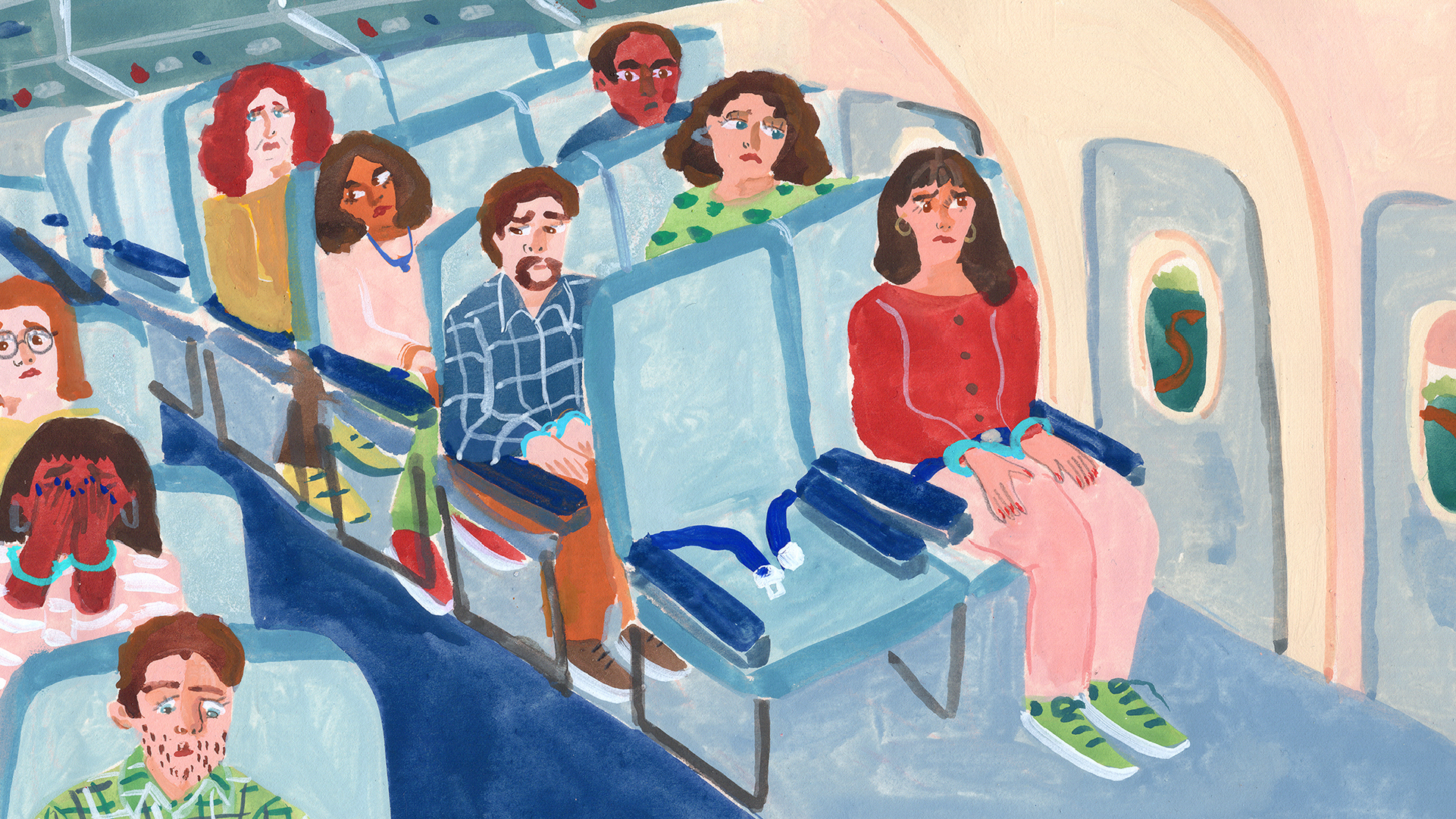
[María]: That’s when we started seeing how they were bringing people from other cars, other buses, how they were putting people on a plane. It was a huge plane, an international flight, an enormous plane. Some people had the clothes they’d been wearing when they were detained. Some had the gray outfit, the one you’d buy in detention. And yes, everyone clearly in handcuffs.
[David T.]: An ICE officer took María off the bus and led her toward the plane.
[María]: I’m handcuffed at the hands, the feet, the waist, and I’m going up the plane’s stairs, and I tell her: no, I don’t want this, I’m not getting on, I don’t want to go. No, no, no, I’m not getting on.
[David T.]: María hadn’t processed the impact of the deportation. She hadn’t even absorbed that in a few hours she’d be somewhere completely unknown.
[María]: She grabs my arm and forces me up, and tells me: you have to do this, it doesn’t matter if you want to or not. It’s something you have to do.
[David T.]: As we already know, it wasn’t a commercial flight. It was set up solely to transport immigrants. María remembers seeing a lot of people on the plane. She doesn’t know if they were police, ICE officers, people from other agencies, but it was a large team accompanying them. Among the detainees, she counted roughly 20 people. She later learned there were 11 Africans and 15 South Americans.
[María]: There were eight of us Colombians. Four Peruvians and three Ecuadorians.
[David T.]: That’s when a flight began that, according to María’s estimate, lasted between 20 and 25 hours.
[María]: The whole time we were handcuffed at the feet and hands cuffed to our hips, our waists, and the food they gave us was a sandwich and water, and you can imagine how you eat that, because they’re not going to take off your handcuffs so you can eat it. They’d let you go to the bathroom whenever they felt like it, not whenever you wanted. They’d say, okay, you can go to the bathroom now, does anyone want to go? Either way, they weren’t going to take off your handcuffs to go to the bathroom.
[David T.]: María didn’t hear anyone crying. At least she didn’t cry. She only remembers one feeling: uncertainty.
[María]: The doubt, the anxiety of what’s going to happen, what’s waiting for us. We didn’t know if they were just going to leave us adrift, just abandoned somewhere.
[David T.]: They arrived in Kinshasa, the capital, before dawn, while it was still dark. They went through immigration without handcuffs, were processed, had their photos taken, and were put on another bus. That’s when María learned they spoke French and another language — she’d later learn it was called Lingala — though it didn’t matter to her, since she didn’t understand a single word of either one. It was very hot. Through the bus windows she couldn’t see much, it was very dark, but she was able to make out one thing: armed people in the streets.
[María]: I don’t know, it looked like an unsafe place. All around I saw trash, unpaved streets. Honestly it didn’t look nice at all, but I also understood it was nighttime.
[David T.]: They were taken to a hotel that would become their place of detention from that point on. There, they were received by people from IOM, the International Organization for Migration, who were the first to explain what was going to happen: the U.S. government would cover their stay there for seven days. They’d be given food and basic hygiene items. Once that time was up, they’d be offered flights to voluntarily return to their home countries.
María talked to Alma, her lawyer, about it. It was clear she wasn’t going back to Colombia. So they decided not to rush and see what other options there were.
[Alma]: And we would first find out from IOM what the seven day deadline was really all about. And as it turns out, it wasn’t really a deadline.
[David T.]: Alma says they first checked with IOM to find out what that seven-day deadline was really about, and it turned out it wasn’t actually true that they had to go back to their countries by then. In reality, during that time IOM would be handling the immigrants’ safe-conduct passes and passports, since ICE had taken their documents when they were detained and never returned them. IOM would also be responsible for assessing each case to determine whether it was safe for them to return home.
[Alma]: And so, you know, once we knew that, then we felt like we could breathe a little bit and try to come up with another plan.
[David T.]: “Once we knew that, we felt like we could breathe a little and try to come up with another plan,” Alma says.
When I spoke with María, in May 2026, she’d been in the hotel in Kinshasa for a month and ten days. The internet connection was unstable and kept dropping constantly. From the very start she warned me that the power could go out at any moment for several hours, and sure enough, it happened to us twice.
She told me that even though she couldn’t even leave the hotel alone, staying there was the best option, all things considered. Each of them had been given a room.
[María]: The hotel is spacious. It has a lot of greenery. Downstairs there’s a dining room, a meeting hall. The rooms have their own bathroom, TV, air conditioning. Of course it has its issues, because the power goes out, the water goes out. In some rooms the TVs don’t work, in others the AC doesn’t work, things like that, but I feel like this country, with the little it has, has tried to give us the best it can.
[David T.]: She also told me that only one of the South American immigrants had decided to go back to his country, Colombia. The other 14 cases, including hers, turned out to be highly vulnerable, and IOM confirmed they couldn’t go back. The immediate solution the organization found was to let them stay at the hotel for three months, which is the length of the tourist visa the Democratic Republic of Congo grants. It also covered their food and other basic needs.
[María]: Honestly, if IOM weren’t here, we’d be in limbo, stranded here in a country we know nothing about.
[David T.]: None of the immigrants had a criminal record, even though the Trump administration had said it would only deport criminals who posed a risk to public safety.
[María]: It’s very important for people to know and understand that none of us here are criminals. That we weren’t sent to this country because we committed a crime, because we’re criminals — no. And I also want people to know that none of us here agreed to, or wanted to, or signed any document to be brought to this country. I mean, we weren’t given the option to sign if we wanted to or not. It’s yes or nothing.
[David T.]: At that point, IOM was processing the immigrants’ documents through the nearest embassy… well, “nearest” in air quotes, because the Colombian embassy, for example, was in Kenya, very far from there.
The second time I spoke with María, I asked her to describe what she was doing.
[María]: Right now I’m in my room. I’m not really doing anything, just talking to you. And before you called, what I was doing was looking at stuff on my phone, lying in bed.
[David T.]: I was surprised that when I asked about her daily routine, she started describing something similar to what she’d lived through while detained in the United States.
[María]: Well, it’s always the same, it’s getting up early. If you want, you go to breakfast, if not, you don’t.
[David T.]: For breakfast they had to go to the hotel dining room, where there were also other guests. Afterward, everyone went back to their room.
[María]: You stay there in bed. We have activities with IOM from 10:30 until 3 or 4 in the afternoon. It depends on the activity.
Unlike detention in the United States, here at least they offered them something to keep them distracted.
[María]: So there are psychology activities and a group meeting where they ask how we’re feeling, if we need anything. Volleyball, soccer, chess, dominoes, maybe watching a movie. I don’t know. And at 7 at night it’s time for dinner. So, dinner, and then back up to the room, and that’s it. And wait for the next day.
[David T.]: Only once or twice a week, the IOM team would take them to a supermarket to buy things, or to a money-transfer place so that those who had documents could pick up money their families sent them. María got by on what her partner could send her from the United States. Her family in Colombia didn’t know she was in this situation on another continent. They thought she was still free in the United States, trying to sort out her immigration status. That’s why she tried to talk to them in the early morning hours, so the time difference wouldn’t make them suspicious, and tried to avoid them asking more questions than necessary. She didn’t want to worry them, especially not at that moment, when she didn’t even know what would happen in the coming months.
Her one certainty was that every day was the same as the last. It was a routine these 14 South American immigrants survived together, and at least they got along well and tried to get through the monotony as a group.
[María]: Oh, honestly, you try to keep your mind distracted, thinking about other things, to really avoid sitting there thinking about how I feel in this situation. I’m not much of a crier, but yes, it’s a very hard situation, but I try to keep my spirits up, to give myself strength.
[David T.]: But it was inevitable. New blows kept coming that wouldn’t let them escape the harsh reality they were living. María and some of her fellow detainees, for example, got malaria.
[María]: About a week ago. And it felt awful, honestly. I felt very weak, I had a really high fever, it was pretty complicated, but they gave me the medical treatment I needed and thankfully I recovered.
[David T.]: And by the time we spoke, there was a new fear circulating…
[María]: Right now there’s a virus going around that’s got everyone on edge, Ebola, but so far it hasn’t reached us, and hopefully it won’t. We’re hoping that by the time it spreads that much, we’ll already be gone, or that it just won’t spread that much.
[David T.]: “We’re hoping,” María says. Hoping — as we’ve said, that was the only thing she’d done this past year and a half.
[María]: The hardest part of this situation for me is that my life isn’t moving forward, that I’ve been on pause this whole time, academically, professionally, that I’ve been bouncing from one place to another, I haven’t even had a stable home besides detention. That was the only place I was as stable as possible for a year and a half, but that wasn’t something, it wasn’t something I deserved.
With her lawyer, she was looking into the possibility of another country taking her in. Or even, as a plan B, requesting asylum in the Democratic Republic of Congo. It was an option that, even though it scared her because of Ebola, and because it was also a dangerous country, was still much better than going back to Colombia. María knew that was the fastest way out, but it wasn’t the easiest or the best. After everything she’d been through, she couldn’t picture herself going back to her country.
[María]: Well, fortunately I’ve always been a very strong person. So, I also feel like now isn’t the moment for me to break down, that now isn’t the time, right now I need myself to be strong for what’s coming, because this isn’t over yet.
[David T.]: María was right. That flight to safety that had begun three years earlier still hadn’t ended.
On June 10, 2026, she sent me this voice message.
[María]: (Audio) Hi. No, no, no, it’s not a bother. Don’t worry. It’s just that I’m talking about this with someone, about how I’m feeling now that I’m here, and I haven’t had much time.
[David T.]: For several days I’d been asking her over and over how she was doing, how her situation had progressed, but she hadn’t answered anything until this message.
[María]: Well, so… I’ve already traveled, I’ve already left Congo. So right now I’m sorting out a lot of things.
[David T.]: Over the following days she told me that, together with her lawyer, they’d decided to buy her a flight to another country. We won’t say which one, for her safety, but it’s a calmer place for her, from which she can pursue a new asylum claim. Two other Colombians who’d been at the hotel with her did the same. The others went back to their countries.
When we were finally able to talk more calmly, María told me how good things were in this new place.
[María]: No, so much better, so much better. Oh, wow. It’s the first time that… I mean, imagine, I’d spent nearly two years without really being free, without being able to move however I wanted, wherever I wanted. I don’t know, I feel good, I feel happy, I feel free, I am free, I’m free.
[David T.]: She still hadn’t regularized her immigration status, but a friend who was already living there recommended her for a job with a family, caring for an elderly person. María took it.
[María]: My job is live-in, at a house. I’m there Monday through Friday, I live there with them, I sleep there. They give me food, everything I need, and they’re happy with me and I’m happy with them.
[David T.]: She told me she’d already applied for asylum and sent in all the necessary documents. She was expecting to hear back in about nine months or so, so she could begin the process of bringing over her daughter, who’s now ten years old and lives with her father’s family. María was very confident it would be a much easier and faster process than in the United States.
She also told me that her family doesn’t know all the horrific details of what she went through, and they also don’t know about her time in the Democratic Republic of Congo. For her, it was easier to tell them she’d decided to move to another country that would treat her better. I asked her if she’d want to try the process in the United States again.
[María]: No, that’s completely off the table. Honestly, it’s the last place I’d ever want to go back to. I feel like it left me with so much trauma, so many bitter memories.
[David T.]: She told me that when she arrived to live in this new place with her new employers, she realized that even though she could eat, sleep, move around whenever she wanted, she was still following rules and an authority that no longer existed, but that had stayed etched in her.
[María]: And I didn’t realize I had this problem until they told me things like, you don’t need to ask permission to sit here. You don’t need to ask permission to eat this. Even when I was right next to them, I was the kind of person who’d say: hey, is it okay if I go to the bathroom? And they’d tell me, you can just go, no problem. You’re an adult, you can do that. Why are you asking me for permission?
[David T.]: María feels that the United States took away her peace of mind, affected her mental health, her everyday life, the way she relates to people… she even partly blames it for breaking the romantic relationship she thought could bloom in the middle of everything. She’s no longer in touch with her ex-partner, who helped her so much in the United States. Now, María is still working on rebuilding her life somewhere safe. She knows it isn’t easy, but as she always told me: she’d rather make this sacrifice than have to go back to Colombia.
[Daniel A.]: María’s case in the United States is now closed. She and Alma, her lawyer, are waiting for a case challenging the third-country deportation policy to reach the Supreme Court. Whatever is decided there will determine whether they can sue the U.S. government for violating her fundamental rights.
But in the meantime, flights keep going out, full of deportees headed to places they’ve never seen. By April 2026, it was estimated that more than 13,000 immigrants had received deportation orders to some 27 countries, and that summer, more than 2,000 of those flights were recorded.
David Trujillo is a senior producer at Radio Ambulante and lives in Bogotá. This story was edited by Camila Segura, Luis Fernando Vargas, and me. Bruno Scelza did the fact-checking. Sound design is by Andrés Azpiri, with music by Rémy Lozano and Andrés.
The rest of the Radio Ambulante team includes Paola Alean, Adriana Bernal, Aneris Casassus, Diego Corzo, Emilia Erbetta, Camilo Jiménez Santofimio, Germán Montoya, Samantha Proaño, Natalia Ramírez, Juan Pablo Santos, Sara Selva Ortiz, Elsa Liliana Ulloa, Franklin Villavicencio, and Mariana Zúñiga.
Carolina Guerrero is CEO.
Radio Ambulante is a podcast from Radio Ambulante Estudios; it’s produced and mixed on the Hindenburg PRO program.
If you liked this episode and want us to keep doing independent journalism about Latin America, support us through Deambulantes, our membership program. Visit radioambulante.org/donar and help us keep telling the region’s stories.
Radio Ambulante tells the stories of Latin America. I’m Daniel Alarcón. Thanks for listening.