
Emilia Sacreblu | Translation
Share:
► Click here to return to the episode official page, or here to see all the episodes.
♥ We live in difficult times. We are a non-profit media, and our permanence depends on listeners like you. If you value our work, join Deambulantes, our membership. Help us elevate Latino voices and tell the story of our communities. Your contribution is directly invested in our journalistic work and makes all the difference.
►Do you listen Radio Ambulante to improve your Spanish? We have something extra for you: try our app, designed for Spanish learners who want to study with our episodes.
The following English translation was generated with the assistance of artificial intelligence.
[Daniel Alarcón]: This is Radio Ambulante, I’m Daniel Alarcón.
In January 2023, Mexican native Marysol Cordourier was 32 years old and had been living in Paris for less than two months.
[Marysol Cordourier]: I didn’t have a job, I didn’t have a place to live, and at the same time I had everything ahead of me.
[Daniel]: She was there because she had been approved for a one-year work visa. But the offer she had received before traveling had fallen through at the last moment. She needed to find employment soon. So she did the typical thing anyone arriving in a new country does: she joined Facebook groups. In her case, groups for Mexicans in Paris.
And some time later she found a message that said something like this:
[Marysol]: Seeking men and women from Latin America of all ages for background acting, Mexicans, Colombians, Ecuadorians, Guatemalans, Venezuelans. All profiles are welcome, please send us two recent photos, phone number and country.
[Daniel]: It was an invitation to a casting call for a film. It didn’t have many details, but Marysol found it intriguing. She had studied theater and had acting experience, but had never done film.
[Marysol]: And I thought about it, thought about it, thought about it, right? I thought about it a lot. I said: “Oh! Well, you know what? Okay. I mean, I’m going to do it. And well, the worst thing is they’ll say no and well, I’m already used to the nos.”
[Daniel]: She sent an email with her information and photos, and a couple of days later they called her to come to the casting. That morning, she got up early, put on black pants and a black blouse, did her makeup, and left her house.
[Marysol]: I was on the metro. I was like: “Ooh, I don’t know how this is going to go.” I mean, super nervous, you know? Super, super nervous. I didn’t know if I had to speak in Spanish or French, I mean, like I just didn’t know what was up, right?
[Daniel]: Marysol arrived at the address they had given her. It was a spacious place with an office building in the back. On the gate there was a sign that said Why Not Productions. She crossed through a large courtyard until she reached a glass door that led to a reception area. There were two girls there who introduced themselves in French.
[Marysol]: I arrive and say: “Hello, um, well I’m Marysol, they called me for the film casting.”
[Daniel]: The girls looked for her name on a list.
[Marysol]: “Oh yes, of course. Sit here. Do you want water? Do you want coffee? No. Well, coffee’s fine.”
[Daniel]: Marysol sat down to wait, observing everything around her: she saw wardrobe racks in the back, a couple of offices and a corkboard with photos. There she recognized one with American actress and singer Selena Gomez… The girls at reception took her to a small room with white walls, a desk and a camera mounted on a tripod.
A few minutes later, the casting director arrived, Christel Baras. A woman with white hair and round plastic-framed glasses… Christel introduced herself and immediately began telling her about the project.
[Marysol]: It’s a film about… about a drug trafficker who has actually always wanted to be a woman. So he goes through a process to transition. And this is all a musical.
[Daniel]: Marysol opened her eyes wide. Surprised.
[Marysol]: I said “What the fuck, what is this?” I mean, a trans narco musical? What is this? I said: This can’t be. I mean, it seemed like a crazy idea to me. But at the same time the idea seduced me, you know? I mean, like… Like I liked it. I said: what are they going to do?
[Daniel]: The film was going to be called Emilia Pérez. You’ve probably heard of it. Its name appeared everywhere in early 2025. First because it was nominated for many prestigious international film awards, winning several. And second, because once in theaters, the film about a Mexican drug trafficker who transitions gender, regrets his past and begins a path of redemption, provoked reactions of all kinds. And opened a debate about how Latin Americans are seen on the big screen… and also about how we want to see ourselves.
Today we tell you the story of this controversy.
A pause and we’ll be back.
[Daniel]: We’re back. Mexican journalist Selene Mazón continues the story.
[Selene Mazón]: After hearing what the film was about, Marysol was speechless for a second. The truth is she was curious but didn’t ask more questions and right away Christel, the casting director, gave her a script.
[Marysol]: I’m going to give you the lines you have to read. I give you the phrase in French because well, she says I don’t speak Spanish, so I give you the phrase in French and you give me the reply in Spanish.
[Selene]: Christel told her the important thing was that her acting felt natural. Then she explained the scene they were going to rehearse: a dialogue between two friends in the courtyard of a neighborhood in Mexico. One of them was telling the other she was about to go out with a rich man and needed advice…
[Marysol]: So one shouts to the other not like: “Hey, where are you going? Oh, well I’m leaving. I’m going to see Fernando now.” “I don’t know. Oh, well, look, I don’t know what to wear because I’ve never gone out with someone with so much money, right?” “Well just act natural, like you don’t care…” “And how? But how do you know these things?” Oh, because that’s how it happens in telenovelas…
[Selene]: The casting lasted about 30 minutes. Before leaving, Christel asked Marysol to spread the word among her acquaintances. They needed more people to participate in the film. Their appearance didn’t matter…
[Marysol]: It doesn’t matter, she says, because there are a lot of people who don’t want to come because oh, I’m dark-skinned or oh, I’m fat or oh, I’m not strong, right? She said: No, no, no. I mean, we want people. I mean, normal people.
[Selene]: Marysol left happy. It was the first time she had gone to a casting for a film and she felt she had done well.
She immediately told the guy she was dating, who was French, and his reaction excited her even more, especially when he told her it was a film by director Jacques Audiard.
[Marysol]: And he told me: “I can’t believe it.” I said: “Yes, well it’s with that director” and he said: “Wow, how cool.” I mean, he was like, super excited for me, right? Like “Oh, you’re going to be a star. Oh, I don’t know what.” He was super happy, right?
[Selene]: He told her he was one of France’s most recognized filmmakers. At that time he had multiple awards, including an Oscar nomination in 2010 for his film “A Prophet.”
And although she was happy, she also tried not to get her hopes up.
[Marysol]: Well maybe the budget falls through. Maybe the production gets delayed infinitely. When you’re part of the performing arts world, you know that anything can go wrong and kill your project, you know?
[Selene]: A month has passed… during which Marysol continued with her normal life: she got a job as a waitress in a restaurant while continuing to apply for positions as a Spanish teacher.
And one day, while walking down the street to meet up with the guy she was dating, she received a call.
[Marysol]: She told me: “Hello Marysol, this is Christel Baras” from the Emilia Pérez casting. Well, nothing, I’m calling to tell you that well, you got the part. We’re going to send you the dates for filming.”
And I: Really? She told me: “Yes, really.” And I: “I can’t believe it.” I tell her “I really want to scream. I’m in the middle of the street” and she started laughing. I remember, I mean, I was super excited, I started crying.
[Selene]: She couldn’t believe she had gotten that job in Paris, without contacts or film experience, something that would have seemed impossible to her in Mexico. That weekend, Marysol celebrated with friends, and in the following days she told her close people in Mexico. She was happy.
A month later, the production called her for a wardrobe fitting at the same place where the casting had been. At that point she didn’t know who she would be playing. She also didn’t have a script or an idea of how the plot would unfold. She only knew what Christel had told her the first time they met.
When Marysol arrived, the team informed her that her role would be one of three domestic workers in Emilia Pérez’s house.
[Marysol]: And I said: “Oh, okay.” I mean, for a moment it was like: “Fuck, what a drag.” I thought it was yes, like a very Mexican telenovela. The fact that the wardrobe was like, yeah like from a Cantinflas movie, right? Like the maid goes like this, with her cap and everything. Yes, I was like “oh fuck, what a drag.” Like very cliché, well.
[Selene]: And although it bothered her a bit, she still wanted to stay in the project. See what would happen. After all, it was work.
Marysol showed up to film her scenes the first week of June 2023 in a studio in Paris. They had set up the stage of a house with a kitchen, living room and a staircase that didn’t go anywhere… There were blue and green screens in the background and lights of all kinds on the ceiling and sides.
[Selene]: Everything was perfectly organized: makeup and wardrobe schedules were met punctually, clothes were always ready and ironed, there was coffee and catering… At lunchtime, everyone – including the director – sat together at the same tables.
And, despite not having a leading role, Marysol never felt lesser.
[Marysol]: It was always like “Where are my actresses?” And I’m like “Well neither Karla nor Selena are here.” And he: “No, I mean you, the actresses” and I: “Oh, ah, he called me an actress.”
[Selene]: It was so different from everything she had heard about the film industry… She quickly clicked with her colleagues in the studio. Off camera, in the common room, they joked, talked about everything a bit and that’s where she started hearing some rumors…
[Marysol]: No, well that they were going to do it in Mexico? Me? Oh, no way? Yes, she says, they were going to do it in Mexico, but then they ended up doing it here and the gossip started, right? Like well I think because of money right? Well yes, I think so because of money.
[Selene]: Something that’s normal in the film world. So nothing… Marysol filmed her scenes in four days and didn’t hear anything about the film until almost a year later.
[Selene]: In March 2024, Marysol was at home when she received a private message from one of her fellow actresses who had participated in the shoot.
[Marysol]: She told me: “Hey, girl, um, they called me to see what’s up with the voices, because they’re going to do the sound layer of the movie. So, obviously I gave them your number.” And I: “Oh, yes, of course, girl.”
[Selene]: Meaning adding voices to the scenes…
The appointment was at a recording studio similar to a movie theater. It had seats, microphones, a screen and padded walls. Marysol and the other actors, all Mexican, sat in front of the screen. Behind them, in a booth with various controls, were the audio engineers.
So the process was as follows: they watched the film and stopped the scenes to dub the background characters. For that, the audio director had given them a script and then gave them instructions about who was speaking at each moment, with what intonation… Everything was carefully coordinated. At the end, it was recorded.
Marysol was attentive to everything and got excited when she confirmed there were shots where she appeared. She even got to dub herself. It was the first time she saw some fragments of the film on screen, including this scene where, in the middle of an empty field, drug trafficker Manitas introduces his wife Jessi to Rita, his lawyer…
[Manitas]: Have you met?
[Selena Gómez]: Yes, I was asking Rita who the guy with you is.
[Marysol]: That’s when we said: Wow, what happened here? Like… I mean, don’t tell me it’s going to come out with that ugly accent.
[Selene]: Jessi’s accent, played by Selena Gomez, sounded… weird to her. Everything up to that point had felt so professional and careful… except that accent. Marysol and other actors were a bit bewildered and even approached the team to ask.
[Marysol]: “Hey, are you going to fix it or does it stay like that?” “No, no. Well we’re still working on that.” “Oh, okay.”
[Selene]: So Marysol didn’t worry much more.
The film premiered at the Cannes Film Festival a month later, in May 2024. The director, Jacques Audiard, and the main actresses attended the red carpet: Karla Sofía Gascón, Selena Gomez, Zoé Saldaña and Adriana Paz…
And here I’ll pause to explain the film’s plot for those who haven’t seen it. So: Rita Mora, played by Zoe Saldaña, is a talented low-profile Mexican lawyer who one day receives a strange proposal: help a feared drug trafficker, known as Manitas del Monte, fake his death and start a new life as a woman. In exchange, he promises to make her rich. That’s how Manitas disappears and resurfaces as Emilia Pérez.
Two years later, Emilia tries to get back her wife, played by Selena Gomez, and her children, who know nothing about her new identity. Emilia poses as a distant cousin of Manitas and, together with the lawyer, founded an organization dedicated to supporting victims of violence and families of disappeared persons. Almost the entire film is in Spanish.
[Selene]: Well, that.
So… Up to that point, Marysol still hadn’t seen the complete film, but she imagined it would be one of those “art cinema” films that go almost unnoticed by most of the public. She followed the whole premiere on social media.
[Marysol]: And then when it won the award I was like: wow, what happened here?
[Selene]: Emilia Pérez made history by receiving an 11-minute ovation, the longest of that edition of the Cannes Film Festival. It won two awards: the Jury Prize, and Best Actress, which was unusual because they gave it to all four main actresses: Selena Gomez, Karla Sofía Gascón, Zoe Saldaña, and Adriana Paz. In the award acceptance speech, Karla Sofía Gascón dedicated it to trans people.
Marysol felt very proud. She was happy not only for herself, but for the whole team she had met during filming. And that feeling only grew when the first reviews of the film began to be published in Europe and the United States…
[Marysol]: I mean that it was a work of art, that it was super daring, that it was super risky, that the actresses were impeccable, that the story was super moving, that yes, no, that the reviews were, I mean, that the music was impressive, that everything was… That it was a masterpiece… And I said: oh, damn, wow…
[Selene]: Days later, Marysol and the entire cast received an invitation to see it at a special screening in central Paris. That day she arrived at the cinema alone, with a mix of excitement and nerves. She settled into her seat next to one of the actresses she had shared the camera with and the screening began…
At first she was focused on seeing what she recognized from the days she was on set or recording the sound layer, looking for herself on screen… But after a few scenes… she actually let herself be caught up in the story.
[Marysol]: I mean, yes, I got goosebumps. I mean, if I said fuck, how hard, man. I mean, how hard to see this on a screen on the other side of the world, you know, damn.
[Selene]: And just as there were moments that moved her and made her laugh, there were also things that pulled her out of the story. Perhaps the biggest was Selena Gomez’s accent… It completely distracted her.
[Marysol]: For a Mexican audience it pulls you out immediately, but yes here in Europe no one noticed. No one, no one, no one, absolutely no one. It was like oh, okay.
[Selene]: And although she understood the argument they tried to give in the plot: that Jessi was from the United States and was learning Spanish, hence her accent, that didn’t make it any less disappointing.
[Marysol]: I mean, it bothered me because I’m an actress and I know that would have had a solution which is: you get her a coach to, to teach her like the Mexican accent, right? Or you fix it in post-production.
[Selene]: Anything, she felt, was better than what she was hearing. But aside from that, she really enjoyed the film. The screening ended with very loud applause from the audience. Marysol remembers that everyone in the room seemed moved. The director, and the lead actress, Karla Sofía Gascón, thanked the team and said that, if the film ever won another award, it would be recognition of everyone’s work.
After the screening, Marysol and the team celebrated on a boat on the Seine.
[Selene]: The film continued its tour through festivals in Belgium, New York, Poland… Generally with good reception from critics. Until it finally premiered on Netflix in the United States in November 2024.
Marysol began sharing stories on her Instagram, inviting her friends to watch it. The comments she received were positive, with many congratulations…
[Marysol]: The first comments were like: Oh, Wow, what a film so, so risky. It’s super cool, it’s super crazy, right?
[Selene]: But days later came one from her best friend Ximena, which completely puzzled her.
[Marysol]: Around 3:00 AM Paris time telling me: “Dude, I just saw the movie. I don’t know what to think. Congratulations for what you did.” That’s it, I mean, like super conflicted. No. And I said: Yikes. What happened here?
[Daniel]: And Ximena wasn’t the only one who didn’t know what to think. The avalanche was just arriving.
A pause and we’ll be back.
[Daniel]: We’re back on Radio Ambulante. Selene continues the story.
[Selene]: Ximena Quintero is one of Marysol’s best friends since they were in high school. She lives in Mexico and, from a distance, had accompanied Marysol through her entire process of moving to Paris: the job search, the casting, the filming…
[Ximena Quintero]: Suddenly I was watching Instagram stories and I saw her post on Netflix, United States, a film called Emilia Pérez had premiered.
[Selene]: She immediately got excited… Marysol had talked to her a lot about that experience…
[Ximena]: And I remember I sent her a little message like: Is it this one? Is it this one? Tell me yes, please. And she told me, yes, friend, this is the film I’m in. And since I didn’t ask her what it was about or anything, well I imagined an art film style.
[Selene]: Ximena asked her boyfriend to please help her find the film on the internet since it hadn’t premiered in Mexico yet. That same night, while Marysol was sleeping in Paris, they settled in the living room and, before hitting play, she sent a photo to her friend to tell her they were about to watch it. It was a Wednesday in November 2024.
[Ximena]: I remember when he puts it on, well the first thing you hear is the part: “We buy mattresses…”
[Selene]: The camera shows a wide shot of a city at night and then zooms in on a speaker from which that recording, very popular on the streets of Mexico City, plays.
Right away, the frame moves inside a building. On a wall hangs a university diploma, the television is on with the news, and on the table there are several crime scene photographs. Zoe Saldaña’s character, Rita Mora, is in front of the computer when she receives a call…
[Zoe]: Hello.
[Lawyer]: How’s that matter going?
[Zoe]: Almost done.
[Lawyer]: The building doorman no longer wants to testify.
[Zoe]: Excuse me?
[Lawyer]: The building doorman no longer wants to testify.
[Zoe]: And you think the jury is going to buy that?
[Ximena]: And then, well, Zoe Saldaña comes out, well, speaking in Spanish. So, I remember, taking into account that he had looked for it on a streaming service, I say: “Hey,” I tell him, “but isn’t it in its original language?” And he says: “this is its original language.” And I, “what?”
[Selene]: Ximena was surprised that Spanish was spoken in the film, because, as far as she knew, it had been filmed in France. For a moment she doubted it was the same one, but continued watching.
As it progressed, she had a strange feeling that grew more and more, especially when they got to the scene where Zoé Saldaña, Manitas del Monte’s lawyer, goes to a clinic in Thailand to get quotes for transition surgery services and in an exchange with the doctor this plays…
[Zoé]: Very nice to meet you, I’d like to know about sex change operation.
[Doctor]: I see, I see, I see… Man to woman… Or woman to man?
[Zoé]: Man to woman…
[Doctor]: From Penis to Vaginaaaa
[Selene]: In the scene, a room lit by white lights suddenly transforms into the stage for a musical number. Stretchers appear, people with medical gowns, others with prosthetics forming part of a choreography. Zoe Saldaña follows the doctor, who begins to enumerate the procedures Manitas would undergo.
Mammoplasty?
Yes
Vaginoplasty?
Yes
Rhinoplasty?
Yes…
[Selene]: Ximena couldn’t take it anymore and asked her boyfriend to pause it.
[Ximena]: He pauses it and I say: “OK, first of all, sorry. Then I didn’t know what we were going to see. It was very uncomfortable.” I told him: “But maybe you’ll understand it better later. And well, if you want, at the end we can discuss it and everything, right?” But, well, we have to keep watching. But yes it was like an apology because it did start to be very uncomfortable to watch.
[Selene]: And it’s that everything seemed cartoonish to her, without tact.
They kept watching and reached the scene for which they had started watching the film: in Emilia Pérez’s house, in the background, Marysol appears in her role as a domestic worker.
[Ximena]: And I was like: “Oh, I’m dying of excitement.”
[Selene]: Ximena took a photo of the screen and sent it to Marysol. But when the film finally ended, she was left with a mixture of conflicting feelings.
[Ximena]: Because obviously I was very happy for her, right? And that was like the feeling of happiness, but I hated the movie, I hated every bit of it. There wasn’t a single thing I liked. It was an uncomfortable movie to watch. And that part of making it a musical made it even more uncomfortable.
[Selene]: With those songs it was impossible to take a painful reality for many Mexicans, the violence of drug trafficking, with the seriousness they felt it deserved. Ximena and her boyfriend stayed up talking. They thought it was in poor taste—a badly told story that tried to be moving but never quite managed to be.And for them, unlike Marysol, the actresses’ accent was the least of the problems.
[Ximena]: The part that really bothered me was precisely the message of: okay, now you’re a woman, now you’re good. Everything else is forgotten.
[Selene]: As if Manitas’s transition to Emilia Pérez were a kind of magic wand capable of transforming his conscience, without any kind of depth or reflection in between.
[Ximena]: I think if they had told you, when she was in drug trafficking, they disappeared or killed so many people in an approximate number, and in her redemption it would have been, when I have to reach at least this minimum number, right?, of body recognition to be able to redeem myself, maybe it would have been a bit more coherent.
No. Simply and plainly it was “Done. No, now I become Saint Emilia, who helped many families find those remains.”
[Selene]: For no one in Latin America is it a surprise that Mexico faces a crisis of violence and disappearances for several years. According to official records, there are more than 130,000 disappeared persons… It’s a wound in the country’s collective memory. That’s why for Ximena, being Mexican, this vision of a repentant drug trafficker seemed simplistic to her. And in the middle of the songs, she felt it almost like mockery.
Still, Ximena sent a message to Marysol, the one we referred to before the break:
[Ximena]: I told her, well, I finished watching it. I’m very happy for you. We’ll discuss it later.
[Selene]: A few hours later they had a call to talk about it. Here’s Marysol again:
[Marysol]: And yes it was there where she told me: “Dude. I mean, what the hell with Selena’s accent. What disrespect to talk about the disappeared. I mean, the music is horrible, dude.” And I said: “Yes, I mean, it’s legitimate, besides, that you don’t like how they represent you.”
[Selene]: Marysol told her she understood… and that yes… the film was inspired by a sensitive reality, but it didn’t pretend to be realistic…
[Marysol]: I mean, it’s not like art cinema or a Czechoslovakian documentary, right? That you say: Damn, no. Well I didn’t understand anything. Nobody saw it, dude. Everyone fell asleep, right? I mean, you know? But rather it’s a super pop product that brings you closer to the phenomenon like that. It does it in a light way, evidently, I mean, it doesn’t go deep into it because I don’t think the intention was to go deep either.
[Selene]: They spent a long time talking…
[Ximena]: Well she gave me the example, it’s like how they portray Germans, she says films about Germans, it’s always going to be about the world war, it’s always going to be about the Nazis, it’s always going to be about everything that happened around it, so she also started to open up the panorama for me that, well, at the end of the day it was a film that had been made to win awards.
[Selene]: But dialogue and respect wouldn’t be the norm in what came after. And I don’t mean between Marysol and Ximena, but in Mexican society.
And it’s that up to that point, November 2024, Emilia Pérez had gone somewhat unnoticed in Mexico, except for some mentions on some film programs. However, a review that went viral less than a month later changed everything.
[Eugenio Derbez]: Selena is indefensible.
[Sara Mesa]: Indefensible.
[Eugenio Derbez]: I was there with people and we kept looking at each other every time we saw a scene, we looked at each other like, what is this?
[Selene]: The speaker is Eugenio Derbez, a Mexican actor and comedian. In Latin America he’s especially known for having dubbed the voice of Donkey in the Shrek films. What you heard is part of a conversation about the film on a film podcast with journalist Gaby Meza. That comment — how indefensible Selena’s accent was — unleashed a wave of criticism from Selena Gomez’s fans. This grew even more when Selena posted a comment in response to a TikTok that had that part edited…
[Media 1]: The Mexican actor dared to criticize Selena Gomez and social media is exploding.
[Media 3]: To the point that Selena Gomez herself didn’t stay quiet and responded to Eugenio like this: “I understand your points, I’m sorry. I did the best I could with the time I was given. That doesn’t take away from the work or the heart I put into this movie.”
[Selene]: All this controversy only made curiosity around Emilia Pérez escalate. Now everyone wanted to know what it was about and clips began to go viral that became instant memes, like this one.
[Selena Gómez]: (Film scene) Even my fucking vulva hurts just remembering you.
[Selene]: Or this one…
[Selena Gómez]: (Film scene) I don’t even have money to eat. He cut me off, shut off the faucet, no card works, all my accounts are blocked. He wants to steal my kids and now my money…
[Selene]: The accents were the first thing, then came the other criticisms on the internet.
I’m watching Emilia Pérez and I must tell you that Selena Gomez’s Spanish is the least ugly thing about the film.
[Helena]: I feel like I’m watching Rosa de Guadalupe hehe.
It’s like one of those dreams when you have a very high fever…
[Selene]: And while that was happening on January 5, 2025, Emilia Pérez won four Golden Globe Awards, including Best International Film. These awards are considered the gateway to the Oscars, which only intensified the discontent of many Mexicans.
There was a tweet, for example, that had more than two million views and more than 17 thousand retweets. It was an image with text in English directed to the Oscars account. This is the translation: This is a message to the Academy: Mexico hates Emilia Pérez. A racist and Eurocentric mockery. Almost 500 thousand dead and France decides to make a musical.
[Selene]: As days passed, Marysol began receiving more and more comments of that type. Similar to Ximena’s. And although they made her uncomfortable and she understood where the criticisms came from, she was clear on her position.
[Marysol]: I think at the fable level… that is again the theme, yes, it seems very sensitive to me, but it doesn’t seem, I mean it doesn’t seem like mockery to me, at no time did it seem like mockery to me or no, I didn’t see it from that place.
Art is made for that, to dialogue, to discuss, to be able to change your point of view.
[Selene]: Besides, she also felt that everything was escalating so fast that many reactions were just to ride the wave.
[Marysol]: Dude, how disgusting! No, dude, what bullshit, dude, what the hell with Selena and I: “Come on, have you seen it yet?” Oh, no, we haven’t seen it. And I: Oh, okay. It’s valid, right? It’s valid to say I didn’t see it and I didn’t like it.
[Selene]: The controversy didn’t stop. What had started as mockery toward the film was becoming a deeper indignation, almost visceral when interviews and statements from the team behind the film began to circulate. Like what the director said during a red carpet at a festival in Mexico…
[Interviewer]: How much did you have to study Mexico to be able to make this film?
[Interpreter]: No, I didn’t study it that much. What I needed to understand, I already knew a bit.
[Selene]: Or saying in another interview that Spanish was the language of the poor and migrants… Or someone from the production team stating they looked for actresses in Mexico but didn’t find any who met the requirements for the main roles; or Karla Sofía Gascón reacting to the film’s detractors…
[Comment]: There are a lot of gatos who think they know about cinema, when what they know is how to scratch. So, what can I tell you? Whoever doesn’t like it, go watch something else at the cinema…
[Selene]: For those who don’t know, in Mexico, gato is a derogatory and classist way of referring to someone who does service work. It’s an insult. Here’s Marysol again…
[Marysol]: I mean, the first thing I thought was like… I got scared. I mean, I got scared because. Because Karla was also very reactive… Marysol: I mean, where are the media? Where is the whole Emilia Pérez team to say don’t answer anything, don’t respond to anything?
[Selene]: During the controversy, some social media accounts reproduced transphobic discourse, referring to Karla Sofía Gascón with masculine pronouns or even going to the extreme of wishing her death.
[Marysol]: And that’s when I said: “Wow, wait.” I mean, regardless of what she may have said, I mean, attacking someone for being who they are seems very serious to me, right? Huh? You attack the ideas, you don’t attack the person.
[Selene]: Everything became too much for Marysol. During almost all the controversy, she decided to distance herself from her social media. She didn’t say anything, didn’t give likes or retweets. And not out of indifference, but from a mix of fear and exhaustion. Social media had become a minefield of hatred that she didn’t want to participate in.
[Marysol]: I honestly told them, I’m already very very tired of this whole technology thing where something becomes famous and two days later it’s no longer famous and especially the reactions like the virulence and violence of the reactions. It makes me feel very bad. I mean, I wish there had been the same noise when the clandestine graves were uncovered as there was with Emilia Pérez.
[Selene]: At the end of 2024, 11 clandestine graves with 17 bodies were located, some of them dismembered, on the Mexico-Guatemala border. According to official data, there are more than 5,000 clandestine graves in the country.
The noise rather came from another side. On January 13, 2025, a week before Emilia Pérez premiered in Mexico, the following TikTok began to go viral.
[TikTok]: Do Mexicans not have the capacity to appreciate the genius of Emilia Pérez? Since Karla Sofía Gascón declared that those who criticized the film were gatos. And the director and his team in various media have stated that they didn’t see the need to hire Mexican actors or to research Mexico. Could it be that the director of Emilia Pérez and his team came humbly to Mexico to give us a lesson in the form of a film to teach us how to correctly narrate and express our social problems? Could it be, dude? Could it be?
[Selene]: She is Camila Aurora, content creator and Mexican trans activist. Camila had found out about the project a year before it premiered and had been excited to learn that its protagonist would be a trans woman.
[Camila]: Because well it was from a sense of pride at that moment, I mean, if it was like: “Well no way, how cool. I mean, a space in a blockbuster film for a trans woman. I mean, yes there was pride at the beginning.”
[Selene]: But she felt the opposite when she saw the film.
[Camila]: For me as a trans woman, it’s an aberration to see that character, to see that story.
[Camila]: They have the opportunity to show character evolution and the only thing they propose that changed in her psychology was that she mutilated her whole body, that she got breasts, that she changed her voice, this, that she changed her nose, that. I mean, they make it seem like being trans is only about altering the body, when they don’t realize everything that goes through the mind.
[Selene]: It seemed like a simplistic and offensive story to her for the trans community. She started publishing several videos on the topic and started getting many supportive comments… One of them particularly caught her attention:
[Eli Flores]: “We should make one the same about France, haha.”
[Selene]: A film like Emilia Pérez but about France.
Camila thought… Hey, that’s a good idea.
[Daniel]: Let’s take a break. And we’ll be right back.
[Daniel]: We’re back on Radio Ambulante. I’ll leave you with Selene.
[Selene]: The idea they left Camila with was to make a parody of France in the Emilia Pérez style. It seemed so good to her that, hours after she saw that comment, she published a new video…
[Camila]: In fact, Emilia Pérez unlocked my artistic vein so much that I want to tell you about a project that I think many Mexicans might be interested in. It’s called Johanne Sacrebleu…
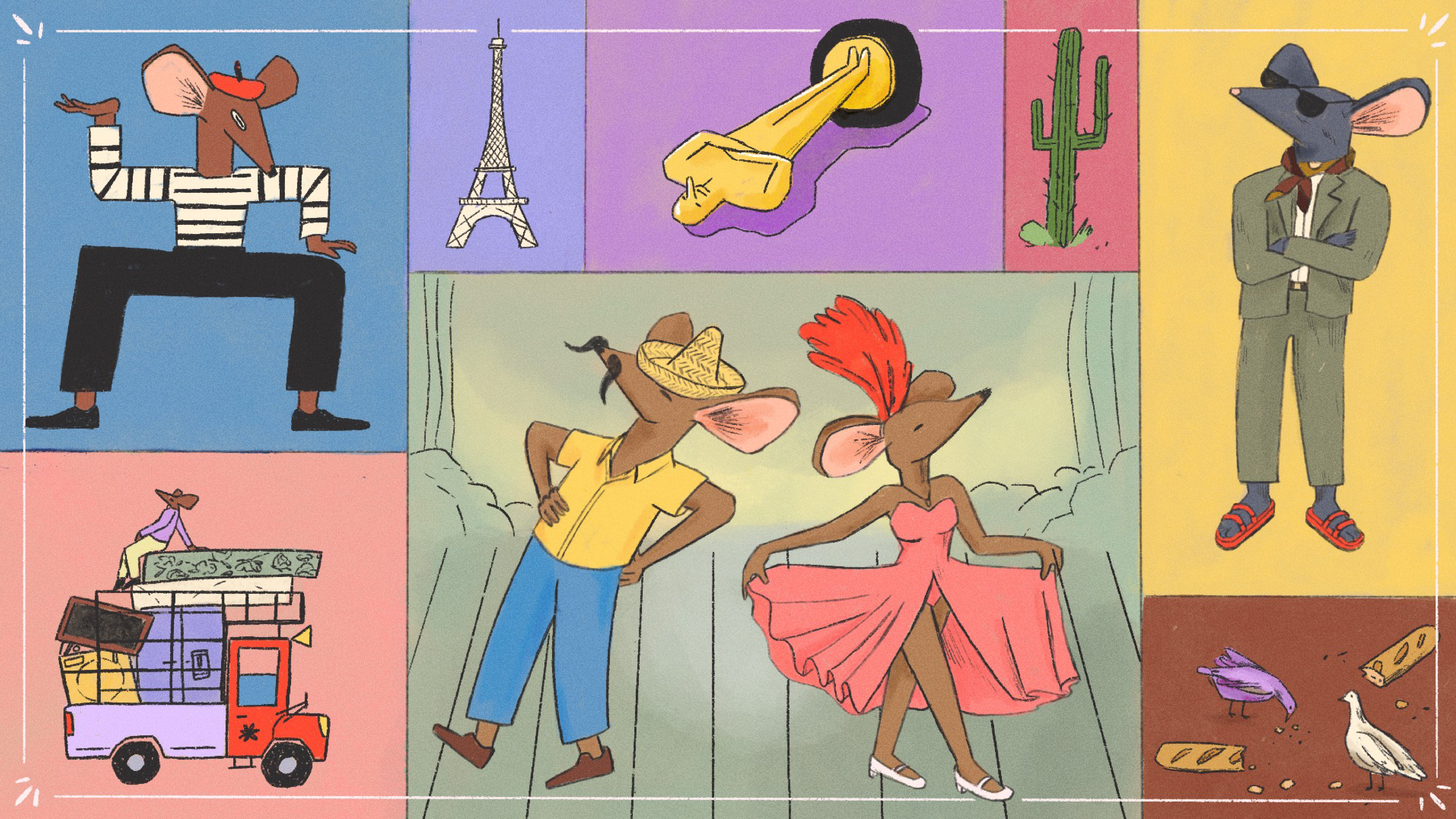
[Selene]: Johanne Sacrebleu, the story of a transgender woman, heiress to the baguette empire, who falls in love with the trans son of the croissant dynasty, Agtugito. Together they embark on an absurd battle to decide which bread best represents France.
The idea received immediate support on social media and Camila launched a crowdfunding campaign to finance the short film. The idea was to release it the same day that Emilia Pérez premiered in theaters in Mexico, January 23, 2025.
[Camila]: This is the update on the Johanne Sacrebleu project, the story that Emilia Pérez inspired me to create.
[…] we’re going to need approximately 50 French mustaches, like 30 rat stuffed animals of various shapes and sizes, many, many berets, lots of garbage, we’re going to film at the Eiffel Tower that’s in the State of Mexico, a Ladybug and Cat Noir costume, a baguette chilaquiles cart, about 20 or 30 mime costumes…
[Selene]: She raised around 50 thousand pesos, about 2,500 dollars and called a casting that 60 people attended. Camila documented everything on social media:
[TikTok]: These are the Johanne Sacrebleu team. We’re going to start showing you the characters and some little bits from the casting. And well more things will be coming out. Everyone says Sacrebleu.
[Selene]: The production of the short film lasted a week: it was shot in three days and edited in two nights and one full day. On January 23, 2025 it premiered at a cultural center and two days later it was published on YouTube.
It begins with a voiceover in French and a series of images of Paris, all the clichés: the Eiffel Tower, cobblestone streets, bakeries with striped awnings…
Right away, on an avenue in Mexico City, about a dozen people begin dancing to a song that Camila composed for the short film that brings together clichés of France: Welcome to France.
For almost 30 minutes we follow the pressure experienced by two trans heirs of bakeries to compete over which is the best bread in France. After two phases of competition, in the end, both realize that the competition is absurd and in passing, after enumerating some social problems of France, they say they’re going to change the country. It’s reductionist, even in bad taste. A mockery. Not very different from how Camila and many people see Emilia Pérez.
And well, the response from social media was overwhelming. Overwhelmingly positive. The day after publication, when Camila woke up, the medium-length film already had more than 100,000 views and was a trending topic on social media. She was surprised by the reaction.
[Camila]: Well intentionally or unintentionally, well I ended up creating a product that reflected itself in a patriotic way for the people who saw it as a defense, like a shield against that insult.
[Selene]: Camila announced she would donate half the resources raised by the short film to the causes that, for her, the film Emilia Pérez had trampled: searching mothers, the National Search Brigade, the trans community, victims of gender violence and disappeared persons.
Meanwhile, that week things also happened in Hollywood: Emilia Pérez received 13 nominations and Karla Sofía Gascón, the lead actress, compared the rejection toward the film with the Holocaust, a statement that unleashed a wave of criticism.
The situation worsened when a Canadian journalist brought to light old racist and xenophobic tweets by Gascón. It was the coup de grâce for a film that promised to sweep all the awards. The same one that at Cannes had received 11 minutes of ovation.
Meanwhile, Camila’s short film, Johanne Sacrebleu, was a viral phenomenon. So much so that a local cinema chain got in touch with her to screen it in their theaters. That’s how Johanne Sacrebleu reached the big screen.
[Camila]: It would be 350…
[Selene]: I went on premiere day, a Friday, February 14, 2025. It was at Cinedot, a new small cinema chain, compared to the monsters Cinépolis and Cinemex.
The cinema is in a shopping center north of the capital. When I arrived, an hour before the screening, there was already a table set up with official merchandise from the parody. What stood out most were some knitted rats.
[Camila]: We have from the rats that were used in the filming of the movie, which are up for adoption, those come with their adoption certificate signed by Agtugo, who is one of the protagonists…
[Selene]: Even posters, stickers, coloring books, 3D printed earrings and t-shirts… As the screening time approached, the small cinema waiting room began to fill with people dressed in white and blue striped shirts, berets and fake mustaches… When it was time to enter, the theater was practically full.
During the screening there was laughter, like when a shot of the Latino tower appeared – a classic monument of Mexico City – as if it were the Eiffel Tower. Everything looked improvised, with a low budget, bad accents, basic dialogue. I assume it was part of the film’s intention.
When the screening ended, I approached to chat with a couple of people. They told me they had already seen the short film on YouTube.
[Selene]: And why did you decide to come to the cinema to see it if you had already seen it on YouTube?
[Her]: Personally I liked all the stories this girl Camila posted. I really like her way of thinking for everything she’s doing and well in the end everything being collected here they’re going to give to foundations and it seems really beautiful to me plus her, plus all the Mexican ingenuity and everything she did to in such a short time put out something, the truth is it seems very funny to me. It’s incredible.
[Him]: For me personally, it seemed like a very interesting, very funny parody. And well, I’m anxious to see the second part.
[Selene]: He says second part because the success was such that Camila launched a second crowdfunding campaign to produce another film that would tell Johanne Sacrebleu’s story in a more intimate and personal way. She raised 180 thousand pesos, around 9 thousand dollars, and had the support of UAM Azcapotzalco to be able to film at their facilities. The sequel premiered in March 2025. In the end, both projects raised more than 6,400 dollars as donations that were divided among three organizations.
[Selene]: Beyond the quality of the plot or the performances, the truth is that this amateur Mexican production managed, somehow, to eclipse a million-dollar production, at least in Mexico.
Through a friend, I reached out to a couple of collectives of searching families to ask if they had seen the film or what they thought of it. And the general response was telling: “We haven’t seen it.” Their reality is different. At the beginning of March, two months after the premiere of Emilia Pérez, a group of these families found a ranch used as a training center and clandestine crematorium by a cartel. The story of violence continues off screen. The wounds remain as well.
Compared to the real stories, Emilia Pérez and Johanne Sacrebleu feel minimal, almost like a footnote. Even so, the controversy sparked by these two projects revealed that talking about narco violence costs us, perhaps because deep down we know there’s no clear way out or simple solution and therefore, the perspective from which we tell these stories matters.
That’s why I kept thinking about something Marysol told me. Stories have no borders, but this freedom demands responsibility.
[Marysol]: I don’t think you have to be from a certain country to talk about a certain country, you understand? I mean, that yes, I don’t believe that. I mean, it’s like if I make a book talking about France and they tell me no, you can’t make books about France because you’re not French. I mean, the history of culture in general ends, right? I mean, it’s over. So I don’t think it’s quite like that. But yes you have to ask yourself questions. I mean, yes you have to ask yourself questions about what we’re going to talk about and how we’re going to talk about it.
[Selene]: A friend of Marysol’s told her that, in the French production where he works, they’re now being particularly careful with topics related to Latin America.
[Marysol]: But he told me that precisely in that production he’s in, that they’re being extremely careful. I mean that as a result of what happened with Emilia Pérez they’re like: Oof… I mean, we better do it right, because otherwise they’re going to, they’re going to hang us, right?
[Selene]: That, perhaps, is the greatest legacy of Emilia Pérez.
OUTRO
[Daniel]: A special thanks to María Elizabeth Araiza Hernández, from Escarabajos Zacatecas; to Indira Navarro and Maribel Cedeño, from Guerreros Buscadores de Jalisco, for sharing their comments for this story. And to Miguel Moctezuma, for facilitating the management of their responses.
Selene Mazón is an independent journalist, she lives in Mexico City. This story was edited by Camila Segura and Luis Fernando Vargas. Bruno Scelza did the fact-checking. Sound design and music are by Andrés Azpiri.
The rest of the Radio Ambulante team includes Paola Alean, Adriana Bernal, Aneris Casassus, Diego Corzo, Emilia Erbetta, Camilo Jiménez Santofimio, Melisa Rabanales, Natalia Ramírez, David Trujillo, and Elsa Liliana Ulloa.
Carolina Guerrero is the CEO.
Radio Ambulante is a podcast from Radio Ambulante Estudios, it’s produced and mixed in the Hindenburg PRO program.
If you liked this episode and want us to keep doing independent journalism about Latin America, support us through Deambulantes, our membership program. Visit radioambulante.org/donar and help us continue narrating the region.