
Life Is Elsewhere | Translation
Share:
► Click here to return to the episode official page, or here to see all the episodes.
♥ We live in difficult times. We are a non-profit media, and our permanence depends on listeners like you. If you value our work, join Deambulantes, our membership. Help us elevate Latino voices and tell the story of our communities. Your contribution is directly invested in our journalistic work and makes all the difference.
►Do you listen Radio Ambulante to improve your Spanish? We have something extra for you: try our app, designed for Spanish learners who want to study with our episodes.
This podcast is the property of Radio Ambulante Studios. Any copy, distribution, or adaptation is expressly prohibited without prior authorization.
The following English translation was generated with the assistance of artificial intelligence.
[Daniel Alarcón]: This is Radio Ambulante, I’m Daniel Alarcón.
Andrés Celis and Cristhian Ayala, both Colombians, became friends around 2010, when they were in college. Later, in their mid twenties, they decided to live together. First with another friend and then just the two of them in an apartment in Bogotá.
This is Andrés.
[Andrés Célis]: It was a very pleasant space, really. There was a turntable, we had a large black L-shaped sofa, and a nice coffee table too. And there were lots of books. It was a very pleasant space, really.
[Daniel]: Besides the space, they liked the location. Cristhian, who was doing a master’s in literature, could ride his bicycle to the university. And Andrés was also very close to his office. After studying political science and focusing on the topic of the armed conflict in Colombia, he now worked at the Truth Commission, an entity created in 2017 as part of the Peace Accords with the FARC guerrilla signed a year earlier.
Cristhian remembers that time very well.
[Cristhian]: I mean, that was a great stage of living together, and even aside from what happened, I still have very good memories of that house.
[Daniel]: And what he says happened began on a Saturday morning in February 2022. They had been there for six months.
That day, Cristhian got up after 7 in the morning to study. He walked to the living room, still somewhat sleepy, and found it very messy. The first thing he noticed were several of his books thrown on the floor. It seemed strange to him. Andrés and he had gone out to eat the night before, had returned home together, and gone to sleep at the same time. He remembered that everything had been left in order.
[Cristhian]: The first thing I thought was that I had gone to bed and maybe Andrés had come in with other people and, well, I don’t know, they had been there drinking.
[Daniel]: But still, everything seemed too weird. The living room had never been left like that after a gathering.
[Cristhian]: I remember, for example, that there was a tuna can thrown on the floor and I was like, wow, but, well, what level of party did these people have or what, that they’re throwing tuna cans on the floor?
[Daniel]: He went back to his room… a bit uneasy. He texted Andrés, who was sleeping in the other room. Since he wasn’t responding, he started talking to him from outside. This is Andrés.
[Andrés]: Well, I started to become aware, not because I had opened my eyes like that, but because Cristhian started saying like, hey, did you have a party? So I remember that I answered him that it was Saturday, to let me sleep. Then he replied like no, seriously, look at how the living room is.
[Cristhian]: That’s when I started to get suspicious because I saw that… I mean, that the mess wasn’t normal. And so I realized and said come out because we were robbed, someone broke into our house.
[Andrés]: And of course, when I opened the door and went to the living room, there were some plums that I used to keep there in the fruit bowl squashed on the floor.
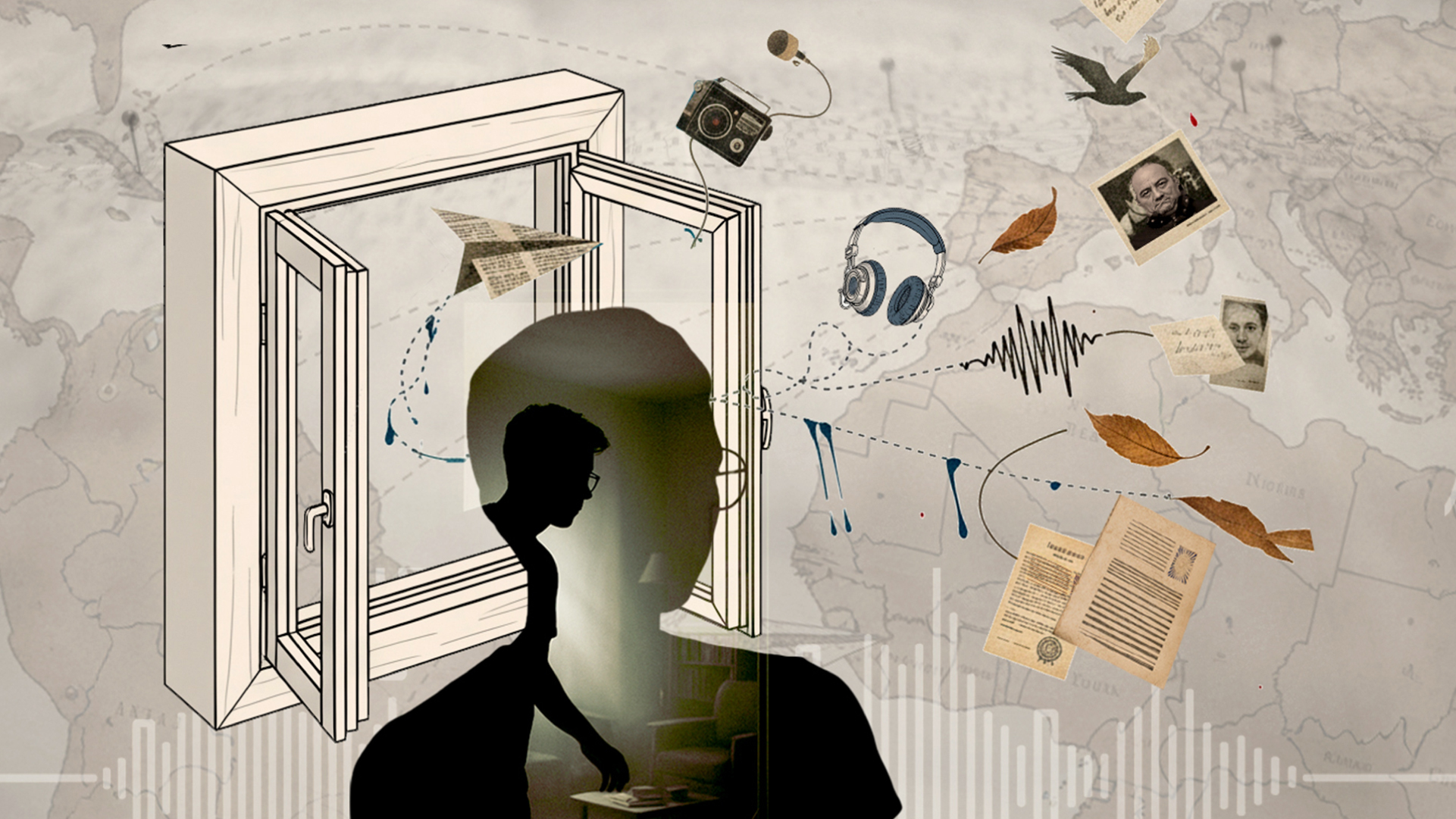
[Daniel]: Without moving, they began to look at everything in detail. The door was closed, but one of the windows in the living room was open. It seemed that someone had climbed up the facade and entered while they were sleeping. They were on the second floor, it wasn’t that high. The mere idea of a stranger prowling among their things made them shudder. At that moment, that house that they had felt so much their own, became a foreign place, as if violated.
[Andrés]: And beyond the fact that there is a violation of your privacy, you don’t realize that you’ve been violated until you’re conscious and, well, I mean, for me it’s… it’s still incomprehensible that we didn’t hear absolutely anything.
[Daniel]: They thought that maybe they had been drugged, but they didn’t feel dizzy, not even sleepy. Whoever came in had to be very stealthy.
They started looking to see if anything of value was missing. Cristhian immediately noticed that his computer and headphones were nowhere to be found. Andrés immediately turned to look at the bag he had left on the sofa the night before. In it, he had two work recorders with which he interviewed those most responsible for human rights violations. Those audios were going to help build the final report of the Truth Commission.
[Andrés]: And then I realize that the bag is there but the bag had been ransacked. So the first thing I do is check if the recorders were there and I say… I mean, my reaction was: damn it. I said well obviously it’s not a common theft.
[Daniel]: And the thing is, during the last few weeks, Andrés had been interviewing one of these characters, who although not the first one he had spoken with, was one of the most important and most complex.
[Andrés]: He’s a warlord, he’s a character who has over 40 years of armed conflict behind him, and the importance lay in having a very broad repertoire in the war, right?
[Daniel]: He quickly looked for the notebook where he had taken notes of the interviews, but all his notes were covered with ink stains.
[Andrés]: Not ink as if they had crossed it out, but ink as if they had smeared their hands and passed it over all the pages. As if they wanted to erase the information. It couldn’t be read. I turned to look where I normally kept my papers, well obviously they weren’t there… my work cell phone wasn’t there.
[Daniel]: Everything he had done in the last few weeks had disappeared in one night. Additionally, they had taken some of his documents and his work cell phone. But it wasn’t so much the lost time that worried him, but the information they had taken.
[Andrés]: The information that the recorders had was about who was behind the development of the armed conflict in Colombia, especially civilian third parties, right? Among which ex-members of the Administrative Department of Security (DAS), army generals, active or retired, and politicians and businessmen can be identified.
[Daniel]: They were audio recordings in which many powerful people were compromised…
And then he felt that through that open window not only had a thief entered. A new fear had also crept in, an unknown anxiety for him, which accompanies him to this day.
Andrés Celis tells us the story. This is Andrés.
[Daniel]: We’re back on Radio Ambulante, here’s Andrés Celis.
[Andrés]: I’m going to start by explaining who the character I had been interviewing even a day before the robbery is. His name is Dairo Antonio Úsuga, alias ‘Otoniel’. He is one of the most wanted drug lords in the history of Latin America. Perhaps the second, after El Chapo Guzmán, head of the Sinaloa cartel.
His criminal history is long. He got into the war in the 80s as a militiaman of the FARC. Then he moved to another guerrilla group and later, in a 180-degree turn, ended up with the paramilitaries.
Although in the mid-2000s he and his men demobilized through a peace agreement, they soon got back into drug trafficking. In 2009, the Gaitanist Self-Defense Forces of Colombia, or the Gulf Clan, as the authorities began to call it, came to light. Otoniel became one of its commanders. Through blood and fire, they dedicated themselves to recovering the territories that were once theirs, and began to commit massacres, displace communities, and extort.
After the peace agreement with the FARC in 2016, the Gulf Clan dedicated itself to occupying the areas that the guerrillas used to dominate. Their power increased so much that they soon became the organization with the most armed men, the greatest territorial expansion in the country, and the one that exports the most cocaine to Central America and Europe. So Otoniel was what the military calls a high-value target.
In October 2021, after pursuing him for years and offering rewards of more than 5 million dollars…
(Archive soundbite)
[Journalist]: Attention, high police and military sources confirm the capture of Dairo Antonio Úsuga, alias Otoniel, maximum leader of the Gulf Clan.
[Andrés]: It was later known, from his own testimony, that it had not been a capture, but that he had surrendered to the authorities.
When at the Truth Commission we found out that he was being detained, we immediately requested the National Police and his lawyers to let us interview him. Otoniel had been in the war for four decades. He knew, perhaps like no one else, the evolution of the conflict, how the business has transformed, who has pulled the strings, and the alliances that have been made between criminals and the State. That’s why it was very important to have his testimony. It’s worth clarifying that none of the interviews we collected had judicial implications. Their purpose was to help us build the final report of the Commission, a document in which, based on testimonies, investigations, and analyses, we would seek to clarify what happened in more than five decades of armed conflict. In this way, the victims’ right to truth would be recognized.
They let us talk to him two months after he was detained. My boss, who was one of the 11 commissioners, and I went. That first time we saw him, he spoke slowly and in short phrases. He was in a cold, small cell that had nothing more than a single bed, a bathroom without a door, and a desk where he received his lawyers. There were also seven cameras that watched him 24 hours a day, and outside the cell, there were several military and police officers, two armored vehicles, and three security rings deployed throughout Bogotá.
We decided to do more than one session, as many as necessary to cover all the years that Otoniel had been in the war. As we progressed in the interviews, I realized that although I had been talking to this type of people for a decade, this time it felt different. And not so much because of Otoniel, but because of the authorities in charge of guarding him, who started putting obstacles in our way. Sometimes they wouldn’t let us in because we supposedly weren’t in the databases for registration, or they wouldn’t allow us to bring pens to take notes. They even abruptly suspended an interview because supposedly the Gulf Clan wanted to rescue him, but that was never proven.
Of course, they were taking very good care of him, but not precisely to prevent him from escaping and continuing to commit crimes. I can’t reveal the details of what we talked about with him, those Commission interviews are not public. But I can say that as Otoniel told us about the criminal alliances between politicians, businessmen, state agents, and even universities with the Gulf Clan, we understood that there were many powerful people trying to contain those truths that he could tell. All that information was on the recorders that were stolen from my house that early morning of February 19, 2022.
Let’s go back to that day. I remember that after coming out of the shock, I called the neighborhood police. I tried to contact my boss several times, but he didn’t answer. I then decided to call Carlos Martín Beristain, another of the commissioners. Carlos has worked for several years as an investigator of human rights violations in various parts of the world. We had become good friends during the work, and he knew perfectly well what was on those recorders. He told me he would come to my apartment immediately. Carlos still clearly remembers what he saw when he entered.
[Carlos Beristain]: What I found is a house that has been ransacked by someone, right? There are things half thrown everywhere, dirty, doors open. At that moment, we didn’t know what had happened and we didn’t have the dimension of the story either.
[Andrés]: We didn’t know who had entered, much less what they intended. Within a few minutes of Carlos being there, two police officers, each no more than 40 years old, also arrived. They asked me only two things: what I had done the night before and what had been stolen. I limited myself to saying that they had taken two recorders from my work, without specifying the type of work or the audios that were there.
[Carlos]: And then they already had a theory of the case. They looked here, there was an open tuna can. There were dirty stains like fingerprints in different places. Right away the police started attributing things to a homeless person.
[Andrés]: A homeless person who, according to them, had climbed two floors of a building in the early morning, had opened a window, and had entered an apartment to steal food. The hypothesis was that upon seeing two recorders, a cell phone, and a computer, he took them to try to sell them on the black market.
I found that idea very unlikely, so I asked them to call the Prosecutor’s Office to record how the house had been left. I saw the police officer make two calls and then he told me that they were going to take a long time to arrive, and that “it would be better to leave it at that.” But I didn’t want to leave it at that, I was willing to wait as long as necessary. I asked him to note in his record that they had proposed the homeless person hypothesis.
The people from the Prosecutor’s Office arrived in less than an hour. There were three agents: a photographer, an investigator, and an expert who was going to collect fingerprints. While we were greeting each other, each one began to fulfill their role. The photographer took general shots of the living room and the facade, the expert put on his white suit, took the brushes out of his bag, and began the inspection.
At the same time, the investigator questioned me about what I had done the night before. She asked me about the house, the neighbors, whether or not I had heard noises, and ended up asking me to make a list of the stolen equipment and the estimated value. With her, I was more direct and told her that the recorders had interviews that I had done as part of my work at the Truth Commission, without mentioning Otoniel. That was sensitive information that for the moment we didn’t want to share. I remember the investigator saying she didn’t know what the Commission was, that she had never heard of it. She only insisted on the list of things that were taken.
Carlos has participated in other investigations of human rights violations. It wasn’t the first time he had been in a situation like that, and he was amazed at the lack of professionalism with which they were examining the house.
[Carlos]: I mean, there hasn’t been a minimal inspection. Saying, well, sorry, let’s take photographs of everything. Let’s collect all the evidence elements that we see here. Right? Let’s mark them. Let’s put a centimeter. Something that is done with a scene. That wasn’t done there, right? What I saw are some investigators who arrived, and in fact, started collecting some fingerprints, but who are very little attentive to what needs to be done.
[Andrés]: In less than half an hour, they stuck to the initial hypothesis of the homeless person. The key, for them, was the food scattered on the floor. Again, I asked the investigator to record that I didn’t agree with that version, that I didn’t believe it was a common robbery, that I was sure this had to do with my work.
It wasn’t until Carlos managed to communicate with the president of the Commission, Father Francisco de Roux, and he, in turn, with the Vice Prosecutor General of the Republic, that the authorities took the situation seriously. Thanks to that, in a few minutes, the house, the block, and the neighborhood were filled with investigators, directors of various departments of the Prosecutor’s Office, and a prosecutor who had been directly assigned to the case.
That’s when the dynamic changed. They gave me a new interrogation, and this time they did ask about my work, about the interviews we had done in the last few weeks. They took photos of the neighboring houses and finally requested the security cameras. The expert, this time in the company of his boss, was taking fingerprints from where he hadn’t taken them before.
At that moment, I wasn’t thinking about anything other than the recorders. I couldn’t even talk to Cristhian. He observed in silence the flow of people inside the house.
[Cristhian]: It was as if they were filming CSI Miami. I mean, there were the investigators taking fingerprints with their gloves, as if there had also been someone… a dead person or something. That actually made me more curious, like, wow, so this is how they operate at a crime scene.
[Andrés]: I don’t remember with certainty the number of people who entered and left the house, but they were surely more than 20. What surprised me the most was that, even when I told them what was on those recorders and that they had taken other documents related to my work, all those people kept going back to the homeless person theory.
With the house full of people and with that story almost officialized, I remember well that one of the agents told me: “Doctor Andrés, don’t worry because in less than 24 hours we will have your equipment back. It’s in the black market.”
10 hours had already passed since we had realized the robbery. We were exhausted. Lastly, they asked me for access to my cell phone lines. As they explained to me, it wouldn’t be permanent, they would only check how I had moved the day before and the calls that came in and went out in that time frame. I accepted.
At the end of the day, the media had already found out what had happened and wanted to know more. The Commission decided to send a press release, and my boss, who appeared in the evening, was the one who spoke to the media.
I preferred not to tell my family at that moment, I didn’t want to worry them. I was waiting to have a moment of serenity to be able to talk to them, but the news got ahead of me.
(Archive soundbite)
[Journalist]: More questions than answers are left so far by the theft of the Truth Commission’s equipment with the account that alias Otoniel made before this body about his participation in the armed conflict in the country. The theft occurred in the early morning of Saturday at the home of the investigator who accompanies commissioner Alejandro Valencia Villa.
[Andrés]: I spoke with my parents about this story, and they told me that although the news didn’t mention my name, they did know that Alejandro Valencia Villa was my boss, and it wasn’t difficult for them to deduce that the investigator they were talking about was me.
[Eduardo Célis]: Wow, how come, how… that thing can’t be. All that was very worrying.
[Lilia Rodríguez]: One thinks many things, many things: What are they going to do to you? Who’s going to take care of you? How are you going to safeguard yourself from all that? Where are you going to be?
[Eduardo]: And then comes the impact of your insecurity.
[Andrés]: Finally, I called them and explained how sensitive the information that had been taken was and how distressed I was. My dad knew perfectly what my job consisted of.
[Eduardo]: I always looked at your work with a lot of respect and admiration, because I knew how important it was. The thing is, I never imagined that the interview with Mr. Otoniel would generate for you personally any situation that would be against you, because ultimately you were doing professional work.
[Andrés]: But my mom, who also had a clear idea of what I was doing, never agreed with my work.
[Lilia]: I was always worried. I would say, Eduardo Andrés, why doesn’t he get out of that, why doesn’t he get out of that? Why does he like that? It seemed like a martyrdom and a great sacrifice to think that after any of those outings, any interview, something would happen to you. No, I never liked your job and you know that I never agreed.
[Andrés]: That’s why, that day I tried not to give her too many details. In a way, that event proved my mom right. The risk of seeking the truth about the armed conflict is very high… I had never felt it… and much less so close.
[Daniel]: A pause and we’ll be back.
[Daniel]: We’re back on Radio Ambulante, Andrés Célis continues telling us.
[Andrés]: After the robbery, I continued working. We had to finish the interviews with Otoniel, so my boss and I went back to his cell. When we told him what had happened, he remained silent for a moment. He always thought about things before responding. He told me he had heard it on the radio. He asked me if I was okay and what else had been taken. I answered him. Then he smiled and reminded us that he had already warned us once that his cell was tapped and that the recorders would have interference. He knew that they were listening to him, to us.
Now I was clear that I too would be subjected to that extreme surveillance. This was no longer just about work, but it had touched me personally. Not even in my house could I forget the situation. The investigators from the Prosecutor’s Office were constantly taking testimonies in my building and in the neighborhood, undercover in case something happened.
In addition to the pressure that things could worsen at any moment, on social media, people began to criticize that a Commission investigator had that type of recordings in his house. Tatiana Navarrete, who worked with me on the same team, also remembers that.
[Tatiana Navarrete]: It’s like ugh… like… how exhausting. Let’s say, of course, they may be right about many things, but why do they have to fall on the weakest link in the chain.
[Andrés]: Tatiana remembers that although in the Commission they gathered the rest of our team to explain the situation to them, she felt everything but tranquility.
[Tatiana]: And I remember that, like feeling a lot of helplessness, because, well, on one hand, this happened, no matter what. It’s something that could happen, but there wasn’t either, well that I remember, such a clear protocol regarding, regarding the issue of what we had to do with a recording.
[Andrés]: Nobody knew what to do. Some colleagues, who had also reported security problems, began to express that they were afraid. At this point, it was evident that this had exceeded the security protocols that the Commission had.
Days after the robbery, Father Francisco de Roux, the president of the Commission, took a first emergency measure. He contacted his religious order, that of the Jesuits, for them to take in Cristhian and me for a while in a house where they lived. He wanted to protect us in case they returned to our apartment. At first, Cristhian refused. But after much insistence, he ended up accepting. He understood it was for his safety, that there were no more options, but still everything seemed absurd to him.
[Christian]: I don’t talk about these topics, I have nothing to do with it, and suddenly boom, all this happens, they break into my house. That’s why I say it’s absurd. I mean, I didn’t choose this, I didn’t… I mean, this has nothing to do with me. And suddenly I’m leaving my house with suitcases to live with some priests for a while. I mean, it was all very sudden as well.
[Andrés]: Before I encouraged myself to tell this story, I had never spoken with Cristhian about what he felt at that moment. Now is when I feel guilty for having involved him in such a situation. But I was only focused on making quick decisions. I was overwhelmed and couldn’t even think about how I was feeling.
Fortunately, the two weeks we were in that Jesuit house were better than we expected. It was a very quiet, calm space, they gave us food, and we had good conversations with the religious.
[Christian]: It was a comfortable space, and the truth is they treated us like kings, and well, they were also aware of all the circumstances, they were constantly concerned. It also served to rest a bit, from that noise they had put us in.
[Andrés]: So much silence and tranquility made me hope that everything was going to get better. But now I realize that I was too naive. The ordeal was just beginning.
A month after the robbery, when we had been in the Jesuit house for a little over a week, I decided to go to another city for a few days to work from there. I wanted to distract my mind a bit and wait for everything to calm down. Cristhian preferred to return to the apartment.
A few days after being in that city, I was assaulted again. I was walking at sunset and stopped for a moment to take a photo. Suddenly, three people approached me from behind asking me to hand over my cell phones… like that, in plural. It was strange that they knew I had two, mine and my work one. With a lot of fear, I handed them both and also my wallet with my documents. That same night I reported it to the police, and I had no other option but to return to Bogotá.
In May, three months after the robbery, in an almost movie-like operation that all the media covered, they extradited Otoniel to the United States for drug trafficking. It was an express process that the government resolved in just six months.
(Archive soundbite)
[Journalist]: Hundreds of drivers and pedestrians recorded the passage of the unusual caravan composed of 25 police motorcycles, two armored vehicles, and two armored vehicles with the capacity to inhibit communication signals. At least 300 uniformed officers, supported by air, carried out the displacement with the alias Otoniel inside one of the armored vehicles.
[Andrés]: He left the country without finishing answering for his crimes related to the armed conflict and without having finished his declarations before the Transitional Justice.
At that point, I really thought that the situation would calm down and that the process in the Prosecutor’s Office related to the robbery in my apartment would be faster. But about four months after all this started, I received a call from an unknown number. Upon answering, a man who had a deep voice, like someone older, began to insult me and tell me that they were going to kill me. Before I could react, he hung up. I didn’t feel fear at that moment. Rather, I was angry at not knowing who was speaking and not having been able to respond.
Although I also reported it, the same call was repeated on several occasions. They also started sending me emails. They were increasingly insistent that they were going to kill me, but I tried to ignore them and focus on the most important event of the Truth Commission, the result of four years of very intense work: the presentation of the Final Report.
That was on June 28, 2022, a historic date for Colombia and for the world. I was there, in a theater in downtown Bogotá.
(Archive soundbite)
[Presenter]: Good morning. Welcome to the presentation of the final report of the Truth Commission: There is a future if there is truth.
[Andrés]: There were so many people: the president-elect Gustavo Petro and the vice-president Francia Márquez, groups of victims, international organizations, ambassadors, and various media outlets. Father Francisco de Roux gave a very emotional speech.
(Archive soundbite)
(Francisco de Roux): We are convinced that there is a future to build together amid our legitimate differences.
[Andrés]: And it was news everywhere…
(Archive soundbite)
[Journalist]: The Truth Commission today delivered its Final Report, the product of more than 30 thousand visits to victims.
(Archive soundbite)
[Journalist]: After four years of investigations, the president of Colombia’s Truth Commission proudly presented the body’s final report.
(Archive soundbite)
[Journalist]: An important step for the reconciliation of Colombia, it also represents a closure of that dark chapter of its history.
[Andrés]: Now that I remember that moment, I feel that it is paradoxical and, at the same time, says a lot about the reality of violence in Colombia. While the Commission was delivering its Final Report and talking about the path to reconciliation, I –one of its investigators– was looking for alternatives to protect my life.
One of those alternatives was offered by the National Protection Unit, which did a risk study and classified my case at the highest level. They gave me a security scheme that included an armored truck, a bulletproof vest, and two bodyguards. And although I know I had no other option, it was an absolute loss of freedom. Now I was never alone, I had two strangers in charge of my life. I didn’t feel safe anywhere. I stopped going to meetings with my friends. Some even distanced themselves because they were afraid of being seen with me.
I also took other measures. I decided not to have direct contact with my parents, not even by phone. It was a way to protect them, so that their phones wouldn’t be intercepted and they would end up being threatened. I only communicated with my brother, who was out of the country at that time. He would give them information about me and help calm them down. But my parents’ fear reached the point of distrusting even the bodyguards.
[Lilia]: When they assigned you bodyguards, it was worse to have those people there. More worried, more worried that at any moment someone would appear, something would happen. The risk for you was very high, very high.
[Eduardo]: From the beginning, I didn’t trust that. It generated a lot of concern for me, because there have been known cases where unfortunately the people are not loyal to whom they are guarding.
[Andrés]: Although they could also have access to the same security scheme, they rejected it.
More than six months had already passed, and the authorities were still not capturing the thief or those who were making the threats. After the ostentatious display made by the Prosecutor’s Office in my house, they only summoned me once to show me the videos from the security cameras. In them, it was perfectly clear that the person who entered the house was not a homeless person. On the contrary, it was someone very skilled who in a matter of seconds climbed up the facade of the building, opened the window, and entered the house. He always had his face covered. He left the place with a backpack where he surely carried the recorders and the rest of the things. A block further on, a taxi picked him up. But even with that video, they couldn’t do anything. They never recovered the equipment that the investigators promised to have back in 24 hours.
The institutional negligence was evident, and it didn’t seem like they were going to act soon. As a last resort, from the Commission, they began to arrange with some Embassies my departure from the country. There were no guarantees to stay in Colombia.
I still have the vivid memory of the tingling I felt in my face when crossing Immigration at the airport at the end of September 2022. I exhale deeply when I think of the moment I sat down, looked at the floor, dropped my suitcase, and began to cry. I had (I have) stuck in my chest the disappointment of leaving my land behind, of having had to say goodbye to my parents and some friends without knowing when I would see them again. I had to exile myself.
[Daniel]: After the break, Andrés begins a new life. We’ll be right back.
[Daniel]: We’re back on Radio Ambulante. Andrés Celis continues telling us.
[Andrés]: I arrived in a town in northern Europe at the beginning of autumn 2022. Although the temperature hadn’t yet dropped below 10 degrees, the cold was already starting to feel worse and worse. As soon as I arrived, I was received at the house of a human rights defender NGO. I remember it was an old building that they were reconstructing. It had two floors, many rooms, and a large garden.
Before traveling, I had already spoken with a member of the organization, Eneko, and he had told me more about this place. He told me that they decided to create it in 2019, when they started receiving many petitions from human rights defenders, political refugees, and exiles who needed a place of reception. This is Eneko:
[Eneko]: When we say reception, we mean a space where people can feel calm and not persecuted, people can heal after having been detained, imprisoned, tortured, can rest, can share experiences, can link with other struggles.
[Andrés]: That made a lot of sense to me from the beginning. Exiles don’t leave our countries because we want to. Arriving at a new place fleeing can be very traumatic, and a space like this house helps it feel less hard.
[Andrés]: They welcomed me very well. Some residents of the place received me in the living room with food. Everything delicious. Each one introduced themselves: they said their nationality, what they did, the reasons why they were in the house, and how long they had been there. I remember well Yusseff and Hattin, both Moroccans, and Chepe, another Colombian.
I understood, with their stories, that within exile and forced global migration, there are privileged ones, and I had been one of them. I left by plane, I didn’t cross the Mediterranean swimming or in a boat, as Yusseff and Hattin did. They also didn’t murder any of my family members or the neighborhood leader of my community, as happened to Chepe, who was also going through his second exile and had left with only three changes of clothes.
Fortunately, they had been able to reach this house which, in the midst of everything, was a safe space. But we all knew that it was a temporary solution, at least until we settled in this new country. For that, I knew that to the weight of my exile would be added a struggle that my companions were already facing, a struggle against the bureaucracy of the State and against revictimization. Eneko had explained it to me and had offered me, like everyone else, accompaniment for the tortuous administrative procedures.
[Eneko]: In this accompaniment of people, you start to learn that it really is a very, very powerful obstacle course that… that these companions face. It’s a constant struggle.
[Andrés]: After eating, the companions took me to my room on the second floor. There was a simple bed, a small wooden closet, and next to it a small desk. On the walls there was dampness that announced the age of the house and the passage of time over it. That first night I felt a very intense cold, and I felt it getting worse over several more nights. It made you want to do nothing, I won’t deny it. But the adrenaline that had been accompanying me since the last days in Colombia motivated me not to lose focus.
A few days later, and thanks to a scholarship from the Norwegian Embassy, I started a master’s degree at the International Institute of Legal Sociology. Later, they accepted me into their student residence and I moved to what would be my second temporary home. I started going to classes and in the afternoons, I would go out with my classmates to a nearby bar and we would stay until midnight eating, drinking, and talking.
At times, I could forget that I was exiled and play the exchange student. I tried to believe the story to counter what my therapist had already warned me about: very soon my mind was going to realize that I hadn’t left on a trip and that I should seek psychiatric treatment to soften the impact. I didn’t listen to him. I thought I was already protected.
But one afternoon, when I returned from classes to my room, I got a call. I answered.
[Luis Beltrán]: Do you copy me, Mr. Andrés?
[Andrés]: There, now yes, I can hear you. I didn’t understand you well.
[Luis B.]: Ah ok, alright then.
[Andrés]: It was the same type of call that I thought wouldn’t come back. The same one that had mortified me for months in Colombia. They had managed to find me on the other side of the world and even had my new cell phone number, the fourth I had had in a year. First, I was surprised, but then came the fear. I decided to put it on speaker and start recording.
[Luis B.]: You have the pleasure of speaking with Commander Luis Beltrán. It’s a pleasure, sir. Do you copy me?
[Andrés]: Luis Beltrán. And where are you calling me from?
[Luis B.]: From the Main Block of the AUC.
[Andrés]: The United Self-Defense Forces of Colombia. It seemed very strange to me, that paramilitary group demobilized in 2006 and that so-called Main Block he was referring to never existed. I followed the thread.
[Andrés]: And what? And what do they want? And what do they need? What do they want? Mr. Beltrán, hello?
[Luis B.]: Yes, I’m sorry. It’s the signal. Copy me, then, as I was saying: two sons of bitches, motherfuckers, sir. And excuse me for the expression of the word, but I have no other way to call it. These people are hiring. Our organization is being financed and hired by these two people. These people brought us photographs of you. Photographs of the family, residence address, and telephone numbers. That’s why, sir, we have your number. Besides, the amount of 15 million in cash for us to execute a death by contract, an assassination, a bloodshed against you.
[Andrés]: Everything was very confusing, even impossible to confirm. According to this man, two people paid him several million to kill me, but apparently, he wanted to negotiate it with me… that is, an extortion.
[Luis B.]: Very delicate situation, my sir, I don’t want you to alarm yourself. Don’t alarm my family, not even the shadow that follows you. Because if you are receiving a communication from us, sir, that is the solution to the problem, if that’s what you want. Because I believe that in life, by talking, people understand each other.
I wanted to get as much information as possible. I insisted that Luis Beltrán say more.
[Andrés]: And who are these people?
[Luis B.]: It’s not that we have the photographs here, the videos where we record exactly, well we don’t have exactly a certainty that I’m going to tell you who they really are. You know them better than we do, because that’s why they brought us your number, photographs of you, residence address, the reason why, sir, we made the decision to make the communication because we investigated you, we followed you for ten days stepping on your heels, breathing on your neck, and you didn’t even notice. We know that you are a good man. We know that you are a person who doesn’t mess with anyone, because if you were a son of a bitch, Mr. Andrés, believe it, you would already be three meters underground.
The call didn’t last more than three minutes. He hung up the phone suddenly.
[Andrés]: When I decided to investigate the Colombian conflict, it was because I imagined a country very different from where I grew up. In the war that has crossed Colombia, these calls are routine. And worse things happen, of course. Now that I think about it, working at the Truth Commission was a bet, somewhat optimistic, but a bet: that there could exist a less violent, less cruel, less barbaric country.
Nothing had happened to me physically, I just received a call from a man pretending to negotiate my hypothetical death. But with that, they had broken me… although it would take time for me to realize it.
At that moment, I felt anger. Again, I told everything to the Prosecutor’s Office and sent them the recording and screenshots of the chats in which they also threatened me. But this time I thought that by making my case visible, I could be more protected, so I also sought out the news program Noticias UNO.
(Archive soundbite)
[Guillermo Gómez]: We spoke with the investigator who is in a location abroad that we cannot reveal. Those who say they have been hired to kill him have already contacted him and are asking him to give them more money than they have already been paid to kill him.
[Andrés]: I gave them an interview without hiding my identity and asked them to publish the recordings. Several media outlets, some international, replicated the news. I changed my cell phone number again. And I thought, perhaps naively, that I was going to be okay.
While waiting for a response from the Prosecutor’s Office about who was making the calls, I continued studying. I thought it would help distract me, but I couldn’t get the threats out of my head. After two weeks of insomnia, I finally accepted my therapist’s advice and had an appointment with a psychiatrist. The diagnosis was post-traumatic stress, depression, and anxiety. I started a treatment with an anxiolytic and an antidepressant, but that made me feel as if my head was underwater, I wasn’t reacting to stimuli. Each day became a struggle to get up, to go to class, to eat, to do the work, and to keep standing. Although I followed all the doctor’s recommendations, took the pills punctually, exercised more frequently, tried to eat well, walked in the mountains near the town, and made an effort to video call my family and friends, I didn’t feel better.
When I said a moment ago that that call had broken me, this is what I’m referring to. Every day the loop of the same unanswered question kept coming to me: Why did this happen to me? Why? I preferred to distance myself from social activities. The long nights of celebrations became a torment due to insomnia.
There came a point when I thought about leaving the master’s program. The Institute offered me to continue virtually, and I accepted. Despite the sacrifice it meant for me, I felt that stopping studying was giving reason to those who had threatened me and forced me out of Colombia. It was like a defeat.
But the situation became unsustainable. I felt more and more out of myself. I was exhausted. Desperate. The ruminative thoughts wouldn’t go away and, on the contrary, they became more hurtful to the point of repeating to myself over and over again that the only way out was suicide.
I talked about this with very few people apart from my psychiatrist, among them my friend Natalia Palacios. Because of her chronic depression, I felt she was the only one who understood what I was going through.
[Natalia Palacios]: I also understand because I know it and I’ve lived it, that depression is not being sad. I also understand that depression is not crying. I know what feeling anxiety is, I know what it is to have your hands go numb, I know what it is to think and think and think and not be able to sleep from thinking. People don’t know, people don’t know! And what I felt for you was pure and physical empathy.
[Andrés]: And she, miles away, became my only support.
[Natalia]: Not even your parents, because your parents, well, dude, I think they were there, attentive and everything, but you could never be sincere, you could never tell your mom I was about to kill myself.
[Andrés]: It’s true, I wasn’t able to. We had several calls a week, but I never touched on this topic. I just tried to pretend that everything was in order. What I didn’t know at that time was that they were doing the same thing: they tried to motivate me, they told me they were fine, but the truth was that they were suffering a lot.
[Lilia]: The sadness was enormous… And the worry about not being able to see you. At the beginning, well, it wasn’t easy to talk while you settling in and everything, we wondered if you were really better or not. These are things that one doesn’t recover from easily.
[Andrés]: What my parents were feeling is called insilio (internal exile) and refers to the impacts and effects suffered by those who stayed behind, the loved ones of those of us who have had to exile ourselves. My father, besides sadness, felt anger towards the Commission.
[Eduardo]: Everything got mixed up and then I felt furious against those who left you alone.
[Andrés]: Although I understand my father’s discomfort, it’s also true that it could have happened to any of the Commission’s investigators, we were all exposed to the war we were documenting also crossing us. But, as I told the commissioners and the president of the Commission at the time, sometimes I felt like I was fighting without all the institutional support, while they continued working to present the final report.
Four or five months had already passed since I had left, and the mental health crisis and suicidal thoughts had only worsened. I reached such a low point that I decided it was time to tell my brother Sebastián. I wrote to him and he decided to travel to accompany me. When I saw him, I was very happy, I felt protected. I hugged him and could cry knowing that I was with someone who knew me and who knew about all the suffering I had gone through. I talked with Sebastián and he told me that for him, from the first moment he saw me, it was more than evident that I wasn’t well.
[Sebastián Célis]: He wasn’t the Andrés that I left two years ago. I mean, you were present in body, but you weren’t as present in 100% of your abilities… your mental capacity, right? I mean, very diminished, withdrawn, I think also anguished, with many feelings and many things in your head, and one perceives that.
[Andrés]: The days he was with me were more peaceful. He would accompany me to sleep, he would take care of me, and I could finally be with someone without pretending I was okay. He always looked very strong, but now I know that he also felt bad.
[Sebastián]: It was difficult to see him in the mornings when he told me that he hadn’t been able to sleep, that he had slept for an hour, when he didn’t want to do anything during the day.
[Andrés]: After three weeks, my brother agreed with my therapist that the best thing was, finally, to tell my parents how bad I was.
[Eduardo]: We did say no, that had to burst someday and it burst.
[Lilia]: It was terrible, terrible for me. I said no, we have to do something because he’s going to get sick, he’s going to get sick.
[Andrés]: Sick I already was, but I could be worse… So very quickly we decided to look for another psychiatrist because it was evident that the treatment wasn’t working for me. At first, the new doses of the medications shook me. I remember that the first four weeks seemed eternal and I only have the image of being on a sofa assimilating the load of the anxiolytic. The idea was to stabilize my psyche, for the body to calm down and to be able to start recovering sleep.
That happened little by little. Sleeping helped me gradually recover mental stability, appetite, and physical strength to move beyond the sofa and the bed. After two months, I was able to do a bit of physical activity again. I genuinely got hungry and regained the desire to socialize, to go out to open spaces. Little by little, I started to recover and to get to know myself in a new version. I finished my psychiatric treatment, was able to graduate from the master’s program, and applied for a doctoral scholarship. So far, I haven’t received any more threats.
And if this were a movie, here would come the beginning of a happy ending. Maybe we would already know where those attacks came from and there would even be justice. But the reality is different and the story continues without an ending. In March 2025, a little more than three years after the robbery at my apartment, the Prosecutor’s Office notified me that all investigations related to this case were archived despite the evidence. The argument is that after reviewing cameras, fingerprints, and phone interception, they couldn’t identify the supposed homeless person who is seen in the video entering and leaving my house.
It’s outrageous, yes, but the decision didn’t take me by surprise. It wouldn’t be the first case of impunity in Colombia and it surely won’t be the last.
Almost three years have passed outside of Colombia and I keep thinking about the same thing: in my case, working for the truth, insisting that we were heading towards a solid peace, paradoxically condemning me to exile. I still don’t know when I’ll be able to return to my country.
[Daniel]: At this moment, Andrés Celis remains exiled and without security guarantees to return to Colombia. Today he dedicates himself to pursuing his doctorate in Human Rights and has a blog on Substack called Relatos sobre el exilio (Stories about exile). You can find the link in the notes for this episode.
Otoniel is in the United States serving a 45-year sentence for drug trafficking. From there, he has continued providing information about the relationship between the military forces and illegal groups.
We want to thank Candela Radio, Sound Business Studios, and A Film to Kill For for allowing us to record in their studios.
Andrés would like to dedicate this episode to those who accompanied him before and during his exile. Especially Yolima—his therapist—Natalia, Kontxi, Carlos, and Lorena.
Andrés Celis is a researcher of the Colombian armed conflict and a journalist. He co-produced this story with David Trujillo, our senior producer. The editing was by Emilia Erbetta, Camila Segura, and myself.
Bruno Scelza did the fact-checking. The music and sound design are by Andrés Azpiri.
The rest of the Radio Ambulante team includes Paola Alean, Adriana Bernal, Aneris Casassus, Diego Corzo, Camilo Jiménez Santofimio, Germán Montoya, Samantha Proaño, Natalia Ramírez, Lina Rincón, Sara Selva, Elsa Liliana Ulloa and Luis Fernando Vargas.
Carolina Guerrero is the CEO.
Radio Ambulante is a podcast of Radio Ambulante Estudios, it is produced and mixed in the Hindenburg PRO program.
If you liked this episode and want us to continue making independent journalism about Latin America, support us through Deambulantes, our membership program. Visit radioambulante.org/donar and help us continue narrating the region.
Radio Ambulante tells the stories of Latin America. I’m Daniel Alarcón. Thanks for listening.