

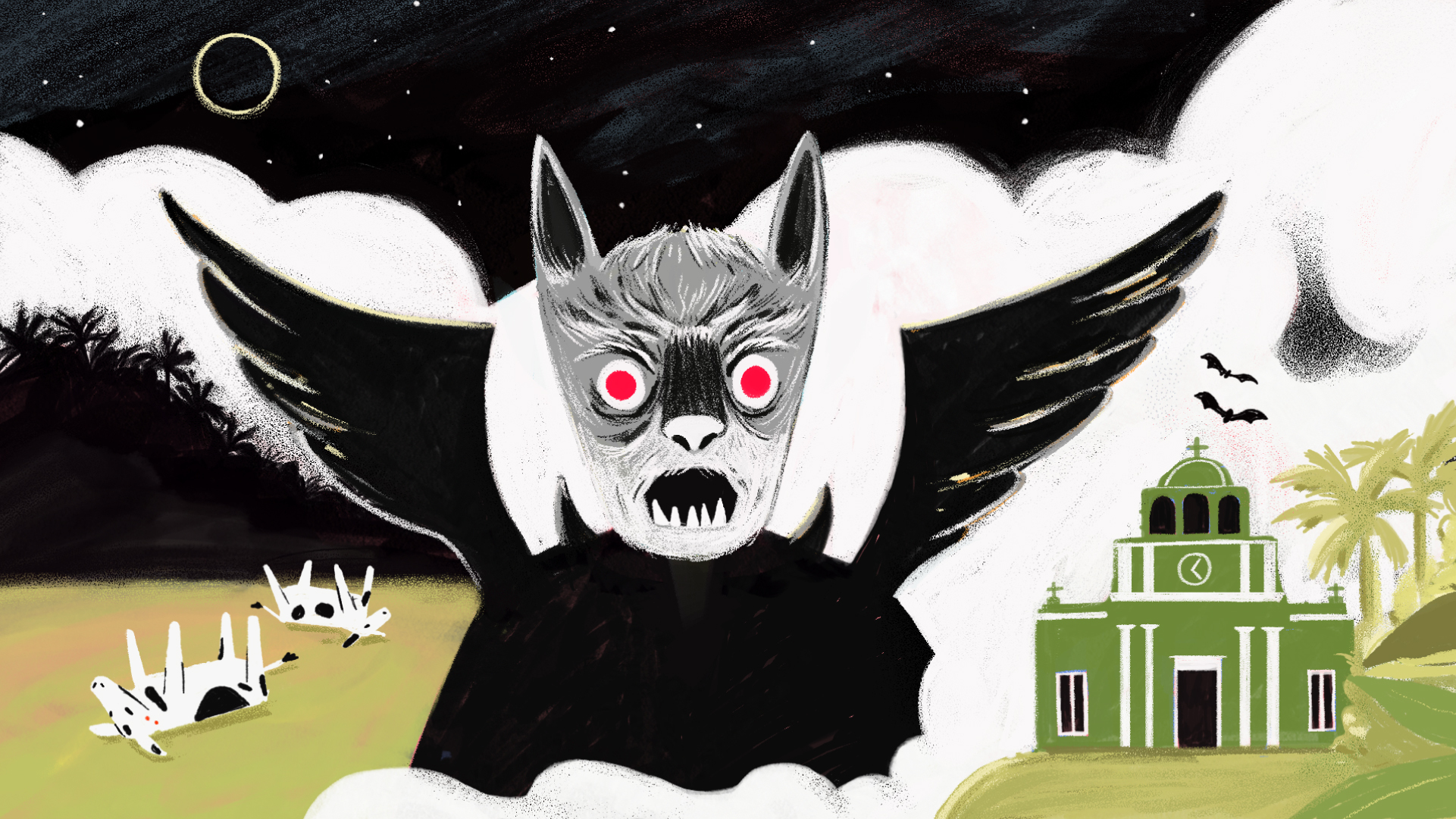
A Vampire Among Us | Translation
Share:
► Click here to return to the episode official page, or here to see all the episodes.
♥ We live in difficult times. We are a non-profit media, and our permanence depends on listeners like you. If you value our work, join Deambulantes, our membership. Help us elevate Latino voices and tell the story of our communities. Your contribution is directly invested in our journalistic work and makes all the difference.
►Do you listen Radio Ambulante to improve your Spanish? We have something extra for you: try our app, designed for Spanish learners who want to study with our episodes.
This podcast is the property of Radio Ambulante Studios. Any copy, distribution, or adaptation is expressly prohibited without prior authorization.
The following English translation was generated with the assistance of artificial intelligence
[Daniel Alarcón]: This is Radio Ambulante. I’m Daniel Alarcón.
Many of you — I dare say almost all of you — have heard this legend. Over the last 30 years, several versions have been told. Some vary slightly, others considerably, but they all share one terrifying creature.
[Daniel A.]: Its origin can be traced back to Puerto Rico. There, in the municipality of Canóvanas, in the northeastern part of the island, a series of extraordinary incidents caused panic throughout the 1990s and sparked dozens of documentaries and news reports.
[Carmen Jovet]: When night falls, a veil of mystery drapes itself over the island of Puerto Rico. Animals in cages in open fields are at the mercy of a sudden and horrifying death at the hands of a being that neither science nor the testimonies of hundreds and hundreds of witnesses have been able to identify.
[Daniel A.]: The legend I’m referring to is that of the Chupacabras. The illustrations that emerged at the time, based on eyewitness accounts and the imagination of artists, depicted it as an alien-like creature. It was drawn with long arms and extended claws, bright red eyes, a back full of large spines, and sharp fangs.
It was said to be a creature with an unstoppable need for blood. It lurked at night, attacking farm animals such as chickens, cows, and goats. Its victims appeared with two fang marks and were completely drained of blood.
Since that first appearance in Puerto Rico in the 1990s, alleged sightings of the Chupacabras would spread to Mexico, Central America, parts of the United States, and more distant countries such as Brazil, Chile, and even China. I lived in Ghana in 1998, and I remember that everyone there was talking about an animal very similar to the Chupacabras. They called it the Sunyani Mystery Beast.
The Chupacabras myth spread unstoppably, crossing borders and even oceans. For several years it was a fixture in popular culture. It appeared in iconic cartoons like Scooby-Doo…
[Woman]: It is the monster!
[Man]: El Chupacabra!
[Daniel A.]: In low-budget horror films.
[Narrator]: Chupacabra Terror
[Actor]: You have seen it, but you do not know what it is.
[Daniel A.]: And in popular songs…
[Singer]: What did you do, Chupacabras, what did you do… You abuser… You abuser…
[Daniel A.]: OK, so… that’s the famous Chupacabras… But what many people don’t know is that this mythical monster was not the first to emerge from the island of Puerto Rico… The Chupacabras has an ancestor — a Chupacabras-like creature before the Chupacabras…
It all happened in 1975, 20 years before the first Chupacabras sightings, on the opposite side of the island. In a municipality of just under 40,000 people, nestled among mountains, with beautiful views and a perpetually cool climate. It’s called Moca.
Journalist Miguel Santiago Colón visited the area to try to figure out what happened. I’ll hand it over to Miguel.
[Miguel Santiago]: In Moca I met Rolando Valle Cardona.
[Rolando Valle Cardona]: This was all wilderness.
[Miguel Santiago]: He’s 57 years old and has lived there his whole life.
[Rolando V.]: There were no houses or anything here. And I’m going to take you to where I used to live. To show you… to show you what it looked like. That’s why they say they looked so small — because of the distance.
[Miguel Santiago]: He took me near his childhood home, in a neighborhood called Parcelas Mamey, to show me a hillside. Today it’s a place full of trees and open fields, but when Rolando was a child in 1975, when this story took place, it was even greener.
[Rolando V.]: From my house, which is over that way, you could look out in the early morning hours and see the little animals in the distance — tiny little spots.
[Miguel Santiago]: Tiny spots. Cows and goats that always grazed at night on that hillside… They were part of the landscape.
We parked next to a cemetery and Rolando pointed into the distance — about ten blocks away, maybe a little more. There, behind a bamboo grove, the hill we were looking for was hidden.
[Rolando V.]: This area, and behind the bamboo — which is behind the houses I showed you — that’s where the dead animals would appear.
[Miguel Santiago]: But they appeared on a hillside, or were they…
[Rolando V.]: Yes. It was what they call a hill…
[Miguel Santiago]: A hillside.
[Rolando V.]: A hill in the area, but it’s all covered up now.
[Miguel Santiago]: It was on that hillside that, suddenly, one day in February 1975, the carcasses began to appear.
It happened one night, then another. Rolando remembers it being 2 or 3 cows per night; other times the victims were goats, and sometimes pigs.
[Rolando V.]: I remember the older adults coming to the area and being horrified because they would see the animals — all dead, with those marks they had on their necks.
[Miguel Santiago]: Two marks on the neck, as if from fangs. And no one had an explanation.
The people on the farm and the neighbors were alarmed. You have to understand something about Moca. It was a quiet town where there was nothing to worry about. Rolando described it to me this way when we spoke at his house.
[Rolando V.]: We all got along, everybody knew each other. There was a lot of sharing back in those days — for example, if someone slaughtered a pig, they’d share the meat, the fruit, the quenepas, all of that.
[Miguel Santiago]: A friendly town…
[Rolando V.]: The people are very easygoing — we always welcome people from other towns, and we’re a peaceful community.
[Miguel Santiago]: It was a place with no room for secrets or mysteries. That’s why the appearance of the drained animals caused such a shock. First of all, it affected the economy of the families — the animals were a source of sustenance and even income. It was also a violent thing, and it wasn’t just the graphic sight of the dead animals that was distressing. Rolando recalls that the adults said horrible things.
[Rolando V.]: I remember my mother talking about it. She said it made her sad because in the early morning hours she could hear the goats and the cows — the cows mooing, the goats bleating — and they already knew that by morning… the bodies would be there.
[Miguel Santiago]: Rolando’s older sister, María, who was nine years old at the time, still remembers what she heard…
[María V.]: I could hear it, and I could tell when they were being grabbed by force, you know — it wasn’t the normal bleating sound they make…
[Miguel Santiago]: But rather a guttural, terrifying sound. María and Rolando would hear those noises at night and the next morning they would see the bodies in the distance, like tiny motionless dots. Since they were the youngest in the family, they weren’t allowed near the crime scene. They had to stay home — a little confused, a little frightened. But also curious. Whenever they saw someone walking past their house, they would ask about the animals, trying to glean any little bit of information.
In those first few days, the adults were weighing several theories.
[Rolando V.]: I heard some people saying it could be a person doing it on purpose — with what they call fisgas, which are like sharpened two-pronged rods.
[Miguel Santiago]: They’re like the harpoons used for fishing in shallow rivers. Many fisgas have three sharp prongs, but some have two. A tool like that could cause a wound similar to what was seen on the dead animals.
As we already mentioned, the animals were appearing with very particular marks — two holes very close together, as if someone had driven something sharp into their necks. Every single carcass had that wound. And they were drained of blood, as if they had been bled out with precision.
Besides the fisga, there were more hypotheses…
[María V.]: Once they told us it was a wild dog. Another day they told us it was people coming with a syringe and sucking out the blood.
[Miguel Santiago]: There was also talk of a bat. A large bat. And others went further still…
[Rolando V.]: And there were even people talking about extraterrestrials and things like that, because around that time I also remember there was a lot of emphasis on… on people saying they’d spotted flying saucers here and there.
[Miguel Santiago]: And it was in this back-and-forth of wild ideas that the giant bat evolved…
[María V.]: Then they started saying it was a vampire. People were making comments like that.
[Rolando V.]: And around that time there were also a lot of Dracula movies coming out in the ’70s, so you naturally made the association.
[Narrator]: A winged creature of terror becomes Dracula’s most fearsome new ally. Enter Dracula’s stronghold at your peril.
[Miguel Santiago]: For two young children, all of this was terrifying…
[María V.]: When they started saying there was a large animal sucking blood, well, as soon as it started getting dark — by that point — the doors and windows and everything in the house were shut, because it frightened us a little, and we were always trying to listen throughout the whole night. You can’t sleep from the fear you’re carrying.
[Miguel Santiago]: And it wasn’t just the children who were scared. The adults too. This is José Luis Rosa, another Moca resident. He was around 30 years old when everything happened.
[José Luis Rosas]: Anyone who says they weren’t scared back then — yes, we were scared. We were scared, and, man, the whole town was scared.
[Miguel Santiago]: None of his animals fell victim to an attack. But he knew people who weren’t as lucky. For example, on Señor Crespo’s farm.
[José Luis R.]: There were a lot of goats dead there — all of them with holes and no blood. Completely bloodless.
[Miguel Santiago]: Or what happened on his neighbor Pablito’s property.
[José Luis R.]: It happened at Pablito’s house — a dog turned up, but it also appeared with two holes and no blood, and it died two or three days later. When so many dead animals started appearing, it really did become a concern because everyone in every household had their animals — their chickens, their goats, their pigs. To sustain yourself, to support the family.
[Miguel Santiago]: What was happening in Moca? No one seemed to have an answer — and then the press arrived to investigate.
[Daniel]: We’ll take a break and be right back.
[Daniel]: We’re back. Miguel Santiago continues the story.
[Miguel Santiago]: News reports about the situation in Moca began appearing shortly after the carcasses were found. The first one I was able to track down in my research was published on February 25, 1975. The headline reads:
[Announcer]: In mystery: deaths of several animals.
[Miguel Santiago]: And it continues,
[Announcer]: About 15 cows have been found dead with a hole somewhere on their bodies. When the skin is removed and the animals are opened up, not a single drop of blood is found inside — as if some animal had sucked it all out.
[Miguel Santiago]: The news was published in El Vocero — a newspaper that had been in circulation for less than a year. It was distributed across all of Puerto Rico and, at the time, was a sensationalist tabloid. Its covers always featured violent crimes with graphic photographs and large, red-lettered headlines. And although it was new, it was already shaping up to be one of the most important outlets on the island.
That first report published about what was happening in Moca was bylined by a man named Augusto Vale Salinas, better known as Tute Vale, who worked as El Vocero’s correspondent for Moca and surrounding towns. After consulting with historians and people from Moca, I learned he was a self-taught journalist, a veteran of the Korean War in the 1950s, and, as we’ve already heard, he had quite a bombastic writing style.
Unfortunately, he passed away some years ago.
In that first El Vocero article, the theory was that an animal — perhaps a bat — was responsible for the livestock deaths. And above the headline, a question appeared:
[Announcer]: Victims of a vampire?
[Miguel Santiago]: Thirteen days after that initial report, in the third article about the animal killings, El Vocero used for the first time the name by which this creature is remembered today.
The headline read:
[Announcer]: Police hunt the Vampire of Moca.
[Miguel Santiago]: The piece appears right below an article about five alleged miracles that occurred in a well on the other side of the island. It reads:
[Announcer]: The police in Moca and Aguadilla, now alarmed by the growing number of animals found dead at the hands of a strange creature or a giant vampire — which kills them and then sucks out their blood — launched a search yesterday through the caves of Moca’s Rocha neighborhood, where many witnesses claim the mysterious nocturnal killer is hiding, the same one that has been terrorizing the farmers of Moca.
[Miguel Santiago]: It also mentions that thousands of bats inhabit those dark caves and that people are afraid to enter. El Vocero continued publishing news about what was happening in Moca…
[Announcer]: Vampire’s victims reach 34…
[Announcer]: Vampire strikes again…
[Announcer]: More vampire victims…
[Miguel Santiago]: There’s something important to highlight here.
[Reinaldo Román]: Originally, El Vocero was the only newspaper that bothered to follow the trail of the Vampire of Moca.
[Miguel Santiago]: This is Reinaldo Román, a historian specializing in Caribbean Hispanic religions and a professor at the University of Georgia. In 2007 he published a book called Governing Spirits, in which, among other things, he examined how the media covered the legends of the Vampire of Moca and the Chupacabras in Puerto Rico.
[Reinaldo R.]: Other journalists — the press that called itself more respectable — steered clear of the Vampire of Moca, thinking it was a sensationalist affair. Some even condemned it as obscurantist.
[Miguel Santiago]: Obscurantist because, instead of seeking scientific, rational answers, the coverage focused on spectacle, belief, and superstition. The condemnation came through a statement from the Puerto Rico Press Association. But El Vocero defended itself in an editorial.
[Reinaldo Román]: …saying that they had not invented the panic they were reporting on — that the panic and fear already existed, and that they were simply spreading awareness of it with the intention of getting the government to clarify what was happening in Moca.
[Miguel Santiago]: El Vocero announced that a group of people from the Puerto Rico College of Agriculture and Mechanical Arts and other scientists had gone to Moca to investigate the killings. But days later, there were still no articles reporting the results of the analyses — though reports of new deaths kept coming.
Around that time El Vocero ran a headline that read: “Warning: invasion of vampire snakes”… The story described a woman from Moca who had gone to the police to report that she had heard the vampire on the corrugated zinc roof of her home, and that she had seen it was an enormous snake.
Four days later, the newspaper reported that hunters had gone to Moca to search for the snakes. It said they had captured two — each two meters long. It also stated that the hunters confirmed snakes don’t suck blood. And, well, yes — they were right. Science has established that snakes don’t suck blood. But that didn’t seem to matter much to El Vocero… because the article ended by returning to the police report the woman had filed — the one about the giant snake. It read:
[Announcer]: Nevertheless, on the other hand, the account given by Doña María Luisa Maisonave, published in our Friday edition, indicates that the snakes do indeed suck blood. Doña María Luisa suggested that horns and sulfur be burned to drive away the terrible killers.
[Miguel Santiago]: That was El Vocero’s formula: a sensationalist headline, followed by a story that never actually proves its claim. And the experts’ version and the non-experts’ speculations were given equal weight. The narrative was always forced — and each time came with new twists.
A few days later, for instance, a story ran with the headline “Radiation detected in victims,” referring to the same dead animals from Moca. The photo showed a man holding a device to measure radiation. It stated that levels of 0.008 and 0.012 gray had been detected. What the article failed to clarify was that not only is radiation present everywhere and something we are all exposed to every day, but those numbers are completely insignificant — normal — and cause no harm.
Around that same time, El Vocero published a story about everything the residents of Moca were doing to protect their animals…
[Announcer]: Farmer Juanito Pabón, from the Cruz neighborhood of Moca, painted a cross on his cow’s right thigh and another cross on her left thigh. When asked what the crosses meant, the humble farmer replied: “I’m painting them to keep that diabolical animal roaming around Moca away from the only cow I have.”
[Miguel Santiago]: That article made me uncomfortable. Particularly that one. That mocking tone — as if a frightened man who is about to lose his only cow, the one that feeds his family, were something to laugh at. As if dozens of animals dying for no apparent reason were a trivial matter.
Undoubtedly, the fact that everything was happening in a rural municipality like Moca helped make the Vampire story attractive to readers.
[Reinaldo R.]: El Vocero in the ’70s — and later El Nuevo Día in the ’90s, when the Chupacabras emerged — portrayed the rural areas as an inhospitable zone, an unknown territory for Puerto Ricans. For the Puerto Ricans who, it seems, made up the majority of their readership — the readers in the urban areas.
[Miguel Santiago]: Meaning the people in San Juan, the capital. For that kind of reader, El Vocero’s coverage reinforced stereotypes about people living in rural areas.
[Reinaldo R.]: They painted that peasantry as isolated, perhaps somewhat superstitious — ignorant.
[Miguel Santiago]: Which isn’t true at all. Rolando — whom we heard at the beginning — the one who was a child when everything happened in Moca — repeatedly told me during the interview that not everyone there believed something supernatural was stalking their community.
[Rolando V.]: There was always a faction — a group that always believed it was a person who did it on purpose, and who never put much stock in the supernatural. In other words, they weren’t saying, “No, it was really a UFO, or it was really a vampire, or it was really a giant bat.” None of that. People believed — and still believe — it was more likely a person who possibly did it on purpose, deliberately, to stir up talk, create hysteria, spread fear, or something like that.
[Miguel Santiago]: By March 27th, one month after the first dead animal appeared, there were already more than 100 victims. The loss was real. And devastating for the local economy.
A few days earlier, the Department of Agriculture had sent two veterinarians to assess the situation. They concluded that the animals had been attacked with shotgun pellets. But the local police challenged that finding. They said the wounds did not appear to have been made by a shotgun and that the more rational explanation was that the animals had been attacked with a fisga.
A Puerto Rican senator representing Moca came forward to state that there had been criminal activity and asked police to find those responsible.
But that statement from the senator was buried in small print in El Vocero, which chose instead to highlight the following:
[Announcer]: Strange craft spotted over Moca. Witnesses allege they saw the unusual object directly above their heads. They decided to follow it in their car, which was fairly easy to do since, according to them, the object was emitting flames or an incandescent light.
[Miguel Santiago]: Moreover, that story claims that some students had seen a creature resembling a strange, gigantic bird circling the area. And in another article, that a pig on a farm had died. A strange bird — a new vampire candidate.
The way information was being presented, the associations being made — it was all chaotic. It had been, throughout that month of coverage. First the vampire had been a bat, then a snake, then an extraterrestrial, then a giant bird. By the end of March, nearly twenty articles had been published in El Vocero on the subject. Some were from Moca, written by the correspondent mentioned earlier, Tute Vale. But reports of animal deaths in other communities near Moca — written by other contributors to the paper — had also been published.
And with every dead animal, peace was lost — and money too. Something had to be done.
And so the hunt began.
[Daniel]: We’ll take a break and be right back.
[Daniel]: We’re back on Radio Ambulante. I’ll hand it back to Miguel.
[Miguel Santiago]: In late March of 1975, a little over a month after the first death, the residents of Moca said enough was enough. It all began one night, after 10 PM, at a small shop in the Roche neighborhood.
[Gabriel Rodríguez]: This is where we’d gather in the afternoon, at night — to play dominoes, gossip, all of that.
[Miguel Santiago]: This is Gabriel Rodríguez, 66 years old. He was at the shop that day because his grandfather was the owner. I spoke with him right there. When the animals started dying, he was 16 years old. And he remembers that on that March night, a neighbor came running in, frightened, shouting “The vampire, the vampire!”
[Gabriel R.]: Saying that the animal had appeared to him out there in the wild, you know? And so, without a second thought, we grabbed whatever weapons we had — machetes, sticks, stakes. It looked like a Frankenstein movie from the old days. And off we went to find it.
[Miguel Santiago]: They were tired of the deaths and the panic. They had to do something about it. There were several men in the shop, but they tried to recruit more people from nearby homes. They knocked on doors asking if anyone else would join them. One of those homes was that of José Luis Rosa, whom we heard from a moment ago.
[José Luis R.]: I was already in bed — my wife says. “They’re going to look for the vampire.” “Alright, let’s go.” So I got down my shotgun and went.
[Miguel Santiago]: José Luis didn’t hesitate for a moment — he wanted to help put an end to what was happening. He’d been waiting for a moment like this. Gabriel and José Luis told me that they weren’t really afraid. They were confident that together they could handle the creature, whatever it might be. They were running on pure adrenaline.
[Gabriel R.]: Let’s put it this way — we were pumped up and ready to find whatever had been the talk of the town.
[José Luis R.]: We were fired up that night. With so many of us there, we were all charged up — we probably would’ve searched for half an hour and called it a night, but there were so many of us that we searched through all the guava groves.
[Miguel Santiago]: In that area it was all wilderness, full of guava trees. They walked and walked, searching for what the man who had supposedly seen the vampire had described. He claimed it looked like a bird.
[José Luis R.]: He said he saw a bird or something — tall, about three or four feet, standing in the middle of the path, opening and closing its beak, flapping its wings — but beyond that he couldn’t see any more because he turned and ran.
[Miguel Santiago]: A bird just over a meter tall. Opening and closing its beak. And so… this monster was hunted for 3 or 4 hours. Through all the wilderness. But eventually the energy dropped considerably and everyone went home…
The only thing they managed to spot that night were the neighbor’s dogs.
The next day, in El Vocero, that hunt was the front-page story. A photo ran showing a group of at least 11 people — almost all men — standing in a pasture, armed with rifles. It would not be the last time someone went looking for the culprit. But they never found anything resembling the bird that man had described, nor any other strange creature.
After that photo, El Vocero continued with the speculation. No longer talking about birds or snakes — it was back to bats. There was also renewed talk of unidentified objects flying over Moca. In one article, a parapsychologist who visited the area stated that something strange was going on there.
Over the following weeks, the newspaper kept reporting more deaths: cows, ducks, rabbits, at least one cat, goats… A wounded dog. But by July 1975, five months after the first report, the articles began to fade. On July 31st, a story was published with the headline “Vampire of Moca Strikes Again.” After that…
[Rolando V.]: After that, nothing more was said about the vampires, about the news. None of that.
[Miguel Santiago]: I found no more reports in El Vocero. The killings stopped, and so did the search for answers about what happened in Moca. El Vocero never reported anything conclusive from the forensic investigations, from the veterinarians, or from the police. The Vampire of Moca remained a mystery.
And well, the Press Association’s statement — which accused El Vocero’s coverage of the Moca events of being obscurantist — didn’t change the outlet’s direction, but it did cause some discomfort.
[Reinaldo R.]: In the weeks following the public censure, three — maybe four — journalists resigned from El Vocero. As far as I know, Vale didn’t resign, or at least it doesn’t appear that way in the press. But other colleagues of Vale’s who were members of the Press Association and of the paper’s editorial team did.
[Miguel Santiago]: Although Tute Vale stayed, the pressure led the newspaper itself to acknowledge that the incident had worked in its favor in its first year.
[Reinaldo R.]: When El Vocero responded to the Press Association’s censure, it noted in an editorial that in less than a year since the newspaper had launched in Puerto Rico, it had achieved a daily circulation of 90,000 copies — far exceeding, for example, the newspaper Claridad, which had launched that same year and had a circulation of fewer than 20,000 copies per day.
The truth is that the Vampire of Moca was a sweeping commercial success, and it turned El Vocero into one of the most important newspapers on the island for decades to come.
For Reinaldo, this commercial success generated by the Vampire of Moca had a great deal to do with what was happening socially on the island at the time… Puerto Rico was going through a serious economic crisis, with unemployment at 15 percent…
[Reinaldo R.]: And it was also said to be a moment when crime was on the rise — when homes were being fitted with iron bars on the windows, when newscasts were filling up with reports of violent incidents.
There’s undoubtedly some kind of relationship — if not causal, then at least contextual — between a crisis and the spread of this kind of narrative.
[Miguel Santiago]: Narratives that feed on fear, panic, and death. Like the Vampire of Moca.
By channeling all of that, El Vocero hit the jackpot.
During my reporting, while searching for clues about what might have happened in that municipality, I came across a Facebook group for people from Moca — residents and former residents talking about local news, notable figures, historical photographs, and topics relevant to them.
I joined, posted a photo of the El Vocero front page — the one from the night of the hunt showing several armed men — and asked if anyone had leads or relevant information about the vampire. I wasn’t expecting any response, but several came in. “I remember going there as a child and seeing lots of dead goats,” one person wrote. “I remember hearing the goats at night, frightened,” said another.
A woman wrote this…
[Edna K. García]: The only person who could have explained it is no longer with us. He was the only one who knew the location, the time, how many animals were being attacked — and he’d show up at the police station to report it, which is how everyone in town found out. If you know who was giving the news, you’ll understand what I’m talking about…
[Miguel Santiago]: She was almost certainly referring to Augusto Tute Vale, the man who bylined most of the stories published in El Vocero on the subject.
Another person told me in a direct message that she had always heard that Augusto Tute Vale was involved in the killings. She told me that Vale had supposedly confessed to her mother that in the early morning hours he would go out to kill animals with an ice pick, and that’s why he was always one of the first to arrive when they were found the next day. But the person who told me this through Facebook has no proof that it’s true.
I asked the people who were living in Moca when the animals died if they had heard this rumor about Tute Vale. This is Rolando again.
[Rolando V.]: Some people allege it was him, others don’t. Some say it might have been someone else who, by living nearby, was always in the know. But his name has always come up — positively or negatively. His name has always been mentioned, and it has always been associated with this.
[Miguel Santiago]: Rolando doesn’t know if it was Tute Vale or not. Or whether he was involved in some way. José Luis — the man who went out to hunt the vampire — has also heard that theory. What’s more, after the hunt that night, a suspicion began to spread: that Tute Vale and the man who came running in to say he’d spotted the vampire had staged the whole scene together. But José Luis refuses to believe it. The man who claimed to have seen the creature was a relative of his — the husband of a cousin.
[José Luis R.]: He was a very humble man. A carpenter, a very humble barber. No, not him. I could maybe believe it about Tute, but not about him.
[Miguel Santiago]: José Luis told me that in Moca, Tute Vale had a reputation for being a troublemaker, and that a lot of people didn’t get along with him.
I tried multiple times and through various channels to contact Tute Vale’s family, but I had no luck.
So based on the evidence, all that can be said is that Augusto Tute Vale and El Vocero turned the deaths of these animals into a spectacle — in poor taste, by many accounts. But nothing more.
And over time, the theories have narrowed down to a dog…
[José Luis R.]: A lot of people said it could have been a dog, but no — I never believed that.
[Miguel Santiago]: Or to one or several people…
[Rolando V.]: Maybe it was someone who wanted to become famous, or someone with an obsession, or someone who wanted to be recognized.
[Miguel Santiago]: It might have been a person, yes — but it could also be something less malevolent, though equally macabre. When the first Chupacabras descriptions emerged in Puerto Rico in the ’90s, people spoke of a creature that walked on two legs and had spines running from its head to its tail. But later, sightings of the Chupacabras reported in other parts of the world tend to describe canine-like figures with sparse hair — or no hair at all. Biologists from several U.S. universities have linked the descriptions to coyotes — coyotes with parasites, with mange. It’s a debilitating disease in canines, and if a coyote is sick and unable to hunt its usual prey, it might try to feed on livestock.
The details — the lack of blood, the fang wounds — scientists attribute those to humans.
But the only thing that’s certain is what José Luis told me: there are very few concrete clues as to what happened in Moca in 1975.
[José Luis R.]: It’s such an unsolved mystery that to this day no one can say for certain what happened to those animals. What was it? Nobody can say.
[Miguel Santiago]: Rolando, for his part — now, with the distance of time, as a 57-year-old man — sees what happened in Moca much like a case of collective panic.
[Rolando V.]: It’s like when there’s an escaped convict on the loose — everything that moves, people are saying, “Look, he must be hiding in there.” Even if it’s just a dog that wandered in.
[Miguel Santiago]: Without a doubt, the fact that the press amplified the vampire narrative helped fuel the panic — the sense that something supernatural was happening in town. It’s one thing to hear about a supposed vampire from your neighbors… but to read it again and again in the newspaper? I imagine you start to doubt yourself.
And despite vanishing from the media just a few months after achieving island-wide fame, the truth is that the Vampire of Moca never really left. In one way or another, it stayed in the municipality.
It’s striking to see how those violent, horrific events — which affected and terrified Moca — have become a marker of identity. This is María Valle, Rolando’s sister, whom we heard at the start of the episode.
[María V.]: We can’t feel — well — super proud that it happened. Because, bless their hearts, they were animals, after all. But it did put us on the map, you know — it marked us. People got to know that there’s a town called Moca, and that’s how it is.
[Miguel Santiago]: Even though what triggered it was terrible, the people of Moca — suddenly — were at the center of Puerto Rico’s public eye. At least for a while.
Maybe it’s that in a place where not much happens, what does happen is necessarily remembered. And time changes things — it heals them too. Because for years, the vampire has permeated everything that it means to be from Moca. All kinds of things have come out of that legend — songs…
Song: Moca, city of lace and the famous vampire…
[Miguel Santiago]: Or a baseball team called Los Vampiros de Moca. People have worked hard to leverage the hook of the vampire mystery to showcase the best of what Moca has to offer.
I asked some people from Moca — acquaintances, friends’ family members — how they felt about being associated with the vampire that terrorized those lands fifty years ago.
[Moca resident 1]: As a child, I was very scared — but that little nickname was given to Moca, right? The Vampires of Moca. Very proud of my town.
[Moca resident 2]: Whether it’s real or fictional, it certainly identifies us as the people from Moca that we are.
[Moca resident 3]: It makes me realize that back then, all of Puerto Rico looked toward our town.
[Moca resident 4]: For as long as I can remember, we’ve always been from a small town — it’s always like, “Oh, the vampire of Moca, behave yourself or the vampire’s gonna get you,” and whatever — but more than that, it’s kind of become our identity now.
[Miguel Santiago]: It was their contribution to Puerto Rican mythology.
So much so that even Bad Bunny — the king of celebrating what it means to be Puerto Rican — projected a giant phrase at his concerts on the island that says it all: “Before the Chupacabras, there was the Vampire of Moca.”
An important reminder.
Unlike the Chupacabras — a monster that achieved worldwide fame — this vampire belongs only to us. It’s Puerto Rican. And nobody can take that away.
[Daniel A.]: Miguel Santiago Colón is assistant producer of The Moment with Jorge Ramos and Paola Ramos, produced by Radio Ambulante Studios. He lives in New York City. This story was edited by Camila Segura, Luis Fernando Vargas, and by me. Bruno Scelza did the fact-checking. Sound design is by Andrés Azpiri with music by Ana Tuirán, Rémy Lozano, and Andrés.
We thank Verónica Barreto Rosa and her family, Amanda Pérez Pintado, and historian Carlos Hernández Hernández for their help with this episode. We also thank our dear friend Luis Trelles for lending us his voice to read the news excerpts from El Vocero.
The rest of the Radio Ambulante team includes Paola Alean, Adriana Bernal, Aneris Casassus, Diego Corzo, Emilia Erbetta, Camilo Jiménez Santofimio, Germán Montoya, Sara Selva Ortiz, Samantha Proaño, Natalia Ramírez, Lina Rincón, Juan Pablo Santos, David Trujillo, Elsa Liliana Ulloa, and Mariana Zúñiga.
Carolina Guerrero is the CEO.
Radio Ambulante is a podcast by Radio Ambulante Estudios. It is produced and mixed using the Hindenburg PRO program.
If you enjoyed this episode and want us to keep doing independent journalism about Latin America, support us through Deambulantes, our membership program. Visit radioambulante.org/donar and help us keep telling the region’s stories.
Radio Ambulante tells the stories of Latin America. I’m Daniel Alarcón. Thanks for listening.