
Against Biopirates | Translation
Share:
► Click here to return to the episode official page, or here to see all the episodes.
♥ We live in difficult times. We are a non-profit media, and our permanence depends on listeners like you. If you value our work, join Deambulantes, our membership. Help us elevate Latino voices and tell the story of our communities. Your contribution is directly invested in our journalistic work and makes all the difference.
►Do you listen Radio Ambulante to improve your Spanish? We have something extra for you: try our app, designed for Spanish learners who want to study with our episodes.
This podcast is the property of Radio Ambulante Studios. Any copy, distribution, or adaptation is expressly prohibited without prior authorization.
The following English translation was generated with the assistance of artificial intelligence.
[Daniel Alarcón]: This is Radio Ambulante, I’m Daniel Alarcón.
In Ayacucho, Peru, on the morning of August 3, 1982, the phone at the Valladolid household started ringing very early. From his bed, Andrés, 14 years old, could hear his father Julio’s voice speaking in a serious tone, as if worried.
[Andrés Valladolid]: I woke up and heard some serious conversations, and that’s when I came out and saw my dad, you know, all sad, right?
[Daniel A.]: Sad and surprised, as if in shock. This is Julio:
[Julio V.]: I found out from the authorities. They told me, “Engineer, a peasant just arrived. They tell me they’ve destroyed all of Allpachaka.”
[Daniel A.]: Allpachaka, a research site of the University of San Cristóbal de Huamanga, where he worked as a professor of agronomy and plant genetics. It was located in a small indigenous community a couple of hours from Ayacucho. There, Julio and his colleagues preserved hundreds of traditional Andean seeds and tubers.
When the call ended, Andrés watched as his father’s figure—an enthusiastic professor who sometimes took him on field trips with his students—collapsed with the phone still in his hand.
[Andrés V.]: That was, I think, the first time in my life I saw my dad cry.
[Julio V.]: I was saying no, no, no, it can’t be… I couldn’t believe it, right?
[Daniel A.]: Andrés remembers how suddenly, the mood in his house darkened.
[Andrés V.]: It was like being at a wake. I mean, everyone with their heads down, thoughtful, obviously very, very worried. Right, because those were already signs that the violence was advancing further.
(Archival sound bite)
[Host]: A Shining Path commando took over the Ayacucho prison to free prisoners convicted of terrorism. Two police officers and 10 inmates died here…
[Guerrilla]: We know how to navigate turbulent waters, danger doesn’t bother us, risk doesn’t stop us, our life is a struggle, more struggle, more struggle…
[Daniel A.]: After that call, Julio set out with other colleagues toward Allpachaka. He wanted to speak directly with the peasants and see with his own eyes how much of all the work they had done was still standing.
Andrés watched him leave, anguished, worried. The work being done at Allpachaka was that important: the protection of ancestral knowledge, legacy and heritage of a people and a country. It was the place where he and his colleagues imagined Peruvian agriculture of the future by rescuing techniques from the past.
The Colombian journalist María Paula Rubiano tells us the story.
[María Paula Rubiano]: Julio reacted so badly when he learned of the attack because for him, Allpachaka was much more than a work project. It was a project to which they had dedicated almost twenty years
From the beginning, his story with Allpachaka was intertwined with the history of Shining Path. Julio began working at the University of Huamanga in 1965. Three years later, an unknown philosopher named Abimael Guzmán began working there as a professor.
At that time, while the Peruvian Communist Party was dividing and Guzmán was joining the group that would later become known as Shining Path, Julio and his colleagues were arriving at Allpachaka to research how the peasants in that region of Ayacucho worked the land and how they could help them improve their crops.
To do this, the university had purchased almost 1,500 hectares from a powerful family in the area. It was a hacienda that had functioned like in colonial times: within the lands lived 16 peasant families who worked in exchange for coca, alcohol, cigarettes, and sometimes money. When it bought the lands, the university hired many of those peasants to work at the new research site.
Julio recalls that during those years some students and professors from the university joined Shining Path, which spoke of building a new state with peasant help. They met in empty classrooms and laboratories, outside of work hours. But at the university, Shining Path gained as many supporters as opponents. Julio was one of them.
[Julio V.]: The vast majority of professors and students opposed that situation. And it was a hard confrontation within the university. The university wasn’t meant to become the base of a political option, but rather to fulfill its mission, which is to address needs or conduct research work.
[María Paula R.]: That’s what Julio dedicated himself to at Allpachaka: researching soil and water conditions, and cultivation techniques and methods. Most of the inhabitants were peasants with Quechua roots who lived in small stone and mud houses, roofed with dried ichu palm leaves and scattered across the hills. The first Shining Path members began arriving at these houses announcing a great change.
While Shining Path was growing, Allpachaka researchers continued working and seeking funding. In 1977, they obtained international cooperation funds to create a Peasant Training Center there. With Swiss money, they installed sheds where they had dairy cows and made cheeses.
At that time, the peasants of Allpachaka were dedicated to growing potatoes, quinoa, broad beans and other crops for self-consumption. They reminded Julio of his maternal grandparents, who lived in a small community with Quechua roots called Aza, on the outskirts of Huancayo.
[Julio V.]: I grew up in the city, but when I went to the farm I spent good years of my childhood there. The nicest memories of my childhood are from that peaceful, tranquil life. In a way my inclination for the farm was born there so I could continue in agronomy.
[María Paula R.]: In a way, he wanted to help other peasants like his grandparents. And one of his first experiments at Allpachaka had that goal: to accompany the community in the search for more efficient cultivation methods.
The experiment went like this: Julio and his colleagues planted a small plot with laboratory-improved seeds and applied herbicides and pesticides to them. Next to it, the peasants planted a chacra, a form of cultivation that combined different varieties of grains like corn, quinoa and kiwicha with other species, like squashes. The long-term results surprised Julio.
[Julio V.]: When there was regularity of rainfall and not much hail or frost, then the production from the plot we managed was far superior to theirs. But when the opposite happened, which is what most frequently occurs in the Andes, then many times from the plot we had set up, practically nothing remained. On the other hand, from the peasants’, yes…
[María Paula R.]: With these results, he began studying those crops and realizing that those supposedly inefficient mixtures of species and varieties had a reason for being.
[Julio V.]: Some are more resistant to droughts, others are more resistant to excess humidity. And in such a way that whether it’s a year with lots of rain or a year with little rain, they’ll always have a harvest.
[María Paula R.]: Perhaps, he thought at that moment, he also had something to learn from them and not just the other way around.
Often, Julio took his son, Andrés, on the field trips he did with his students. It was during one of those trips, when Andrés was 11 or 12 years old, that he really noticed Allpachaka. And not exactly for what his father was doing.
[Andrés V.]: There I was able to meet many very beautiful college girls that my dad taught and who were always very attentive to the professor’s little brother.
[María Paula R.]: The field trips were a kind of tradition at the university, and in each one they visited a different community. They went so that students and professors could get to know the plants and animals of the region and learn about the lives of the peasants. The students remember that on those trips, Julio Valladolid stopped at a tree or a plant and asked everyone to gather around for an explanation.
[Julio V.]: Let’s see, what class is this animal, what species of plant, what are the medicinal characteristics they have.
[María Paula R.]: Julio stopped and spoke to them about the nutrients in Andean grains or the protein in native potatoes. But they didn’t just study. While they traveled by truck, they sang and one of Julio’s colleagues even played the guitar. And when they stopped to eat something, which always ended up being the cuy, or guinea pig, that the peasants had prepared for them, Julio brought out bottles of beer and they all toasted.
[Julio V.]: So we became very good friends with the peasants. That’s the only way for them to transmit their knowledge to us.
[María Paula R.]: Julio wanted to get closer to the peasants, accompany them, and learn their ways of cultivating. And they wanted to be able to save that knowledge.
In Allpachaka, the center dedicated to research on traditional peasant practices, native varieties of seeds and livestock were preserved. They even had llamas and alpacas. Recovering those species was part of the mission of agronomists like Julio.
During the 60s, a movement known as the “Green Revolution” emerged in which scientists around the world applied new agrochemical technology to create better plants. A famous example is a wheat variety developed by Norman Borlaug that was resistant to pests and very productive. But to function, these improved seeds needed specific care: irrigation technology and large amounts of fertilizers and pesticides. That is, resources that medium and small producers couldn’t always access.
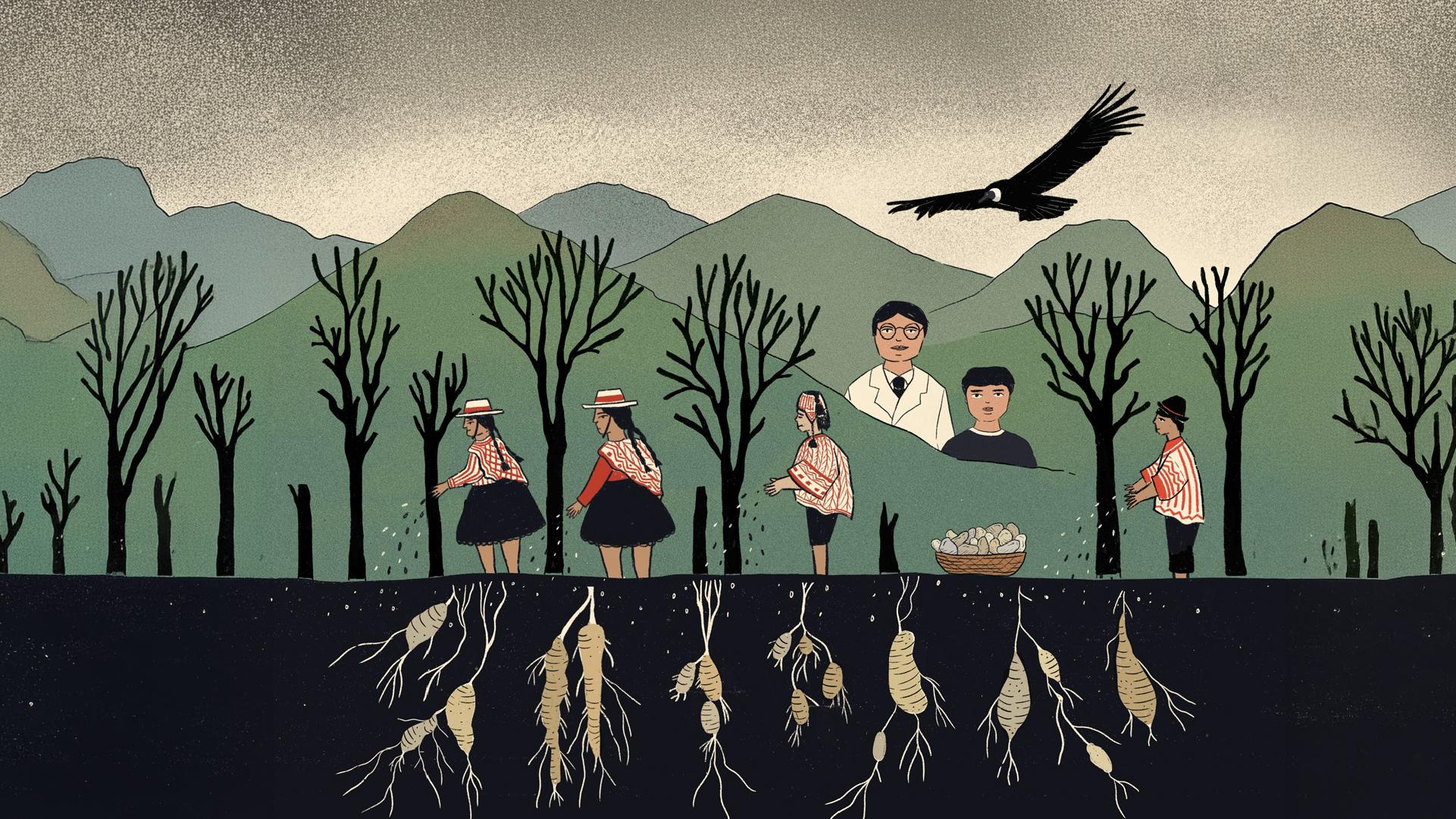
For Julio and his colleagues, the alternative was in the peasants’ traditional agriculture, which had been proven to be remarkably resilient in the face of droughts, humidity and climate variations. Those native varieties needed to be protected. And that’s what they did in Allpachaka. In a kind of large laboratory, they preserved hundreds of seeds and tubers. Because they were also aware of another risk: the Green Revolution could lead to what they called genetic erosion.
[Julio V.]: Genetic erosion is the phenomenon through which varieties, mainly traditional varieties, disappear.
[María Paula R.]: Today, there are hundreds of varieties of native potatoes in Peru. But little by little, they might start to be replaced by commercially more successful potatoes—those that are more uniform in appearance, or taste, or that reach a certain size that people associate with quality. All this leads to the most unique varieties starting to disappear.
[Julio V.]: So without realizing it, they’re losing species that have certain characteristics, that can resist certain diseases, that can resist certain pests.
[María Paula R.]: Or that can withstand a flood, or a drought. And this is dangerous for food security.
[Julio V.]: Because if you don’t have those more rustic varieties that don’t require all those conditions that the modern ones require, well, at any moment there could be a health problem, a food problem.
[María Paula R.]: And in the face of that problem of genetic erosion, the solution was to create seed banks.
The idea is to preserve as many varieties as possible in case climate change, a plague or any other type of catastrophe makes them extinct. This is how large-scale seed banks emerged all over the world. The largest in the world is in the Arctic: the Svalbard Seed Vault, which is like a Noah’s Ark for plant life on the planet. It was built into the side of a mountain on an island halfway between Norway and the North Pole, and there they preserve varieties of crops for possible catastrophes. Today, it has over a million seed samples from almost every country in the world.
And Allpachaka was like that, but on a much smaller scale. Inside the Andean seed bank, behind thick adobe walls, on a cold mountain, the researchers preserved hundreds of seed and tuber varieties in perfect order. They weren’t just keeping them there: they took them out and planted them from time to time to make sure they wouldn’t lose their germination capacity. They also gave seeds to peasants to recover traditional varieties that they had lost during the years of the hacienda, when the powerful families didn’t allow them to work the land as they wanted.
And that’s how things went for years. But in the early 80s, that scenario began to change abruptly. On May 17, 1980, Peru held general elections for the first time in 17 years, after a military dictatorship.
(Archival sound bite)
[Host]: The inhabitants of this town 120 kilometers from Lima are participating in elections for the first time in their lives.
[María Paula R.]: That same night, the day Peru returned to democracy, a Shining Path commando burned ballot boxes and voting records in the town of Chuschi, in Ayacucho. The Shining Path movement wanted to overthrow the government and create a communist state following Maoist thought. For them, democracy was a bourgeois institution. And that was a warning: the armed insurrection had begun.
A few months earlier, Andrés had started high school at an elite school in Lima. But by the end of 1981, due to problems with violence and the economic crisis that Peru was going through, the family had to move to Ayacucho, the region where his father worked. Everyone in the family knew that things there weren’t going well, but when they arrived in the city, Andrés witnessed just how tense things were.
[Andrés V.]: It was 9, 10, maximum 11 o’clock at night and the streets were already empty. Everyone had retired to their homes, doors were closed, and that was very different from Lima, which at that time had an intense nightlife with restaurants, discos, etc.
[María Paula R.]: Life in Ayacucho had already started to change due to the conflict. The curfew began at midnight and many didn’t even wait until then to go home. Julio’s colleagues had already begun to receive threats from Shining Path militants, who went to their offices and gave them condescending lectures. They weren’t taking orders; they were warning them not to get in their way.
[Julio V.]: The situation was getting more and more tense.
[María Paula R.]: At home, the family listened to the news on the radio: Shining Path was planting bombs in the center of Lima, burning ballot boxes in Junín, murdering mayors and local leaders in different cities.
[Julio V.]: That’s where the whole situation starts to get more complicated.
[María Paula R.]: Although Allpachaka hadn’t been directly affected yet, those who worked there knew the guerrillas were getting closer.
While they continued to conduct investigations and teach classes at the university, Sendero members went to Allpachaka more and more frequently to meet with the peasants. Some of them, who had been children during the time of the hacienda, told me they remember growing up seeing those young people with Shining Path arriving at the houses of community members.
[Catalino Ventura]: They approached us, the boys. They spoke to us, they advised us, they gave us advice. Everything was fine, everything, everything was fine, everything was fine.
[María Paula R.]: This is Catalino Ventura, who at that time was a teenager.
[Catalino V.]: That’s how they were winning us over. That’s how they were winning.
[María Paula R.]: The Shining Path members came to the community assemblies at Allpachaka and spoke to the peasants about building a new Peru. They told them that it was necessary to eliminate the old state for everyone to be equal, without differences between the powerful and the workers. For Catalino, who had grown up under the yoke of the landlords, who as a child had been paid with coca leaves and made to work from dawn to dusk, those ideas resonated. But those who presented themselves as liberators also acted as judges and executioners. If they knew someone was against them, they would seek them out and kill them.
And Julio and his colleagues, who had for years opposed the emergence of Sendero at the University of Huamanga, were on that black list.
[Julio V.]: Then rumors came out that such a person is on the list to be executed, you see? And that creates an environment of insecurity, a little bit terrifying, right?
[María Paula R.]: Still, they continued working. During the day they went to the fields in Allpachaka, and at night, back at home, they were subjected to the searches that the police and military were doing all over Ayacucho, searching for suspected Shining Path members. Catalino says he remembers that time as one filled with fear.
[Catalino V.]: We lived really afraid. You can’t sleep with tranquility. You’re sleeping a little. Because suddenly the police arrive. And if you’re not at home, right away… Terrorist. Where is he? Where have they hidden him? There he is. Shoot. They’d kill you directly.
[María Paula R.]: It was a time of tension and uncertainty. Some university professors had already left Ayacucho. But Julio and his family stayed.
On the night of August 2, 1982, Catalino was at his house in Allpachaka. Suddenly, he heard a noise he had become familiar with during those months, like an explosion followed by gunfire in the distance.
[Catalino V.]: Tec, tec, tec. Shots. What’s that?
[María Paula R.]: There had been a bomb. Catalino got up and walked toward the hill where the University was located. Above, on the mountain, some lights were flickering and he could hear those noises.
[Catalino V.]: Terreros were exploding. Because Terreros are dynamite. I can recognize it. I know the detonation of dynamite.
[María Paula R.]: Other peasants from Allpachaka also heard the explosions and saw the lights.
[Catalino V.]: Everyone was scared.
[María Paula R.]: Because they recognized what those sounds meant: Shining Path had attacked them. Catalino says he didn’t sleep much that night. And early the next morning, the peasants went up to see what had happened.
[Catalino V.]: And then we saw that some sheds were burned down. In those little sheds was where they kept the seeds. Completely ruined, everything scattered.
[María Paula R.]: According to historical investigations and journalistic reports from that time, a Shining Path commando group came down from the hills and entered the research site to dynamite and burn some of the university’s installations. They entered all the buildings. The cattle sheds where Julio had told me that, with Swiss financing, they had installed purebred cows and other animals. They released the cows from that shed and shot them dead. According to reports from that time, they killed several dozen animals.
The guerrillas also entered the seed bank and scattered all the seeds and tubers on the ground. They took out the machines they used to process grains and destroyed them. They burned several of the buildings.
That morning, one of those peasants ran down the hill to a police station to report what had happened. And that’s how the news reached Julio’s house. When he arrived at the research site with some of his colleagues, he found everything destroyed.
[Julio V.]: Everything was chaos. The materials scattered, the buildings half-burned. It was chaos, chaos.
[María Paula R.]: And seeing the seed bank destroyed had a special impact on him.
[Julio V.]: So it was seeds, that’s almost like destroying the life of… of communities. And it seemed to me that it went very much against, even, against the Andean way of understanding life.
[María Paula R.]: For Julio and his colleagues, that attack had destroyed a project to which they had dedicated decades of work. And it had destroyed the material basis on which Andean peasants built their livelihoods. The seeds.
[Julio V.]: Because if you destroy a food warehouse, after all, it would last for how long? But if you destroy seeds, it will affect generations and generations to come.
[María Paula R.]: The next day, some journalists went to take photos of Allpachaka. In black and white images from that time, you can see Julio standing among some sacks. In his hands he holds native potatoes and seeds.
[Julio V.]: I don’t know if you’ve seen the photos, but we picked up all of that.
[María Paula R.]: The peasants who worked there, together with Julio and his colleagues, spent days gathering up what they could. Many of the scattered seeds had gotten mixed with the earth or had been stepped on.
[Julio V.]: But well, we gathered up what we could. Not all of it. Some of it, not all of it.
[María Paula R.]: They saved dozens of varieties. But it’s estimated that in that attack, hundreds more were lost.
After that, the work at Allpachaka never really recovered. The buildings remained destroyed for years. The university didn’t have the resources to rebuild them. The peasants continued to farm the land and were still the owners, but the work of the university and its ties with that community weakened. It was no longer the place where Julio imagined Peru’s agricultural future, nor the refuge where he kept all those rescued seeds safe.
A few weeks after the attack, Julio and his family decided to leave Ayacucho. Some professors with whom he had worked had been assassinated. Or they had disappeared. Rumors persisted that he too was on Sendero Luminoso’s blacklist.
[Julio V.]: We could see them at any moment, they came in groups. So the situation was deteriorating.
[María Paula R.]: The family returned to Lima. It was 1982, just two years into the armed conflict, which would extend for two more decades and leave some 70,000 dead, mostly Quechua peasants from rural areas of Peru. Julio didn’t return to work at the University of Huamanga. And he never returned to Allpachaka, nor to see those peasants he had worked with for so many years. But that work had left a mark on him.
[Julio V.]: Those years at Allpachaka shaped me.
[María Paula R.]: I spoke with some of his former students, with colleagues, with community members, and they all coincide in describing him the same way: as an enthusiastic and cheerful professor, but who also gained authority when he spoke seriously. As a researcher who knew how to translate academic knowledge in a way that rural peasants could understand. And as someone who respected traditional knowledge and encouraged his students to respect it too.
[Julio V.]: Normally, the intellectual, when they work in these rural areas, they look down on the peasants. They look down on them. So, what sense does it make, they won’t learn. But if you respect their intelligence, if you respect their ways of seeing the world, they respect you too and they transmit their knowledge to you. And you realize that there’s a wisdom that has been maintained for millennia there.
[María Paula R.]: Julio was one of the pioneers of a branch of thought called agroecology, which not only criticizes the industrialization of agriculture, but proposes learning and rescuing traditional peasant practices, and mixing them with new technologies when they’re appropriate. Although it’s a growing movement in Latin America, in places like Peru and Bolivia, at that time it wasn’t recognized or promoted by governments or most academic circles. It was a marginal vision.
[Julio V.]: People used to say, the kids are crazy. They say that nature has its own knowledge. They’re nuts.
[María Paula R.]: In the late 80s, Julio started teaching classes at another Peruvian university. And there he continued his research on traditional agriculture. He published about the Andean chacra, that form of cultivation that combines varieties of seeds and crops, which he had learned from the peasants during those years at Allpachaka.
Over the years, the family stayed in Lima. Andrés finished high school, then his undergraduate degree in law, and his master’s in intellectual property. He had always been interested in computer science and mathematics, but as time went by, issues related to his father’s work began to interest him more.
[Andrés V.]: And it’s also that we talked a lot. We’d go to conferences, we’d have discussions, and well, yes, I think I ended up absorbing quite a bit of my dad’s knowledge and also his, a bit of his ideology and view of the world. It’s influenced me a lot.
[María Paula R.]: Andrés understood that that scientist he remembered, the same one who took him to the laboratory and asked him questions about chlorophyll after dinner, had become a very different person.
[Andrés V.]: He became a much more spiritual person. When he talked about the Andean worldview, about respect and veneration toward the Apus, the protective mountains, the deities and all that, he didn’t do it in an automatic way, or because he had heard it, but because he was already feeling it.
[María Paula R.]: While Julio was moving away from technical books, Andrés dove headfirst into mountains of scientific studies and research. Fresh out of a master’s degree in Plant Genetics, he ended up in the Bioinformatics unit of the International Potato Center, the CIP, a research center that keeps thousands of varieties of Andean tubers in one of the largest gene banks in the world.
Somehow, it was a monumental version of that small seed bank that his dad created and that Sendero destroyed.
With this work, Andrés began to think about other ways to recover traditional knowledge, different from or complementary to his dad’s.
Thus, during the 90s, their professional paths advanced in parallel but without crossing. This continued until 2003, when Andrés was called to an enormous project to preserve knowledge related to eleven native Andean crops in more than 150 communities in Peru. Six institutions came together, both public and private. One was PRATEC, where Julio worked.
There, Andrés was in charge of monitoring the genetic diversity they were discovering. His work was no longer sitting in front of a computer, but going to the communities and accompanying the collection of seeds and tubers. On those outings, far from the desk, he understood why after joining PRATEC his dad had changed so much.
The thing is, that work was also beginning to transform him.
[Andrés V.]: It was a super enriching experience and it was, let’s say, my first and greatest approach to what traditional knowledge is…
It was another, another way of seeing life, another way of conceiving life, another type of relationships very different from what one can see in the city.
[María Paula R.]: For three years, Andrés and his dad worked together. They traveled through Ayacucho, Cajamarca and Puno, sat in the same office, and attended the same meetings. Until in 2006, Andrés received a call with an unexpected job offer.
He took it as just another work challenge, but for his dad, it was a clear sign of the destiny that the Apus, the deities of the mountains, had prepared for Andrés.
[Andrés V.]: My dad always told me, he always says, even now, that the Apus knew what they were doing when you entered the CIP and to work at PRATEC because they were preparing you for your current work.
[María Paula R.]: A strange job in a unique office in the world. Now he would be in charge of defending traditional Andean knowledge and Peruvian genetic resources, just as his dad had always done. But in his case, against a global and much more sophisticated threat: the biopirates.
[Daniel A.]: A pause and we’ll be back.
[Daniel A.]: We’re back on Radio Ambulante. Here’s María Paula.
[María Paula R.]: That job that Julio believed the Apus had prepared Andrés for was a position at the Peruvian Commission Against Biopiracy. It had been created a few years earlier, in 2004, when Peru launched law 28.216 that protects Peruvian biological diversity and the collective knowledge of the country’s indigenous peoples.
Since then, Andrés is one of the three biopirate hunters that exist in the world. The other two are his colleagues at the Commission. The thing is Peru is the only country that has an institution of this type.
There’s no eye patch, no peg leg. A biopirate is much more discreet.
[Andrés V.]: A biopirate is precisely someone who tries to appropriate something that doesn’t belong to them. Related to plants, animals and traditional knowledge.
[María Paula R.]: By law, in Peru any scientist or company that wants to exploit and sell Peruvian species must ask permission from the government and the communities and share the benefits with them. One form of biopiracy is to skip that rule and simply collect seeds and plants for economic purposes without asking permission.
A concrete example of this is maca.
[María Paula R.]: This root, which looks like a wrinkled radish, is known as “natural Viagra” for its fertility-stimulating properties. Although indigenous communities in Junín have used its root for aphrodisiac purposes and for memory for at least 2000 years, in the nineties international interest in the plant emerged. In fact, it was several patents on maca, including the one granted to a company called PureWorld Botanicals in 1999, that drove the creation of the Commission Against Biopiracy in Peru.
The appetite for maca continued to grow and reached its peak between 2013 and 2014. At that time, legions of Chinese businessmen arrived at the Bombón plateau in central Peru, and took away roots, seeds and even soil that they loaded into trucks. They paid in cash at exorbitant prices. And today, the Chinese province of Yunnan replaced the Peruvian province of Junín as the world’s largest producer of maca.
The second form of biopiracy is when someone claims traditional knowledge as their own before patent offices. It’s a bit complicated so to explain it, Andrés gives an example.
[Andrés V.]: Imagine that a person X is walking through the countryside and gets a cramp, sits down, cramped and a peasant comes and tells him “look, you know for that cramp, drink this little juice from this little plant x.” The man drinks it and it actually cures his cramp. So the man says “aha, this could be a very good business.” So I’m going to patent this little juice that the lady gave me.
[María Paula R.]: And it’s precisely when they request the patent, that Andrés and his colleagues have the opportunity to, in quotes, start their hunt. Around the world, those seeking patents are obligated to publish their applications, so that a third party can give their opinion, or even oppose.
And well, in this case, that third party is Andrés. Every day he sits at his computer and digs through, one by one, patent applications for new discoveries at intellectual property offices around the world. He doesn’t search blindly: his team has a list of 276 endemic species from Peru that are their priority.
[Andrés V.]: We look for those that are using these resources or are based on these resources. And when we identify them, we proceed to analyze whether they’re potentially using traditional knowledge.
[María Paula R.]: And if so, to oppose, they develop a technical document that demonstrates that the application lacks both inventive level and novelty, two of the key requirements for granting a patent. Then, the Peruvian embassy sends this document to the intellectual property office of the country where the patent is requested, which decides whether it is approved or denied.
[Andrés V.]: To date we’ve managed to identify 473 cases of biopiracy in the patent system, of which 170 have been resolved favorably. Now, there are cases that have been resolved in a month and there are cases that have been resolved in seven years.
[María Paula R.]: He’s fought companies from four continents.
On 87 occasions, it was against companies wanting to patent the use of sap from the Dragon’s Blood tree, a resin used as a liquid bandage because it helps heal wounds. In 2006, after discovering some applications at Japan’s patent office, he began a fight to protect the juicy red berries of camu camu, an Amazonian fruit that is part of the diet of many indigenous communities in the region. The applications sought to patent an antioxidant from the fruit, without specifying which one. But the analysis showed that the most abundant antioxidant in camu camu was “ascorbic acid”: in other words, vitamin C. Absurd.
But perhaps the most representative case for Andrés is that of Sacha Inchi, a tree that grows throughout the Amazon rainforest, but whose greatest genetic diversity is in Peru. The seeds of this plant have lots of fatty acids and that’s why Chayahuita, Bora and Huitoto women use them to make a moisturizing cream. Andrés discovered that two French companies wanted the patent on those seeds for cosmetic purposes. The Commission warned that they shouldn’t be granted.
[Andrés V.]: Basically because they were based on traditional knowledge of indigenous peoples.
[María Paula R.]: One of the companies withdrew the application. The other went ahead and the French patent office did grant it to them. The Commission began calling journalists and activists. The case resonated in France, where, thanks to an NGO in that country, it reached the front pages of newspapers.
[Andrés V.]: It came out in Le Monde newspaper, in various publications and the first International Meeting Against Biopiracy was also organized in France.
[María Paula R.]: Andrés attended the meeting, which was held in a room of the French Congress.
[Andrés V.]: And the first thing that caught my attention when I arrived was that there was a lot of press, television cameras, equipment, um, people recording, taking photos. It would be a room for maybe 100 people, maybe a little more. And it was completely full. That’s when I realized the magnitude of the event.
[María Paula R.]: Besides Andrés, activists and peasants from Ecuador, from Guyana and from some African countries spoke about biopiracy cases that had occurred in their countries.
[Andrés V.]: A week passed, I think, or two weeks maximum, and the company that had this patent sent a communication to the Embassy of Peru in France informing them that they were withdrawing their patent.
It was very, very gratifying. Well, it wasn’t a… A special joy, it’s an achievement. Yeah, it was more or less like scoring a goal in the World Cup.
[María Paula R.]: In 2014, the Nagoya Protocol came into force, which is an international agreement, now ratified by 142 countries and which, among other things, establishes that the use of genetic resources must benefit both countries and researchers as well as communities of origin.
But despite this type of agreement, today the fight against biopiracy faces new challenges, specific to technological advances: and it’s that now scientists can decipher the genetic code of hundreds of thousands of species and share them in enormous virtual libraries. If before biopirates had to go collect a physical plant to extract its compounds, today they can simply create those same compounds synthetically using these databases.
Since Andrés began his work against biopiracy, Julio has always insisted on one issue: that he never forget that these genetic codes wouldn’t exist without centuries of work by indigenous communities.
He says look, we wouldn’t have these resources if they hadn’t been raised with great care by the peasants. So that always has to, has to be highlighted, it’s not just like that. It’s not that the resources are just there and that’s it. No, they’ve been raised with great care by native indigenous peasants and we have them to this day for that reason.
[María Paula R.]: The thing is, Julio, who closely follows his son’s work, believes that today debates around biodiversity only focus on economic value.
[Julio V.]: Now everyone is obsessed with defending traditional knowledge, linked to those plants that have economic value, either because they’re food for exclusive people or because they have active principles that can be used in the big pharmaceutical industries…
[María Paula R.]: But recognizing only that, Julio says, isn’t enough.
[Julio V.]: We also have to take care of the diversity of knowledge, of nurturing. And those who have this nurturing knowledge are the peasants. So, we have to take care of the peasants too.
[María Paula R.]: Those peasants of today, descendants of the peasants that Julio worked with some decades ago. The ones he approached to help and from whom, in the end, he ended up learning.
[Daniel A.]: María Paula Rubiano is an environmental journalist and lives in Medellín. This story was edited by Camila Segura, Emilia Erbetta and me. Bruno Scelza did the fact checking. Sound design and music are by Andrés Azpiri.
The rest of the Radio Ambulante team includes Paola Alean, Adriana Bernal, Aneris Casassus, Diego Corzo, Camilo Jiménez Santofimio, Germán Montoya, Sara Selva Ortiz, Samantha Proaño, Natalia Ramírez, Juan Pablo Santos, David Trujillo, Elsa Liliana Ulloa, Luis Fernando Vargas y Mariana Zúñiga.
Carolina Guerrero is the CEO.
Radio Ambulante is a podcast by Radio Ambulante Estudios, produced and mixed in the Hindenburg PRO program.
If you liked this episode and want us to continue doing independent journalism about Latin America, support us through Deambulantes, our membership program. Visit radioambulante.org/donar and help us continue narrating the region.
Radio Ambulante tells the stories of Latin America. I’m Daniel Alarcón. Thanks for listening.