
The Podium | Translation
Share:
► Click here to return to the episode official page, or here to see all the episodes.
♥ We live in difficult times. We are a non-profit media, and our permanence depends on listeners like you. If you value our work, join Deambulantes, our membership. Help us elevate Latino voices and tell the story of our communities. Your contribution is directly invested in our journalistic work and makes all the difference.
►Do you listen Radio Ambulante to improve your Spanish? We have something extra for you: try our app, designed for Spanish learners who want to study with our episodes.
This podcast is the property of Radio Ambulante Studios. Any copy, distribution, or adaptation is expressly prohibited without prior authorization.
The following English translation was generated with the assistance of artificial intelligence.
[Daniel]: Before we begin, some news I’ve been wanting to share with you for a while: this Thursday, April 9th, the new series from Central, the series channel from Radio Ambulante Studios, comes out. The story takes us straight into New York’s late-night party scene, but also into its most compassionate and courageous side. “Las Reinas de Queens” follows a group of trans women, all Latina immigrants, who make a living as sex workers and performers in the city’s clubs. It’s a fascinating, irreverent, and proud story. You can listen to it starting Thursday at centralpodcast.audio, or on whatever app you use to listen to your podcasts. Here’s a little preview:
[Rula Ávila Muñoz]: In New York, Lorena Borjas protected Latinas who have learned to survive three times over: as trans women, as immigrants, and as sex workers.
[Lorena Borjas]: I’m going to get wherever I need to get like a dog in a fight, clawing and scratching my way there.
[Rula]: But when she died, a fourth battle began: to thrive in a world full of threats. Listen to Central, “Las Reinas de Queens,” on the iHeartRadio app, Apple Podcasts, or wherever you listen to your podcasts.
[Daniel Alarcón]: This is Radio Ambulante, I’m Daniel Alarcón.
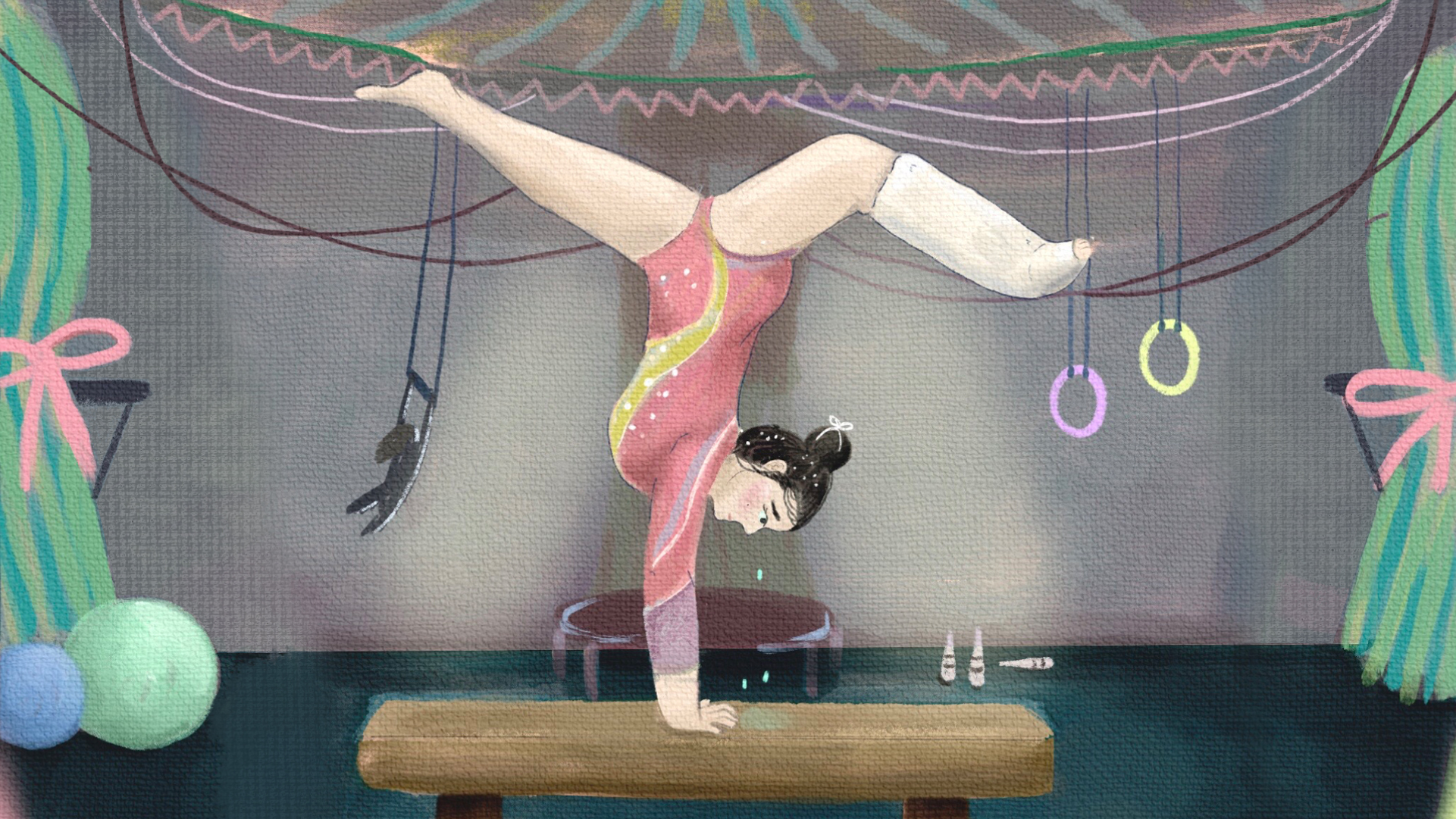
Today’s story begins in a gymnasium in Buenos Aires, Argentina. There are beams, parallel bars, vaulting boxes. Everywhere there are traces of magnesium, that white powder that gymnasts put on their hands to prevent moisture and improve grip on the apparatus. It’s a powder that dries the skin and even the environment, and that Gabriela Parigi, the protagonist of our story, could distinguish from several meters away.
Gabriela has spent much of her life inside a gymnasium. At four years old, after taking some dance classes, her parents were recommended to take her to artistic gymnastics instead. She had too much explosive energy.
[Gabriela Parigi]: I was this tiny, strong thing, with little pony legs all muscular. My whole bearing was already like a mini gymnast. So clearly there was some super clear energy there that needed to do more of the sport of artistic gymnastics.
[Daniel]: Instead of climbing on the furniture in her house, now she had a place to go do her acrobatics. And she loved it. A few months after starting, she was already preparing for her first presentation. A floor routine that she had practiced over and over but completely forgot minutes before going on stage.
[Gabriela]: But nobody found out because I made it all up, and I remember the dances I did. I was doing these waves to the sides, like choreographic movements.
[Daniel]: She remembers and laughs. Because she was having fun. For her, everything was a game. This is Claudia, her mother:
[Claudia]: So that was Gaby. Gaby enjoyed what she did. She didn’t back down and understood that it was also a game and also her way of expressing herself.
[Daniel]: At six years old, Gabriela already began to compete officially. And by seven, she got second place in a tournament, her first podium. She was wearing a leotard, her hair in a bun, her face made up.
[Gabriela]: I went up to the podium with a teddy bear. With a little dog I had named Charlie. And yes, I remember this feeling of, oh well, I did well, I got on a podium, I’m good at this. I mean, also like a feeling of certain expectation around me.
[Daniel]: An expectation that came, more than anything, from her coaches, who already saw her as a promising talent in artistic gymnastics. So they proposed to her parents that she start training double shifts: in the morning and in the evening. In the afternoon, in between, she would go to school. Like this every day of the week, including Saturdays and holidays. The only rest day would be Sunday. Little by little, Gabriela’s entire life and that of her family would start to revolve around gymnastics.
[Claudia]: Her food, her sleeping schedule, her waking schedule, her school schedule, whether she could go to a birthday party or not, whether she could go on vacation or not, how she dressed. The central world was gymnastics, and all its constellations revolved around it because it was the axis that disciplined everything else.
[Daniel]: When at 12 years old Gabriela was already part of the Argentine national team, her mother confirmed that all the effort was worth it.
[Claudia]: This seemed like a serious thing. And how were we going to waste such talent that we had in the family? That’s how it was seen.
[Daniel]: From then on, every step Gabriela took would be in the direction of a single goal: preparing for the next tournament. And on that path, Gabriela would have to give up many things, even what had brought her there in the first place.
[Gabriela]: This feeling of, well, enjoyment, play, something that burst out of my body, I feel something like that, and at some point starting to realize […] that there was something about the game that was no longer driving me, that it had begun to transform into something else.
[Daniel]: Our producer Aneris Casassus produced this story. Here’s Aneris.
[Aneris Casassus]: In her long days at the gym, Gabriela was beginning to feel that the pressure was winning over play. It’s not that she always had a bad time. No. She loved gymnastics. But the training was getting tougher and tougher. In many ways.
[Gabriela]: Ways they talked to us. Look, I’ll tell you a bit, it still upsets me, you know, like literal phrases they’d say to us, “come on, fatty, come on, are you retarded or what?” I mean.
[Aneris]: They didn’t explicitly tell her not to tell anyone, but she, like her teammates, knew there were things better left unsaid.
[Gabriela]: There were some things that I understood as, well, legitimized or normalized, that high performance sport was like that and that gymnastics was like that.
[Aneris]: If she wanted to be an elite athlete, she had to endure anything. Including pain. Or especially pain. That would make her, in quotation marks, “strong.”
[Gabriela]: Having them make you do splits for five minutes and sitting on top of you to spread your legs wider and you holding back tears or not, or crying while you keep doing it like some militarized thing.
[Aneris]: These types of situations were repeated frequently. But there is one particular day that was marked in her memory forever. Because it was, perhaps, the only day she didn’t stay quiet. She had just returned from vacation. She was in the gym trying to get back into the training rhythm, practicing on the parallel bars.
[Gabriela]: I was very tired. I remember my body was trembling, I mean, I was like reaching a limit that I identified that no, that I was kind of past it. And I told my coach that I couldn’t, that I couldn’t do any more, that my hands were hurting a lot, that I had all my hands open with blood blisters. I mean, it was literally there on my body. And my coach then told me, well, don’t do more parallel bars, go climb the rope then. And climbing the rope is much more painful on the hands than doing parallel bars.
[Aneris]: And not only that. Climbing the rope inside the gym was seen as a sign of punishment.
[Gabriela]: At some point, tacitly what I felt was like, oh, you rebel, well, look, if you rebel this happens. Like something of a psychological maneuver.
[Aneris]: But Gabriela didn’t say anything more at that moment. She did what the coach ordered and finished the morning shift, in extreme pain. When she left the gym, her dad was waiting for her in the car.
[Gabriela]: And well, he sees me getting in and that I was upset, but it’s not the first thing I told him, you know? As if he had to ask me, and he asks me: “And Chuchi, how did it go?”
[Aneris]: Gabriela started telling him about the colors she had received that day in each of the apparatus. In parallel bars, she had gotten red, the worst possible score, a grade she never received.
[Gabriela]: And when I tell him red, he says, “Oh, what happened?” And I start crying and get upset and well, I tell him this whole situation. And my dad stayed perplexed, silent. And well, we arrive home and he locks himself in an office we had at home, and there I hear him calling my coach on the phone. And he says, And I remember these phrases like “You’re crazy, how are you going to do that to the girl? But you’re insane. She’s a child. You’re a Nazi. You’re an animal Nazi, son of a bitch. What you did.” Umm and I was like saying I have to go back to train this afternoon and at the same time thank you for doing this, I mean, I say.
[Aneris]: Despite the situation, no one at home doubted that Gabriela would go back to train that afternoon. This is Claudia, her mother, again.
[Claudia]: We accepted that mistreatment. Crying and chewing on anger, but not abandoning. We got into a flowing river and the water carried us away.
[Gabriela]: It wasn’t obvious to kick over the board and leave. Not for them. I mean, proposing that to me out of nowhere, even less for me, with all the bombastic speeches they built for you like, no, but what about the future, and representing the flag. And Argentina. And the country. And the nation. And the pride.
[Aneris]: It was an entire life project that had been forming for years, with enormous sacrifice. So no, they had to continue.
That same afternoon, Gabriela returned to the gym and kept going as always, eight hours a day. But she did notice a change since her father called one of her coaches. They no longer punished her by making her climb the rope; however, there was something more subtle that was still there.
[Gabriela]: The metaphor of pushing past the limit and pushing and becoming strong. And these extremes were there all the time.
[Aneris]: The message permeated Gabriela’s mind, and thus becoming strong she reached the South American Games, the Pan American Games, the World Championships… And dozens of tournaments inside and outside the country. She was just a 12-year-old girl, but on television, they were already asking her about her retirement… It’s known that a gymnast’s career is short. Too short.
(Archive soundbite)
[Journalist]: What’s your goal after gymnastics?
[Gabriela]: Well, for now I’m preparing for the Olympics. I don’t know when I’ll quit, at what age, I’m not thinking about that yet. There will come a point where, well, my body will tell me no, that it doesn’t want any more, and well, after that I don’t know, start a family.
[Aneris]: Seeing that video, almost 30 years later, Claudia can’t believe it.
[Claudia]: How is a little girl’s body going to say enough?
[Claudia]: After that, she started getting injured. The translation of that hyper-demand was a sequence of injuries.
[Aneris]: There were many. But the worst, perhaps, was when she was 15 years old. Gabriela was preparing for a new tournament. She was practicing a jump and had just finished the last repetition she would do that day.
[Gabriela]: I landed standing and I landed well. I take a step, and when I take the step, my foot kind of gets stuck with the mat, and I hear crack, crack, crack. I mean, like in three phases. And then I grab my ankle, and I realize that something had exploded inside.
[Aneris]: She had a triple ankle fracture.
[Gabriela]: And the first feeling is that all that mega effort and mega training and focus and objectives and everything was vanishing, falling in an instant, falling, collapsing. So it was a feeling of very, very strong restlessness. And also something of a social narrative, because, oh, I’m not going to make it to that tournament. So someone else will go. So I lose my space, I lose my place. I mean, not thinking about my body, not listening to it, but what it meant in terms of results, triumph, reaching that place. And once that moment passed, I don’t know, the next day or so, the feeling was one of relief, it was a small lapse of, well, no, I don’t know, like some of the pressure was being released a bit, and it’s crazy to feel that because at the same time I was broken.
[Aneris]: But broken and all, she still had to go to the gym to continue with her physical preparation. That time, she spent several weeks in a cast and rehabilitation.
[Claudia]: I think it’s crazy not to have allowed her to be injured at home, but I didn’t see it at that time either.
[Claudia]: And at the same time, it made me run in search of magical, impossible, and non existent solutions because she generally always had a commitment ahead that she had to fulfill, and so, as it was an obstacle course, if you didn’t overcome that obstacle, you were left behind.
[Gabriela]: My parents trusted what the doctor said. Trusted what the coach said or what the manager said.
[Aneris]: And everyone said that, one way or another, she had to make it to the next competition… no matter which one.
[Daniel]: A pause and we’ll be back.
[Daniel]: We’re back on Radio Ambulante, Aneris Casassus continues to tell us.
[Aneris]: A while after recovering from that injury, Gabriela decided to change coaches. She felt she had reached a ceiling and needed a new work plan. She was 16 years old and had little time left in high-performance competitions.
[Gabriela]: Around my 18th, I visualized myself ending my career because at some point I was already getting old for what archetypally at that time were artistic gymnastics careers.
[Aneris]: She wanted to retire through the “big door,” the one they had talked about so many times. So she set a goal for two years: to prepare for the Pan American Games in Santo Domingo, Dominican Republic, and for the World Championships in Anaheim, United States. Both in 2003.
Throughout her career, food had always been an issue. Gabriela knew it as soon as she started, when one of her coaches called out her and her mother for bringing chocolate cookies for snack. So from that moment on, she knew by heart what things she could eat and what things she couldn’t.
But with the change of coaches, everything got worse. As the date of the tournaments approached, they began demanding that she lose 100 grams per day. So every time she got on the scale…
[Gabriela]: I’d take the hair clips out of my head, cut my nails. I mean, like this extreme thing of, I don’t know, if I could have taken out my teeth. I’d take out my teeth. I mean…
[Aneris]: Basically, she stopped eating. Or she would binge and then vomit in secret. And this way, she lost nine kilos in two months.
[Gabriela]: But my narrative was that I looked divine, I was thin, I looked pretty, I was desirable, I was strong, powerful. But my body was telling me that I had cramps. I mean, I was having cramps.
[Aneris]: There came a time when, for her mother, it was obvious what was happening to her daughter. So she took her to a nutritionist.
[Claudia]: She said to me, “But what do you want to do with this girl? Make her anorexic?” And that was the first time I realized that this sick environment was making us all sick, I, no…
[Aneris]: But nothing was going to alter Gabriela’s plans. Dragging along her eating problems, she continued training for those two tournaments. They would be the final wave of her career. When the date arrived, she traveled, competed, and performed. She achieved very good scores, and with that, she officially said goodbye to high-performance competitions. She was 17 years old, had 64 medals, 25 trophies, and more than 20 injuries.
She felt that with all her experience, she had to do something. She decided to study to become a coach… She wanted to change things.
[Gabriela]: And also something like a sense of justice, you know? Like saying, well, this is important that working with children be done this way, not that other way as I experienced it.
[Aneris]: It was a way of not leaving the gym but inhabiting it from another place. She joined a team of coaches to train girls between 9 and 13 years old. She was enthusiastic, felt there were many things to improve.
[Gabriela]: I get happy because I feel there are many things I’m doing differently in terms that have more to do with, like the treatment, with not mistreating or abusing.
[Aneris]: She coached the girls for almost a year and a half. Until one day, something inside her completely broke.
[Gabriela]: And I remember the day I went into crisis, it was a girl I was training who was suffering a lot, a lot of back pain from significant injuries. I remember like seeing her up on the beam and understanding the pain this kid was having in her back.
[Aneris]: It was as if only at that moment, seeing the suffering of that child, she became aware of the demands she had subjected her own body to throughout her life. What until that moment she had accepted naturally, now, from another angle, became impossible to bear.
[Gabriela]: At some point, it was like my child and my recent gymnast saying no, no, no, she has to stop, we have to get her off the beam right now and take her home. I mean, she has to stop.
[Aneris]: But for the coaching team she was part of, stopping was not an option. What mattered to them was something else.
[Gabriela]: How are we going to get her to the tournament? That’s the north. And that’s the why. And that’s the goal. Everything else adjusts around that.
[Aneris]: This way, with that same method, she had achieved all her medals. And yet now she couldn’t find any meaning in it. All those medals, at what cost? All those medals, for what?
[Gabriela]: When I understood that what I actually disagreed with was encouraging children to compete and that being the framework that orders everything around it, I said, no, but I can’t have a dialogue with anything else here. If this is what I disagree with, if it’s with the backbone of the issue, I have to withdraw.
[Aneris]: Her mother remembers that stage very well.
[Claudia]: She experienced it with a lot of suffering, I think, because she thought she was going to revolutionize the world of coaching with her ideas, and she realized that alone she… couldn’t.
[Aneris]: So after that day when she went into crisis, Gabriela started going less and less to the gym, until one day she didn’t return…
[Gabriela]: And I feel it was like a sunset. I mean, like at some point. Tick, tick, tick. Like gradually, less and less. Less and less. Less and less. And I don’t remember, I get goosebumps. I mean, I don’t remember the last day.
[Aneris]: The last day she went to the gym. The first day of mourning.
[Gabriela]: And that was the hardest part of all. Like identity mourning.
Because leaving the gym made me happy. Now, no longer being the gymnast was very painful, because I was the gymnast for my teammates, for my family, and I occupied that role in society.
[Aneris]: That’s how it had been throughout her life. Every time there was an event at school, they asked her to do a choreography… At any family gathering, too. 16 years where everything had been gymnastics.
[Claudia]: And Gabi was a gymnast. After that, she was a person.
[Daniel]: And that person, who was she?
She would have to begin a journey to find out.
A pause and we’ll be right back…
[Daniel]: We’re back on Radio Ambulante, Aneris Casassus continues to tell us.
[Aneris]: Gabriela’s life had always revolved around gymnastics, and now, without even continuing as a coach, she felt lost, not really knowing where to put her time and energy. She wanted to try new things, think about what she would like to do. She signed up for tango classes and began studying architecture at the university. She loved drawing. As a child, on Sundays—the only day she didn’t train—she would spend her time drawing. She could spend hours and hours among papers and colored pencils.
[Gabriela]: It was like, oh, look at all this, what I had inside. And what happens is that I didn’t have time, there was no enablement, there was no space.
[Aneris]: Her mother could also perceive what she was going through.
[Claudia]: It was taking the lid off the pot, right? so that… so that all the pressure inside could come out and find what she wanted to do, where she wanted to do it. And that was the beginning of a path because she didn’t stay there either.
[Aneris]: A path that would not be easy for her at all. Especially for one particular reason: everything she started, she did with a single logic.
[Gabriela]: My drawings were unbearably perfect, I mean, everything with a high-performance sport degree that was unsustainable. And so, I finished.
[Aneris]: By the end of that year, she began having panic attacks and anxiety. So she decided to start therapy. Throughout her gymnast career, she had never given much importance to her mental health. Neither she nor anyone in her environment. It was something that wasn’t discussed much. Confronting herself was a complete novelty.
[Gabriela]: That year was a year of a lot of pain, a lot of learning, but also a lot of health at the same time, you know? I mean, I opened the floodgates to, well, emotions, sensitivity, the unspoken, the hidden.
[Aneris]: She was finally working on her eating problems and putting into perspective everything she had lived through. All those things she had kept quiet and normalized for so long, she could now put into words. First in therapy and then with her parents. She started talking, for example, about the fear she had often felt doing a jump…
[Gabriela]: I mean, it wasn’t fear of doing poorly in the tournament or that the movement would look ugly. I mean, it was a fear of breaking my head.
[Claudia]: She never communicated her fear of death, which she talks about now. Never ever. To me, that’s something that gives me chills. I don’t have it incorporated like it could have happened to Gaby.
[Claudia]: I fought for a long time against guilt, and in that too, Gaby helped me understand that it’s not our fault, that we were part of a scheme in which we didn’t have other tools to have done it better.
[Aneris]: Gabriela didn’t feel angry with them; she understood them. Her own parents and also many other parents she had crossed paths with over all those years…
[Gabriela]: And those mothers and fathers? I mean, some are super harassing, and there are others who aren’t, and who for the first time in their lives have a child with athletic talent.
[Aneris]: But nobody teaches them how to deal with that. They don’t know the best way to care for them in that environment. And besides, most parents almost never enter the gym. The coaches’ rule is that the farther away they are… the better.
In the midst of this whole process between therapy, architecture, and tango Gabriela also arrived at a circus school. She signed up to take acrobatics classes. She thought that resuming movement, in another environment, could be interesting. The first day she introduced herself with her name and didn’t say much more…
[Gerardo Hochman]: But I immediately realized she was a gymnast by her physical biotype, by her energy, by her way of moving.
[Aneris]: He is Gerardo Hochman, the director of the circus school at that time and also the acrobatics teacher. The classes at the school were group-based, but Gerardo worked with each student differently, according to their needs. From the start, he understood what Gabriela’s first challenge would be.
[Gerardo]: She also at that moment faced this creative issue of not having a model, not of not having a routine to repeat, but something to invent.
[Aneris]: The capacity for improvisation that came naturally to her at four years old, she had completely lost after so many years of being encased in the rigid and precise movements of artistic gymnastics. So Gerardo began working on that, proposing exercises that would take her out of the box. And it worked…
[Gabriela]: There, to some extent, my little gymnast Gabi also began to dialogue, you know, this that I was telling you about the exhibitions, the improvisations, what I played with.
[Aneris]: At 20 years old, Gabriela was playing again. Playing using her body.
Gerardo remembers that sometimes he would make corrections so that the movements would be easier…
[Gerardo]: And she would be surprised, right? Saying ah, how easy or how enjoyable, and it doesn’t require that maximum muscular effort, right? Finding some of that, some ways of behaving physically that are kinder to the body and that make, well, a body that came very trained and also very battered, let’s say, find another enjoyment, another pleasure in doing it and a softer way.
[Aneris]: Gabriela appreciated it because, by that point, she already had something clear.
[Gabriela]: Besides the competitive spirit, I wanted to leave behind the sensation of physical risk, injury, and life or death.
[Aneris]: In this new stage, Gabriela could choose. She avoided the scale or the trampoline, for example. Any exercise that would compromise her body. She preferred floor acrobatics where she could combine all her bodily language with dance and theater. And so, very soon, the circus would become for Gabriela a kind of laboratory. The laboratory to build her new identity.
[Gabriela]: The type of education I had in gymnastics, always that feedback of good, bad, this, that, thin, fat, neat, messy, was something that someone else told you. It wasn’t a self-perception. I began to build that self-perception in the circus.
I started to feel that no, that on the contrary. You had to be a bit like weird, be freaky, be like a bit outside the system, you know? In that sense, like well, you have a big back, show your big back, you have those curls or whatever, let them loose, use them.
[Aneris]: She no longer had to wear her hair pulled tight in a bun as she had done for almost her entire life.
For Gabriela, it was all too different from what she was used to; she had to completely change the logic that dominated her mind. A logic that her mother also knew very well.
[Claudia]: You have to think that in gymnastics, at that time, especially the scoring is about errors. I mean, they start from ten and deduct for errors. They’re constantly looking to see what mistakes you make.
[Aneris]: In the circus, on the other hand, achievements were celebrated.
[Gerardo]: Once you enter an artistic family, inside there’s no competition, there’s solidarity.
[Aneris]: A solidarity she had never felt before. That’s why she stayed there full time.
It was like regaining a lost childhood. She left architecture, started participating in shows with her colleagues, and enrolled in the professional circus arts training that the school offered. And for everyone around her, it was clear that she was now different.
[Claudia]: All her creativity poured in there. She was happy as could be, happy.
[Gerardo]: I get the feeling that Gaby refounded herself, that she reset herself.
[Aneris]: Without knowing it, Gabriela had found in Gerardo the best possible teacher to accompany her process. He too had a past as a professional athlete. From his childhood and for 20 years, he had played volleyball and was very good. But one day he rejected the national team to dedicate himself to art.
[Gerardo]: At some point, I realized I didn’t want to compete. Like I didn’t want to beat anyone, and so I stopped being an athlete. It wasn’t like it was a revelation from one day to the next, but it was a process in which I gradually realized that I didn’t want to beat anyone.
[Aneris]: Something similar to what Gabriela felt when she saw the girl on the beam. Gerardo could clearly understand what she was going through.
[Gerardo]: Yes, I remember having told her at some point that she had to stop being an ex-gymnast, with all the weight that the word ex carries, more than the word gymnast, right? Of being an ex-someone and starting to assume herself as a present acrobat.
[Aneris]: It wasn’t about denying the past, but learning from it. Taking what served her and leaving behind what she no longer wanted for her life. Understanding, also, that there can be many things that define our identity. And that an identity is defined each day, with what we do, and it changes, it always changes. And that was okay.
[Gabriela]: There was also something that I ended up like healing a lot about my body in the circus environment. Within that world, I quickly had a singular place in that ecosystem. It was a place where I found a lot of identity. I went from being a gymnast to an acrobat.
[Aneris]: And she would no longer have any tournament to reach.
[Daniel]: Gabriela wrote and stars in “Consagrada” (Consecrated), a biographical play where she narrates her experience in high-competition gymnastics. She got to present it at the National Center for High Performance Sports in Argentina, where athletes from all over the country train. The same place where every day they weighed her to see if she had lost 100 grams.
Aneris Casassus is a producer at Radio Ambulante and lives in Buenos Aires.
This episode was edited by Camila Segura and by me. Bruno Scelza did the fact-checking. The music and sound design are by Andrés Azpiri.
The rest of the Radio Ambulante team includes Paola Alean, Adriana Bernal, Diego Corzo, Emilia Erbetta, Camilo Jiménez Santofimio, Germán Montoya, Sara Selva Ortiz, Samantha Proaño, Natalia Ramírez, Juan Pablo Santos, David Trujillo, Elsa Liliana Ulloa, Luis Fernando Vargas y Mariana Zuñiga.
Carolina Guerrero is the CEO.
Radio Ambulante is a podcast from Radio Ambulante Estudios, produced and mixed using the Hindenburg PRO program.
If you liked this episode and want us to continue doing independent journalism about Latin America, support us through Deambulantes, our membership program. Visit radioambulante.org/donar and help us continue narrating the region.
Radio Ambulante tells the stories of Latin America. I’m Daniel Alarcón. Thanks for listening.