
Birth Certificate | Translation
Share:
► Click here to return to the episode official page, or here to see all the episodes.
♥ We live in difficult times. We are a non-profit media, and our permanence depends on listeners like you. If you value our work, join Deambulantes, our membership. Help us elevate Latino voices and tell the story of our communities. Your contribution is directly invested in our journalistic work and makes all the difference.
►Do you listen Radio Ambulante to improve your Spanish? We have something extra for you: try our app, designed for Spanish learners who want to study with our episodes.
This podcast is the property of Radio Ambulante Studios. Any copy, distribution, or adaptation is expressly prohibited without prior authorization.
The following English translation was generated with the assistance of artificial intelligence.
This is Radio Ambulante, I’m Daniel Alarcón.
Daniel is the name my parents gave me when I was born in Lima in March of 1977. I know a few things about that day: that it was a cloudy Saturday, and I was born by C-section at 8 in the morning. That I inherited my mom’s wavy hair. And my dad’s nose.
These simple, ordinary details are already part of my story, and in some sense, part of what I’ve always considered my identity. Something I never questioned, that I never had doubts about. But even though the story we’re bringing you today isn’t about me, or about my birth, it has made me wonder what it would be like to know nothing about my origins… what the impact would be of having the first moments of your own story be so blurry.
Today: how a group of people turned the search for those simple details into the mission of their lives.
We go to Argentina, and Emilia Erbetta tells us the story.
[Emilia Erbetta]: In January of 2026, Mónica Snaidman welcomed me into her home. And when I turned on the recorder and asked her to introduce herself…
[Mónica Snaidman]: Well. My name is Mónica… Was I born? No, sorry. Can I start over?
[Emilia E.]: Mónica doesn’t know exactly what day she was born. Her birth certificate says it was February 2, 1967, but she’s no longer so sure that’s actually her birthday. It’s not a doubt that’s only recently appeared — quite the opposite: the question of her origin has followed her since she was very young, since age five, when she started to notice she didn’t look much like her parents. Her mother, for example, was very, very fair-skinned, while she had darker, olive skin. Her father was dark-skinned, but when Mónica compared him to the parents of other kids her age, he seemed too old.
[Mónica S.]: I always felt like they were much older parents compared to my classmates. I also felt like I didn’t fit in. There was something that didn’t add up, and I started asking, all the time…
[Emilia E.]: With that insistence kids have. But her parents’ answers didn’t satisfy her…
[Mónica S.]: Something inside me kept saying no, there’s something here that’s not right, not right at all.
[Emilia E.]: Back then, in the early 1970s, Mónica was a very shy girl, a bit absent-minded at school, and at age six she was still wetting the bed. Her parents didn’t understand what was going on with her, and they took her to see several psychologists and psychiatrists, who even ended up medicating her. But nothing really worked. Until a psychologist recommended that they start by answering the questions Mónica kept asking, more and more insistently.
She still remembers the afternoon she was playing in her room with her dolls when her dad and mom came in. Somehow, she noticed they seemed different than usual, a little nervous. Her dad sat down in an armchair, and her mom sat on the bed.
[Mónica S.]: They tell me, “We need to talk about something — we wanted to tell you that you weren’t born in Mommy’s belly, because her belly doesn’t work right. So God brought you in another mommy’s belly” so that you could come to us.
[Emilia E.]: After that conversation, Mónica stopped wetting the bed. But that story about the broken belly and God only satisfied her for a while. Because as she grew older, she wanted to know more.
[Mónica S.]: And I kept asking, all the time — but what else do you know? And where do I come from? And what did they tell you? And why did they give me away? I always asked that.
[Emilia E.]: She’d ask her mom, her dad, her aunts and uncles.
[Mónica S.]: What they told me was that they knew there was a very young girl from the interior of the country who couldn’t keep me, who worked in domestic service, and that, well, that’s exactly why they gave me up.
[Emilia E.]: She didn’t know how to explain it, but there was something about that whole story that didn’t sit right with her. That’s why she never stopped pushing…
[Mónica S.]: Everyone would get upset. Why do you want to know if that bad mother abandoned you? Why do you want to know, when you have aunts and uncles here who love you, family who loves you, and you were raised well…
[Emilia E.]: Mónica understood all of that, but she couldn’t stop imagining… It wasn’t that she didn’t love her parents — not at all, she’d always felt loved and cared for — but she still wanted to know.
[Mónica S.]: That’s something you never stop asking yourself, no matter what they tell you. And you know the love they gave you. Because they really did raise me with love, I never lacked for anything, but it’s something you need to complete…
[Emilia E.]: When Mónica was 15, in the early 1980s, her parents got sick with cancer. He died first, and her mother, three years later.
She went to live with her aunts and uncles for a few years, until she finished school. And then she became an adult on her own. She studied, started working… For her, life went on in solitude, though the question of that other family that might be out there somewhere always stayed with her.
She spent many years like that, without daring to do anything. Until in 2003, after going back and forth many times, she decided to start actively searching. Since she didn’t know where to begin, she started with the only thing she had: her birth certificate. On it, she was listed as the biological daughter of her adoptive parents, which was already strange.
The birth certificate had two important pieces of information: the name of the midwife, Ofelia Pintos Lemos, and an address — the place of her birth, on Jufré Street 140, in the city of Buenos Aires. She decided to go there.
[Mónica S.]: When I get to the building, I see it’s a building like this one, I didn’t understand anything…
[Emilia E.]: Like the one she lives in now… an ordinary apartment building, nothing like a hospital, a clinic, or even a health center — basically it was a three-story apartment building, with balconies facing the street and a dark marble entryway, and a glass door.
She peered in: inside, a hallway stretched out and ended in a staircase.
[Mónica S.]: There was someone at the door. And I asked them. I said, let me ask you something… Back in ’67, did this building already exist? Yes, they told me. But wasn’t this a hospital before? Didn’t it used to operate as a hospital? No. They said: this was always a rental building until it got subdivided.
[Emilia E.]: In other words, until the owner subdivided it into smaller apartments.
[Mónica S.]: I left there in shock because I didn’t understand.
[Emilia E.]: She had gone there hoping to find the midwife, or get some contact information for her, or maybe a document — something that would help her search… All that hope collapsed as she stood on the sidewalk looking up at the apartment building.
She decided to keep searching through other channels. A few days later, she went to the offices of Abuelas de Plaza de Mayo, the organization created in the 1970s to search for children who had been taken during the military dictatorship. By that point, in 2003, they had already restored the identities of about 60 people.
Mónica thought they’d be able to help her there. She knew the Abuelas worked with the National Bank of Genetic Data, comparing the DNA of the families of the disappeared with people who had doubts about their identity, like her. But at the office, they explained they only worked with people born between 1974 — two years before the dictatorship began — and 1983, when it ended. She was born in 1967.
But they pointed her in another direction… They advised her to go to the Civil Registry, to an office that investigated cases like hers — people born outside the years of the dictatorship. In adoption cases, for example, they could help contact biological families. At that office, she was helped by a woman who asked to see her birth certificate in order to open a file. Mónica gave her all the papers she had. The woman read them, and upon seeing the midwife’s name, told her something she never expected…
[Mónica S.]: She tells me that the people who signed that birth certificate, and that midwife, were part of child trafficking, and that it’s going to be very difficult for me to find my biological mother.
[Emilia Erbetta]: Child trafficking. Mónica short-circuited. The idea of human trafficking felt completely foreign to her, like something out of a movie. She didn’t quite understand what it meant either, because at the Civil Registry office they didn’t tell her much more than that.
What she did know was that within a couple of days, everything she had imagined about searching for her biological mother and father had dissolved into thin air.
[Mónica S.]: Right, what I thought was: I see a midwife’s name, I look her up, and she’ll remember from back then. I never imagined this…
[Emilia Erbetta]: Now, when she looks back on those years, she can laugh a little at how naive she was. But at the time, the truth is she didn’t know what to do with that frustration, with that pain. Everything was much murkier than she had imagined.
[Mónica S.]: It was really hard to hear that, but honestly, I didn’t understand much. It was like it hadn’t sunk in, but I felt like what she was really telling me was that it was going to be very hard for me to find my biological mother. How? How… How was I supposed to do it?
[Emilia Erbetta]: So she did the only thing she could think of. It was 2003, and she decided to post her story, with the little she knew, on a forum — one of those internet sites that were so popular before social media. She wrote that she was adopted, that she’d been born at Jufré 140 in February 1967, and that the midwife who had signed her birth certificate was named Ofelia Pintos Lemos. In the post, she asked for more information — any detail mattered. Mónica posted it like someone throwing a bottle into the sea, hoping that someone, somewhere, would read it.
[Daniel A.]: We’ll be right back.
[Daniel A.]: We’re back on Radio Ambulante. Emilia continues the story…
[Emilia Erbetta]: Mónica’s message took more than a decade to reach its destination. After posting about her search on that forum, she went 12 years without any news. During all that time, she never stopped imagining finding her parents, but she didn’t know where to search next.
Until one day in 2015, she got a message on Facebook from a woman — also named Mónica — who told her a story very similar to her own: she too was adopted, and had also been born at Jufré, with the same midwife, Ofelia Pintos Lemos, though a few years later, in 1975. I wanted to speak with her for this episode, but she isn’t in good health right now. That same night, the two Mónicas got in touch through Facebook chat.
[Mónica S.]: We were so nervous. I remember we stayed up talking until 5 in the morning on a weeknight, because it was something, something. It was really intense to find people who, so to speak, came out of the same crib, in different years, but who had passed through the same hands when we were so defenseless.
[Emilia E.]: And the next day they went back to chatting. And the day after that, too. They couldn’t stop. They compared their stories — how each of them had found out she was adopted, what she felt, what she said, what she did with all of it. For the first time, they’d found someone on the other side who could understand.
They decided to keep searching to see if they could find anyone else like them. Online, they started trying different combinations, always focused on the midwife and the Jufré 140 address. And that’s how they found a clip from a television program.
[Host]: Hello, hello, hello… Thank you all so much, there’s enormous excitement for this first episode of: Los unos y los otros, for the year 2014, on América TV.
[Emilia E.]: This program was dedicated to helping people find their loved ones. And there, for the first time, they saw Ricardo.
[Ricardo Blanco]: I’m Ricardo Blanco, I’m 47 years old, I’m looking for my biological mother and a possible twin brother…
[Emilia E.]: Ricardo lived in Adrogué, a town about 30 kilometers from the city of Buenos Aires, and was born in 1966.
[Ricardo B.]: I have very little information about my origins, but a very strong need to know them. Finding them would be a dream come true.
[Emilia E.]: As soon as they found the video from the program, they reached out to him on Facebook. And when they started talking with him, they saw that his birth record listed the same address as theirs: Jufré 140.
And, like them, Ricardo had always felt something set him apart from his family, though he didn’t know what. Here he is…
[Ricardo B.]: It was something I had inside, right here in my chest… that I was adopted, and that I was a twin, you know?
[Emilia E.]: He doesn’t know why — it was just a feeling. He first brought it up with his parents when he was 14.
[Ricardo B.]: I asked a couple of times if I was adopted, if I was a twin, and they’d tell me no, whatever, that I was crazy, that I was dreaming… Until one day — I don’t know, I must’ve been somewhere between 17 and 19 — I go to a bar, we’re having a beer with some friends. I go to the bathroom. When I went to open the door — the door opened, and it was me opening the door from the other side, and that’s when it hit me. Can you imagine that? I had long hair, like this… and a chinstrap beard. And so did he. And that’s when I was floored.
[Emilia E.]: It was like looking in a mirror. He couldn’t believe it. But before he could understand what was happening or react, the other man was already gone.
[Ricardo B.]: I went out… We were outside, at a table, outside, with my friends. I told them what happened, but I was floored, and that night I came home drunk and confronted them.
[Emilia E.]: When he got home, in the early hours of the morning, drunk, his parents were asleep.
[Ricardo B.]: I woke them up and said: Tell me the truth, am I adopted?
[Emilia E.]: Right then, they admitted it: yes, they had adopted him. At first they didn’t tell him much — just that they couldn’t have children, and that’s why they’d adopted him first, and then his sister.
For Ricardo, discovering that lie was a first break. He’d always had a difficult relationship with his parents, especially his mother, who accused him of being crazy, very difficult. And this made things much worse. He started asking more and more questions, which his parents answered reluctantly, giving him only the bare minimum.
And at some point, those conversations started turning into arguments, in which, each time, Ricardo learned some new detail.
[Ricardo B.]: At one point, talking, what came out — what came out in conversation — was that, well, it was hard to adopt back then, that it was very bureaucratic, so they bought us, they had to buy us.
[Emilia E.]: Bought them, like you’d buy a puppy. What do you think I am, merchandise? he shouted at them that day.
That detail — the purchase — opened up a whole new picture. If they’d paid for him, they wouldn’t have adopted him. His parents hadn’t just lied to him his whole life — they’d also committed a crime.
A serious crime, because they had illegally appropriated him through an illegal adoption. Armed with that, he sat down to talk with them before going on the television program.
[Ricardo B.]: I tell them, look, I’m going to go on TV to find where I come from. There’s a program like that, so I’m going to go. I need you to tell me the truth, now…
[Emilia E.]: At that point he felt he was ready to go all the way — he didn’t care about anything.
[Mónica S.]: Either you tell me, or I’m going to go look for it myself and report you, because you took me illegally.
[Emilia E.]: His father finally started to tell him. He told him about the fall day he went to pick him up at the apartment on Jufré Street, the one that appears on his birth certificate. He told him that they’d been trying to have children, and since they couldn’t, an acquaintance put them in touch with the midwife. She, they were told, could get them a baby.
[Ricardo B.]: And then they tell me that when they contacted my dad, they told him there were two babies. Whether he’d want both. My dad says yes. When he goes back the next day to pick me up, they tell him the other one had died.
[Emilia E.]: Ricardo was a very small baby, possibly premature, weighing just over a kilo. Maybe that’s why his father wasn’t so surprised when they told him the other baby had died. The next day, when he went back — maybe to take care of some paperwork — he ran into a nurse.
[Mónica S.]: She said to him, “Did you end up taking both of them?” So, apparently, someone else had offered more money and taken the twin.
[Emilia E.]: It’s all speculation, he knows that, but Ricardo is convinced that baby is the same man he ran into that day at the bar.
[Ricardo B.]: Also, I don’t know, I mean, things happened to me, you know? I’d run into a friend. “What’s up, asshole? I saw you in Adrogué and you didn’t say hi.” “No, that wasn’t me.” “Yeah, it was you, it wasn’t me.” Well, three or four times like that. So I said, well, that’s when it really started to… started to make a lot of noise about my identity.
[Emilia E.]: After the program, Ricardo got several messages from people who, like him, were also searching for their families. But no one had any information about his biological mother, or about his supposed brother. When the two Mónicas contacted him, in 2015, a year had already gone by since the program aired.
When they started talking, the first thing they noticed was that Ricardo’s birth certificate listed the same Jufré address, yes, but the midwife’s name wasn’t the same. This one was a woman named Gregoria Agra de Pasini. But Ricardo has a sister, who was also bought. And on her birth certificate, the midwife listed was the one the Mónicas already knew: Ofelia Pintos Lemos. In other words, two different midwives, the same address, and at least four babies: Ricardo, his sister, and the two Mónicas.
And so, now, they really dove into investigating. Because something was starting to seem obvious: if all of this had something to do with the buying and selling of babies, then they couldn’t be the only ones.
[Mónica S.]: We started googling and looking to see if there were more people, and we kept finding people who had posted their stories. And we started bringing them in. That’s how we found out about everyone.
[Emilia E.]: It was like putting together the pieces of a puzzle without knowing the full picture. And all those pieces were very similar to each other.
[Mónica S.]: All of us were bought, or something was paid for us — an apartment, a piece of land, a brand-new car, a used car, whatever it was, but something was always handed over.
[Emilia E.]: For example, a cousin confirmed to Mónica that her parents had paid $1,500 for her.
[Mónica S.]: …All of us registered as the biological children of our adoptive families, and we were all told the same thing: a very young mother who couldn’t keep us, who worked in domestic service, and who had to go back to her home country.
[Emilia E.]: They formed a Facebook group called “For Our Identity — Midwives Ofelia Pintos Lemos and Gregoria Agra.” They used the midwives’ names to attract others like them, anyone with either of these two women listed on their birth certificate. Little by little, requests to join the group started coming in. One, then another, then another…
One day, a man joined the group and told them he’d been born in 1976, that he was adopted, that he’d taken a DNA test to see if he was the child of disappeared parents with negative results, and that his birth certificate listed the name Ofelia Pintos Lemos. So far, nothing new. But this man had found a twin brother.
[Mónica S.]: That was exciting for us, because — how did you manage to find a biological brother? How does that work?
[Emilia E.]: The explanation was found at the National Bank of Genetic Data, an organization created in Argentina specifically to store the genetic information of relatives of people who disappeared during the last dictatorship.
The Bank has always worked with Abuelas de Plaza de Mayo, and in 2009, they compared the DNA of everyone who had come forward with doubts about their identity but had gotten negative results. That’s how they found six pairs of siblings. One of those pairs was this man we just mentioned and his twin. When they checked their birth certificates, there was something linking them: both listed the same address, Jufré 140. But there was a new detail: the brother’s birth certificate was signed by a different midwife, one they’d never heard of before: Marta Beatriz Rosignoli.
[Daniel A.]: And with that name, another story opened up.
We’ll be right back.
MIDROLL 2
[Daniel A.]: We’re back on Radio Ambulante. Emilia Erbetta continues the story.
[Emilia E.]: Who was this new midwife they’d never heard of? This Marta Rosignoli? The first thing Mónica did was search for her online, to see if anything came up.
[Mónica S.]: We googled Rosignoli, and — boom — a group, a page, Facebook, all these people looking for their identity, connected to this midwife…
[Emilia E.]: Among all those people was a woman named María Videla. María was born in early May of 1976, but didn’t find out she was adopted until 2004, at 28 years old.
By that point, her father had already died, and she hadn’t seen or spoken to her mother in years. They’d had a huge falling-out, and the distance between them had grown so large that when María went to find her at work, she barely recognized her. Here’s María…
[María Videla]: She was completely different, like, I don’t know, like a worn-down old woman.
[Emilia E.]: They went to a café to talk. And María decided to lie to her so she’d tell her the truth.
[Mónica S.]: I told her straight out: Look, Mom, people from Abuelas came looking for me at home, telling me I’m the daughter of disappeared parents. What do you have to tell me? And she says, no, no, no, you’re adopted, but you’re not the daughter of disappeared parents. And I say, whose daughter am I then? “I don’t know, I have no idea. Your dad took care of all of that. I didn’t get involved in any of it.” So she just kept putting it on someone else. And since he was dead, it was easy for her to get out of the situation.
[Emilia E.]: She didn’t give her much more information, or any documents. To get her birth certificate, María had to go to the National Registry. There, she read the name Marta Rosignoli for the first time.
Up to that point, María had followed the same path as Mónica, as Ricardo, and as many others: the questions within the family, the birth certificate, the visit to Abuelas de Plaza de Mayo, a negative DNA result.
But unlike Mónica and Ricardo, she decided to act right away. And after getting the negative DNA result in October 2006, she published a letter to the editor in the newspaper Clarín.
[María V.]: Mom, I’m looking for you. Today more than ever I am María, and in these days so empty of you, I’ve decided to share my need to find you, or to find an image of you, or someone who knew you.
[Emilia E.]: In the letter, María gave a few details about her birth: the date, the place, the midwife’s name. And she ended with…
[María V.]: I’m putting myself in the hands of anyone who can give me information. I wouldn’t want to die without knowing my true origin.
[Emilia E.]: A journalist helped her build a website, which she called “María’s Story.” And so she began a kind of press campaign on radio, in magazines, on television — wherever they’d have her, she went.
[María V.]: You expose yourself to gossip, because really, all you care about is that someone sees you and feels connected to the story — but it was a media exposure that was… that was exhausting.
[Emilia E.]: But somehow it worked, because the emails didn’t take long to arrive. Not just a few — María estimates she got 800 a day. She had two friends who helped her read through them. All kinds of people wrote to her, willing to help her find the midwife Marta Rosignoli.
[María V.]: And then someone would say, I don’t know, I work at such-and-such bank. I have access to this information. I know she collects her pension on such-and-such day at the San Isidro branch. This one knew she’d worked at such-and-such hospital. So suddenly there was this whole team of people investigating…
[Emilia E.]: Without meaning to, she’d become an amateur investigator, a detective of her own story. Among all the information she gathered was the address of the midwife’s house. One day she went to ring the doorbell, but no one answered. She went back some time later, but she wasn’t there either. Neither was anyone in her family.
That’s why, when the Argentine government announced the date of the next national census in 2010, María saw a new opportunity.
She thought census day was perfect: she could go to the midwife’s house, get inside, and ask questions without raising suspicion.
[Emilia E.]: On October 27, 2010, she left home very early, along with a friend.
[María]: So we showed up with little folders, really early, so the real census worker wouldn’t beat us to it, and we went to Rosignoli’s house and all that. Convinced we were going to get information out of her, and with the bad luck that she’d moved.
[Emilia E.]: It was as if the midwife was always somewhere else, staying a few steps ahead of her.
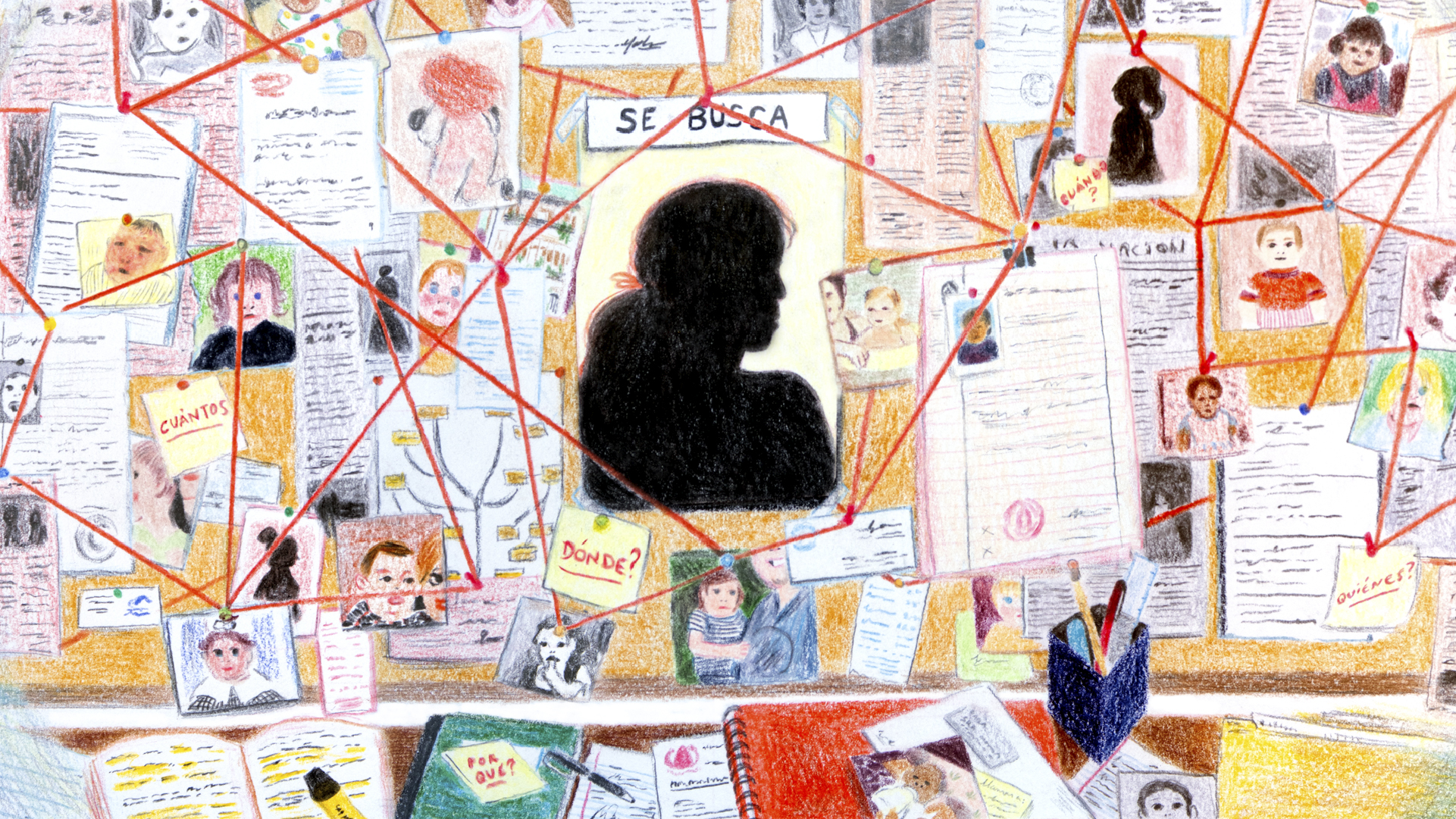
María tells me this story sitting in her architecture studio, at her desk, where there’s a huge pile of papers she’s gathered over these 20 years of investigation: emails, news clippings, copies of case files, photos, even a family tree for the midwife — the traces of work that, for a few years, consumed her life.
[María V.]: So, María’s story was also Marta Rosignoli’s story. And that… that whole amount of information that I don’t know, that reached her about how much I knew — somehow it closed in on her, and I think that’s why she wrote me the letter.
[Emilia E.]: A letter she received in 2010 through the midwife’s lawyer.
[Marta Rosignoli]: Hello, María. I hope you can read these lines with complete calm…
[Emilia E.]: In the letter, about four handwritten pages, Marta Rosignoli told her about her early days as a midwife and how she’d built up a client base of patients she treated. She also mentioned a supposed convent where babies were given to families who couldn’t have children of their own… but she, she said, had nothing to do with that.
She also didn’t remember names, or faces, or dates from that time. In short: she couldn’t help her.
[Marta R.]: Believe me, María, that your parents’ name doesn’t ring a bell for me. What I can tell you, María, is that if I’d known about the malice and cruelty of certain people, I would never have become a midwife. Today it’s a disgrace to appear online as a criminal, with all the media coming after me as if I were one.
[Emilia E.]: How did you react when you got the letter?
[María V.]: I said, she’s a piece of shit, just like my mother. They only think about themselves. That’s what I thought — I’m not going to find anything here. Like… that’s it…
[Emilia E.]: If she’d been searching for her all that time, it was to ask for some information about her biological mother. But it was clear she wasn’t going to get it that way.
After receiving the letter, María filed a criminal complaint against Rosignoli. Maybe that way she could get some information, even if it had to be by force.
Now, all of María’s hope rested on a single object. It was a filing cabinet she’d seen in some photos in a 1976 court file against Rosignoli. A file she’d found thanks to a tip she got from the Abuelas de Plaza de Mayo office when she began her investigation. When she got a copy, she went to a bar near the courthouse and read it from beginning to end. That’s how she learned that in 1976, only a few months after her birth, neighbors near Rosignoli’s office had filed a complaint after seeing strange activity — people coming and going with babies.
According to the file, the whole raid sequence seemed straight out of a movie. When police arrived, they found a baby in an incubator, some empty cribs, an operating room, and a couple waiting to receive a baby. A few minutes later, they heard noises on the roof: Rosignoli was trying to escape across the rooftops with two babies in her arms.
María read all of this as if in a trance.
[María V.]: And what I take away from that file is that, at the time of the raid, along with the three babies and everything else they took from the office, they also took a filing cabinet — and I said, where’s that cabinet? How could someone secretly running a child-trafficking operation have a cabinet full of files on the babies, the fathers, the mothers, the buyers, and not take a photo of every single card? No, there was only a photo of the cabinet itself. I looked into what happened to that filing cabinet. It was returned.
[Emilia E.]: When she read that, María thought — how absurd, how could they return something that might have had information about the origin of those babies… It seemed obvious to her that the justice system had wanted to cover the whole thing up.
She kept reading. The file described how the police detained Rosignoli during the raid but released her a few days later. The midwife posted bail, which was later returned to her, and in 1978 she was sentenced to two years in prison, suspended — meaning not served. The file also listed the name of a couple who had gone to buy a baby for 270,000 pesos, about $1,600 at the time.
But even so, the cabinet was gone, its mere existence still told her something…
[María V]: When I saw the raid file and saw how many cards there were, I thought — we’re a whole lot of people. But up until that point I’d felt pretty alone. The others hadn’t started organizing to search yet.
[Emilia E.]: “The others,” she says, referring to the other groups of searchers, like Mónica or Ricardo, the protagonists of the first part of this episode. When she discovered the file, it would still be several years before she’d meet them — more than five.
Let’s go back to them, then, to the moment when the group of men and women sold by the midwives Ofelia Pintos Lemos and Gregoria Agra de Pasini met the group of people sold by the midwife Marta Rosignoli, around 2016.
The link, as we mentioned before, had been the story of two twin brothers who reunited thanks to a DNA test. Each one had a different midwife listed on his birth certificate, but both had been bought and sold. That proved the connection between the two groups.
But there was something else — something María hadn’t paid much attention to, but that turned out to be revelatory for Mónica and the other searchers: at the start of the letter Marta Rosignoli wrote to María, she mentioned a few doctors and a few other midwives she’d worked with. She didn’t give names for the doctors, but she named the midwives — “Señora de Gómez,” “señora Catalina Olija,” “señora Nélida Benítez,” “la señora Hayde Braun,” “señora de Spinelli,” “señora Emilia Torres de Ugalde…”
[Mónica S.]: So, what did we do?
[Emilia E.]: This is Mónica, again.
[Mónica S.]: We all started googling, and we found that for each of those midwives, there were already groups of people out there searching for their identity.
[Emilia E.]: Groups of ten, twenty, thirty searchers, with stories very similar to their own. In total, more than 200 men and women born between 1956 and 1983 who have the signatures of some of these midwives on their birth certificates.
Mónica calls them by these women’s last names: “the Rosignolis,” “the Pintos Lemoses,” “the Torres de Ugaldes,” “the Piccardos.” Without the letter María received, they might have thought these were isolated cases. But maybe without meaning to, without even realizing it, the midwife had exposed, with her letter, the threads that connected them all.
What they came to believe was this: these women operated in a kind of network, interconnected to procure and sell babies. It’s a conclusion they reached by talking among themselves, comparing their stories, going over birth certificates, and making connections between names that appeared in the letter and addresses they’d found. Rosignoli’s case was a perfect example: she didn’t practice out of the Jufré 140 apartment, but out of a house in another neighborhood — the one we mentioned earlier that was raided — yet she still appears signing birth certificates listing births at that Jufré address.
Mónica is able to recall the midwife and birthplace for many of the other searchers. For her, someone who’d spent so many years paralyzed, learning all these stories pushed her to search even more intensely for her own. One day — she’s not sure if it was 2015 or 2016 — she decided to go to the home of a neighbor of her aunt and uncle, a woman named Coca. Talking with them, Mónica had found out that this neighbor had been the go-between who connected her parents with the midwife. And even though she’d been so close all along, it had taken her years to work up the courage to knock on her door.
[Mónica S.]: I knew that woman was there, but I never dared to ring her doorbell. I don’t know — I was embarrassed, scared. I don’t know. It was something I couldn’t explain.
[Emilia E.]: This time she worked up the courage. Coca was already a very elderly woman, who had worked as a nurse for Ofelia Pintos Lemos, the midwife listed on Mónica’s birth certificate. The woman let her in, and when Mónica asked if she remembered who her biological mother had been, she answered:
[Mónica S.]: “And why do you want to know?” she says to me. “If it hadn’t been for what happened to you, you’d be barefoot, surrounded by kids. I don’t even care.” I told her — but I still have the right to know, because those would be my roots, to know the truth.
[Emilia E.]: The woman told her that either way, she didn’t remember.
[Mónica S.]: She told me the same thing we’d been hearing all along. It’s very hard to know who it was, because there were so many young mothers giving birth, so many babies being handed over. It’s very hard to know exactly who your mother is.
[Emilia E.]: But she offered her another lead: if Mónica wanted, she could put her in touch with the midwife’s son. The midwife had died, but he was still alive. She had nothing to lose, so she went with another searcher to the address they’d given her. A man of around fifty-something opened the door… and she asked him about Ofelia, about his mother…
[Mónica S.]: And he says, “What do you want to know about my mom?” So we started telling him. “Ah, I already know.” And he starts telling us. When he starts telling us — it was one horror after another, because he grew up in that horror, and he had normalized it.
[Emilia E.]: He told them that in the kitchen at Jufré 140, where he and his mother lived for many years, the stove burners were always lit, to keep newborn babies warm. The consulting room was in his bedroom, so many nights he had to sleep on a couch in the living room.
[Mónica S.]: But he’d tell us: My mom didn’t steal babies. And she didn’t sell them. She was doing a favor for mothers who didn’t want to keep them. That’s what he’d tell us.
[Emilia E.]: Of course — because it was his mother…
[Emilia E.]: In their conversation, this man also mentioned two other midwives who worked with his mother. Mónica wrote down these names, and when she got home, she went through her searcher’s routine again…
[Mónica S.]: When we googled them, both midwives turned out to be real, and there were a lot of people looking for their families connected to them.
[Emilia E.]: One of those midwives worked at Rivadavia Hospital, a health center in Buenos Aires where the courts also investigated the theft of nearly a hundred babies between the 1970s and the 2000s. That could be the origin of some of the children who were given away.
Another hypothesis is that many of them were the children of sex workers from a brothel in the Mataderos neighborhood, where another one of these midwives also worked.
But those are just that — hypotheses drawn from conversations, from scattered pieces of information. That’s one of the questions they still haven’t been able to answer. Maybe the most important one.
[Mónica S.]: We haven’t been able to identify where they were getting the babies from. As more and more people kept turning up, our idea was to bring everyone together in one group, because we believed that with each of our own accounts, we might be able to start tying together that piece about where they were getting the mothers from — and in one case, we would’ve known…
[Emilia E.]: They also thought that appearing in the media might help their mothers see them and recognize themselves in the story — remember a name, an address. But that, at least so far, hasn’t happened.
Over all these years, they have managed to do two things: establish connections between at least a dozen midwives, and outline a kind of modus operandi for how the babies were handed over to the buying families. But there are no records of the women who gave birth in those offices. Many of them may not even know they have a son or daughter out there somewhere. What were they told? That their baby had died? Did they give them up voluntarily? Did they receive money? None of the information they’ve gathered so far can answer those questions. And in many cases, like Mónica’s, Ricardo’s, and María’s, the adoptive parents have also died, leaving nowhere left to look for new leads.
And faced with this, everyone reacts differently. The search can be exhausting, and many, after a while, have decided to stop…
[Mónica S.]: It’s not easy. Life itself, work, not having enough hours in the day — whoever can go out and investigate, does. Sometimes there’s a big group of us searching, all plugged in, sometimes it’s just two or three of us. But it doesn’t matter, because we know that whoever’s out there searching and active is searching for everyone. If we share the same midwives, then whatever one of us discovers is for all of us.
[Emilia E.]: Even so, Ricardo Blanco, whom we heard at the start of this episode, has already given up hope of finding his biological parents.
[Ricardo B.]: I think it’s like looking for a needle in a haystack… I mean, it has to be random, the planets have to align for you and it just happens. So I’ve already grieved it… for me, I’m never going to find them, because if I look at it rationally, the odds are basically zero — I’d say 0.001, something like that.
[Emilia E.]: It’s not that it doesn’t matter to him — he knows this story marked his whole life: the way he relates to his children, the way he falls in love, everything.
[Ricardo B.]: I never fully commit to relationships. And if you ask me, hey, what marked you? Well, what else is supposed to mark you?
There’s always this idea of abandonment lurking underneath, right? Because you feel like you were abandoned — sometimes it gets to me. Then I say, no, what’s the point? It doesn’t make sense, and I don’t want to go there, because in the end… I can’t tell you exactly what it makes me feel, but no, and sometimes it doesn’t do me any good, you know? It brings on this kind of anguish… but then I try to… we cover it up and move on.
[Emilia E.]: María Videla also put her search on hold. The complaint she filed against her midwife moved forward, and the case has been ready to go to trial for a while now, though it’s already been more than four years without any news. Very often she thinks she should go to the courthouse to check on it, but day-to-day life gets in the way and she doesn’t go. In these years, she’s moved, and had a son, and life started heading down other paths. So much so that today she doesn’t even know whether Marta Rosignoli, the woman who kept her up at night for so long, is alive or dead.
[María V.]: The narrative is: I want to know my identity — and no, I already know my identity. I know who I am, beyond not knowing who gave birth to me. I know I have fragments, obviously, of the story, and I would love to… But at some point you also have to make peace with the idea that you could die without ever knowing who your parents were. Now my eyes are filling up with tears, but I’m saying, somehow you have to make peace with that, because otherwise, it’s like an illusion that completes your day, and you can’t spend your whole life chasing illusions. I mean, there are everyday things that are so beautiful that you’d miss out on if you didn’t…
[Emilia E.]: In February of this year, 2026, I met up with Mónica a couple of blocks from the building at Jufré 140, to walk over there together. When I got to our meeting point, I saw her from a distance talking with some neighbors in front of an auto repair shop. And I walked up with the recorder running.
[Mónica S.]: How are you?
[Neighbor]: Good. Good, good. Good.
[Mónica S.]: Let me ask you something — actually, let me tell you something first. Have you lived here for a long time?
[Neighbor]: Yeah. Yeah, 52 years.
[Mónica S.]: Okay…
[Emilia E.]: The neighbor from the repair shop remembered seeing the midwife…
[Mónica S.]: Do you remember anything? Anything at all?
[Neighbor]: I remember because, you know how in the neighborhood word gets around fast. The midwife was a heavyset redhead.
[Mónica S.]: Yes, exactly. Exactly. I can’t believe it. Well, I was told I was born there, at Jufré 140…
[Emilia E.]: Mónica told him her story and about her search. They exchanged phone numbers, in case the man remembered anything else. Afterward, we asked other neighbors if they remembered anything about the midwife on Jufré Street. We talked for a long while with a shopkeeper who’d spent his whole life in the neighborhood. Mónica carried a folder with some printed pages, and had her phone ready with photos of the woman to show them.
[Mónica S.]: The woman was heavyset, kind of a redhead, she’d come outside in a white coat. Don’t you remember?
[Neighbor]: No, not at all.
[Mónica S.]: You don’t remember anything?
[Neighbor]: No, no, no. No idea.
[Emilia E.]: We arrived at the door of Jufré 140. The sun was beating down hard, so we talked for a while in the shade of a tree. Mónica was very excited after the conversation with the mechanic…
[Mónica S.]: I loved what the guy at the shop said. It doesn’t matter — just him telling me he saw her, a heavyset redhead who used to come out in her white coat… that alone is a discovery for me, but it gives me, I don’t know, some kind of emotion. It’s incredible. Because I don’t know… someone who saw her alive.
She’s moved because, after all, that’s the one certainty she has about her first days of life, before she became Mónica Snaidman. In this place, she can say: I passed through here, I was here. This is where I began.
[Daniel A.]: Emilia Erbetta is a producer at Radio Ambulante and lives in Buenos Aires. This story was edited by Camila Segura. Bruno Scelza did the fact-checking. Sound design and music are by Andrés Azpiri.
The rest of the Radio Ambulante team includes Paola Alean, Adriana Bernal, Aneris Casassus, Diego Corzo, Camilo Jiménez Santofimio, Germán Montoya, Sara Selva Ortiz, Samantha Proaño, Natalia Ramírez, Juan Pablo Santos, David Trujillo, Elsa Liliana Ulloa, Luis Fernando Vargas, Franklin Villavicencio, and Mariana Zúñiga.
Carolina Guerrero is the CEO.
Radio Ambulante is a podcast from Radio Ambulante Estudios, produced and mixed on the Hindenburg PRO program.
If you liked this episode and want us to keep making independent journalism about Latin America, support us through Deambulantes, our membership program. Visit radioambulante.org/donar and help us keep telling the region’s stories.
Radio Ambulante tells the stories of Latin America. I’m Daniel Alarcón. Thanks for listening.