
The Return | Translation
Share:
► Click here to return to the episode official page, or here to see all the episodes.
♥ We live in difficult times. We are a non-profit media, and our permanence depends on listeners like you. If you value our work, join Deambulantes, our membership. Help us elevate Latino voices and tell the story of our communities. Your contribution is directly invested in our journalistic work and makes all the difference.
►Do you listen Radio Ambulante to improve your Spanish? We have something extra for you: try our app, designed for Spanish learners who want to study with our episodes.
This podcast is the property of Radio Ambulante Studios. Any copy, distribution, or adaptation is expressly prohibited without prior authorization.
The following English translation was generated with the assistance of artificial intelligence.
[Daniel Alarcón]: This is Radio Ambulante. I’m Daniel Alarcón.
In July 2025, a young woman—around twenty years old, Venezuelan—was at the border between Costa Rica and Panama. We changed her name at her request.
[Luis Fernando Vargas]: What do you want to be called?
[Mar]: Mar.
[Luis F.]: Mar, how are you?
[Mar]: Good.
[Daniel A.]: Our senior editor, Luis Fernando Vargas, met her in Paso Canoas. It’s a small city of more than 11,000 permanent residents, right on the line that divides the two countries. It has houses and shops on both sides.
She was with her mother and younger sister in the park on the Costa Rican side, sitting on a bench near a tree, shielding themselves from the intense, overwhelming midday sun.
She and her family had left Venezuela four months earlier, aiming for the United States.
[Mar]: Everyone’s goal in going there was to have a good economy, a good future, and then return to their own country—because it’s not like we wanted to stay there forever, you know? My plan was to keep studying there, work, buy my things in Venezuela, and come back.
[Daniel A.]: They crossed the Darién jungle, but this year was very different from previous years, when thousands of people passed through daily.
[Mar]: We crossed the Darién. We spent four days in that jungle. It was rough.
[Luis]: Were a lot of people going through, or not?
[Mar]: People don’t go that way anymore.
[Daniel A.]: What’s remarkable isn’t that Mar is there—after all, in recent years, Paso Canoas has been a constant transit point for migrants like her, seeking a better life. Those are stories we’ve heard many times.
What actually draws attention about Mar is that she hadn’t just crossed the border from Panama into Costa Rica to continue her route north. No. She had done that months ago. She had made it all the way to Mexico.
What was remarkable was that she was already on her way back.
What she wanted to do that day was cross from Costa Rica into Panama. To continue her journey… toward Venezuela. Mar was heading home.
[Luis F.]: I was just told you’re leaving for Panama today.
[Mar]: Yes, God willing. We’ll see if we can, because the police won’t let us through. We’ll see if they let us pass today.
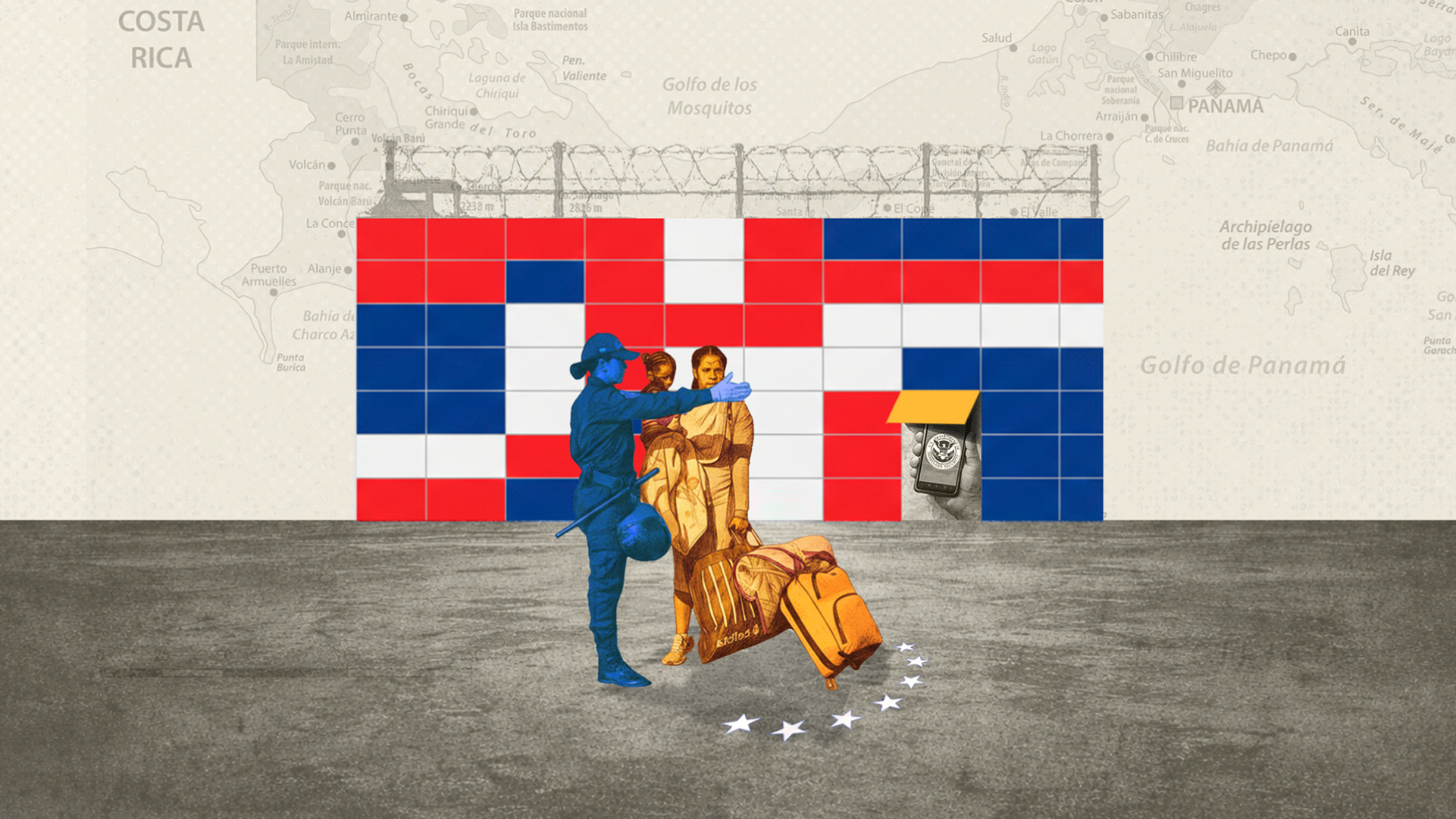
[Daniel A.]: We’ll see if they let us pass, she says—because Panamanian migration authorities were denying entry to anyone without a valid passport, something many migrants, after months or years on the road, simply don’t have. Entry was blocked because, nearly a year earlier, Panama had suspended diplomatic relations with Venezuela following suspicions of election fraud.
Stories like Mar’s are common in Paso Canoas. Over the past year, thousands of people of different nationalities have arrived there—people who, at some point, had been seeking opportunities in the United States. People willing to travel thousands of kilometers under grueling conditions and through real danger. A whole dream, a whole hope.
But with the arrival of Donald Trump to the presidency of the United States and his anti-immigration policies…
[Donald Trump]: All illegal entry will immediately be halted and we will begin the process of returning millions and millions of criminal aliens back to the places from which they came. We will reinstate my Remain in Mexico policy.
[Daniel A.]: They decided it was better to return to the country they had said goodbye to.
Luis Fernando visited Paso Canoas to understand what that return journey looks like.
I’ll leave you with him.
[Luis F.]: Mar, her younger sister, and her mother began their journey from Venezuela to the United States in March 2025, less than two months after Trump had entered the White House for the second time. They wanted to apply for asylum. But they were cautious. They weren’t fully up to date on everything, but they had heard that the new U.S. government had a strict anti-immigration policy.
And by that point we were already flooded with news like this.
(Archival audio) UNO TV
[Reporter]: Less than two hours into the new administration, the U.S. government canceled the CBP One appointment program for migrants seeking asylum.
(Archival audio) ADN 40
[Reporter]: Donald Trump is following through on his campaign promises, and this afternoon from the Pentagon, the deployment of 1,500 soldiers to the southern border was ordered. These soldiers join the 1,500 troops already stationed in the area conducting operations.
(Archival audio) Noticias Telemundo
[Reporter]: They’ve called it a massive wave—this is the largest joint immigration operation in the history of the state of Florida.
[Luis F.]: But they decided to try anyway. They still wanted to go through the formal asylum process. To enter legally. After traveling through Colombia and crossing the Darién and Panama, they got stuck in Costa Rica—not in Paso Canoas, but at the other border, with Nicaragua. They didn’t have enough money to continue. So she and her mother looked for work, and before long they found it. Mar found a job at a small grocery store. It was one of the hardest legs of the journey.
[Mar]: We lived in a little tent—a tent—and we had to sleep in the streets. In the tent, but on the street.
[Luis F.]: That’s when they started noticing what we already mentioned: many migrants heading back south.
[Mar]: Yes, quite a few people are going back to their countries, or staying in these countries—because Mexico is somewhat dangerous, yes.
[Luis F.]: These weren’t caravans—just small groups. But they were constant. On Trump’s first day in office, the United States hadn’t just canceled migration appointments at the border with Mexico—it had literally shut the border.
Mexico was a complicated country to wait in for things to change. There, stories of kidnappings, extortion, murders, forced labor, and violence against migrants are common. Many transit routes—especially those used by undocumented travelers—are controlled by organized crime. There are also human trafficking networks for crossing the border into the United States. All of this has led the UN to consider the route through Mexico the most dangerous overland migration route in the world.
With that danger and no guarantee they could enter the United States and settle without being deported or detained, many—frightened or simply exhausted from months of travel—felt it wasn’t worth trying.
But Mar and her family weren’t ready to give up on the possibility of entering the United States. By that point they had been traveling for two months. And after buses and long walks, they made it to Mexico.
[Mar]: We were afraid because people said a cartel would grab you farther ahead to kidnap you and demand money. But we took the risk and left at night on foot. We walked for about two days to Tapachula.
[Luis F.]: As we said, their plan when they left Venezuela had been to get an appointment through the U.S. immigration service app to enter as asylum seekers. And even though the administration had eliminated that process since January, they wanted to keep going—to see what happened, to see when it might resume. Maybe they wouldn’t be able to get an appointment through the app, but perhaps there would be another way.
They had to stop in Tuxtla, Chiapas, nearly two thousand kilometers from the U.S. border. There, again, they needed to work and save a little money before moving on. Mar got another job, this time at a bridge construction site…
[Mar]: The first day they had me cleaning, and the second day they took me to where they were building a bike path—but since they were short on staff, they made me a supply clerk. I had to hand out materials and tools—the pickaxe, the shovel—to the workers, log everything, and so on.
[Luis F.]: And while they saved money, they waited to see if the situation in the United States would change.
But the appointments kept not opening up, the raids and deportations kept happening, and the U.S. government kept fighting in the courts to eliminate Temporary Protected Status for Venezuelans. Things were looking less and less optimistic every day.
For two months, they lived and worked under difficult conditions—just as they had done in Costa Rica. They were tired, and with everything they had heard on the road about the situation in the United States, they said: “no more.” Four months on the route, and their goal seemed almost impossible. Their plan of working there for a while and returning home no longer seemed feasible, practical, or appealing.
And so the journey back began. Mar and her family returned with a group. It wasn’t large—just about eleven people. They came by bus and traveled quickly, in just a few days. And in several places, Mar heard the same thing.
[Mar]: Everyone says: no, we’re going to Venezuela—because it’s better to be in your own country than in a foreign one, and so on.
[Luis F.]: And so she arrived in Paso Canoas on that July day when I met her. Several people from her group had stayed behind in San José, the Costa Rican capital, looking for some way to earn money to continue the journey through Panama and Colombia.
There was a bitter feeling in Mar—not anger, but disappointment layered on top of exhaustion.
[Mar]: Tired of traveling. But I just don’t want to keep being in other countries anymore. I’d rather be in my own country. You have your little house there, and that’s it. I mean, the situation in Venezuela isn’t great, but it’s better to be at peace.
[Luis F.]: Although she had already covered most of the return journey and no longer lived in fear of the situation in Mexico, the stretch that remained for Mar—actually quite short compared to the rest—had become increasingly difficult.
If on that day when I spoke with her they managed to cross into Panama, Mar would begin her journey to a region near the Darién, to take a boat to the Colombian Caribbean.
The trip was by boat because the Panamanian government had begun closing the Darién route about a year earlier. This is the news from those first days.
(Archival audio) Voice of America
[Reporter]: Fear and anxiety grip hundreds of migrants in Necoclí, a required stop in Colombian territory for crossing the Darién jungle, after Panamanian authorities installed barbed wire fences to block the crossing at four different border points.
[Luis F.]: Images circulating on social media and news outlets show the paths that more than a million migrants had traced through the Darién jungle over the years, now being blocked by meters and meters of barbed wire.
With this tactic, the Panamanian government aims to turn the Darién jungle back into a plug—a barrier once again.
So by July of that year, the only option for many people was to take the boat. A route that is also dangerous: there are many accounts of boats sinking or being overwhelmed by waves. And then there was the issue of cost.
[Mar]: It’s very expensive. It’s nearly $300 per person. Many people—because they know you’re a migrant and assume you’re carrying a lot of money, as if we’re all super rich—see you as a cash machine and charge you for everything, for everything.
[Luis F.]: But that worry about money would be for another day. First, there was another challenge: actually getting across the border from Costa Rica into Panama at Paso Canoas.
I said goodbye to Mar, wishing her luck on this stretch of the journey, and wondering why Paso Canoas has become such an obstacle for many migrants on their return south—and what that means for a town that has lived off migration for years.
[Daniel A.]: A short break and we’ll be right back.
[Daniel A.]: We’re back. Luis Fernando continues his story.
[Luis F.]: As we said, Paso Canoas has become an obstacle for many migrants on their return south.
The city sits right on the border line. The immigration and customs checkpoints are scattered along the Pan-American Highway, which runs through the center of town. But the border between the two countries isn’t marked here by a river or a mountain range. In reality, it’s a row of shops and commercial warehouses—duty-free stores, like those in airports.
There’s also a tolerance zone for free movement: you have complete freedom to walk and buy or sell things within 100 meters of either side of the border line. Many shopping centers have entrances in both countries. There are corridors with stores where you walk in and aren’t entirely sure which side of the border you’re on.
It used to be a shopping destination for Costa Ricans—cheaper than the capital or other cities, with the added draw of being able to cross into the neighboring country. Then, when mass migration from the south to the north began, it became the Costa Rican city most affected by the humanitarian crisis.
At the peak, about 2,600 people passed through daily. All of them had recently left the Darién; many had no money to continue or even to stay. A humanitarian aid worker in the area told me they distributed food in the streets and camps. Often, 900 plates weren’t enough for all the families and individuals who needed to eat.
Today, the number of people returning south is far lower. The Costa Rican government stopped releasing official figures, but humanitarian organizations working in the area estimate around 200 to 300 people pass through daily—and they are in a very vulnerable situation…
[Rafael Lara]: Right now, we say that in the migratory flow, there are two castes.
[Luis F.]: He is Rafael Lara, National Coordinator of the Red Clamor in Panama, a religious organization that for many years has provided humanitarian aid to migrants. With the Darién closed, in recent months they have concentrated their operations in Paso Canoas.
[Rafael L.]: There’s the caste of migrants with a valid passport, and the caste of migrants who only have a national ID or a birth certificate.
[Luis F.]: Those with a valid passport can cross into Panama and continue their journey, or get help from the few remaining International Organization for Migration officials in the area to enter a voluntary assisted return program. They help you with the necessary paperwork to fly back to your home country. And then there are the others—the most vulnerable—who are the majority.
[Rafael L.]: Migrants with only a national ID. Or without an ID, or just a birth certificate. They have to figure it out on their own.
[Luis F.]: Let me explain. Because if you don’t have a valid passport, in Panama you need a consular permit—something that until recently was impossible due to the breakdown of diplomatic relations between Venezuela and Panama. And if you don’t have what’s required to apply for the permit, the option is to cross irregularly, avoiding officials from the national border service.
[Rafael L.]: So if the Panamanian government finds these people at checkpoints, they might send them back to Costa Rica—but not before handing them a significant penalty, a fine they will never be able to pay.
[Luis F.]:Fines ranging from $1,000 to $5,000. And if that fine isn’t paid, Panamanian authorities won’t let them continue their journey.
This policy meant that in February 2025, when the return of migrants from the north first became noticeable, a significant group of people became stranded in Paso Canoas. Panamanian migration authorities wouldn’t let them through without a passport. At one point, there were nearly 300 of them. The majority were Venezuelan.
It was a scene Paso Canoas had already witnessed, several times, over the years—when people were heading north. With Cuban, African, Haitian, Venezuelan migrants…
On February 11, 2025, a meeting took place between the security ministers of Panama and Costa Rica to discuss conditions for allowing these migrants to enter Panama. If Panama was going to let them continue, they wanted entry to be controlled, with document checks and criminal background reviews on Costa Rican soil. They agreed to bring people to a shelter to carry out the process.
But within minutes, things exploded. A caravan of dozens of Venezuelans decided to cross the border without permission.
Costa Rican authorities in Paso Canoas didn’t stop them, but about five or six kilometers in, SENAFRONT—Panama’s National Border Service—arrived.
[Reporter]: A considerable number of the national border service and transit police have now arrived and have tried to intercept this caravan of migrants who have been walking for approximately an hour and a half since leaving the Paso Canoas area, and at this moment they are not allowing the migrants to cross.
[Luis F.]:It was tense—there were arguments, shouting… It didn’t come to physical violence, but Panamanian authorities sent the caravan back to Costa Rica, where police took them to a shelter in Paso Canoas. They spent several days there, unable to continue their journey.
I was in San José, where I live, following the news—and the image that stays with me is cruel, brutal. I saw it in almost every news report: a mother shouting at the police who had blocked her way, and also at the camera recording the scene. With one arm, she shields her young daughter—about 6 or 8 years old. The little girl is crying, frightened, and inconsolable. It’s an image that stays with you.
That caravan marked a before and after in Paso Canoas. A few days into their stay at the shelter, the people detained in the caravan began leaving the city one by one. Some were taken by Panamanian government buses after their criminal records and documents were reviewed. But there wasn’t room for everyone. Those who remained found ways to continue their journey. Perhaps, I was told, some used smugglers… And since that day, out of fear of not being able to cross, human trafficking—already a problem in the area—has increased.
[Jossette Chavarría]: This measure also triggered an increase in all these approaches by trafficking networks—a complex situation in the area. But people are also forced to coordinate with these individuals due to the very real limitation of not being allowed to continue.
[Luis F.]: He is Jossette Chavarría, a social worker who collaborates in Paso Canoas with the Jesuit Refugee Service—one of the organizations that has for years provided aid and monitored the area. Humanitarian organizations have observed a new pattern in how migrants are crossing into Panama. Those coming back from the north must pass through San José, the Costa Rican capital. There, they take the last bus to the Paso Canoas border, which arrives close to midnight.
[Jossette Ch.]: It’s always on the last buses that the largest numbers of people in this flow arrive. Those who have the means will continue on their way, and those who can’t continue immediately are the ones we see daily during the day at this border.
[Luis F.]: In reality, the numbers tend to be far fewer than the 200 or 300 people estimated to pass through daily.
I also spoke with Adriana Calzada. She’s Mexican and belongs to the congregation of the Sisters of Charity of the Incarnate Word. She’s also one of the coordinators of a community kitchen run by a group of different religious congregations at the Catholic church in Paso Canoas—currently the most important humanitarian aid center in the city.
[Adriana Calzada]: At the community kitchen, we serve an average—I can say this—of around 50 people. There have been times we’ve served 90 people and times we’ve served just ten.
[Luis F.]: In other words, even though migrants pass through Paso Canoas daily, they’re no longer as visible as before. It’s a drastically different situation from what the city has experienced over the past 10 years.
It’s also different in another way—emotionally. Adriana has noticed that the migrants arriving at the shelter now seem deeply affected.
[Adriana C.]: They arrive with disillusionment, exhaustion, frustration—just fed up. Really fed up.
[Luis F.]: She arrived in Paso Canoas in 2024 to work with migrants. It’s an initiative by congregations from different countries that recognized the need for humanitarian aid in Paso Canoas, a key point on the migration route. Adriana, who has always moved from place to place, volunteered.
Before that, she worked at a shelter in Palenque, Chiapas, in southern Mexico, with people who were still heading toward the United States. And of course, she witnessed trauma, physical exhaustion, many things…
[Adriana C.]: People would tell you: how much we were robbed, how many people we saw killed in the Darién, or we saw the child fall—all the horror stories we know all too well.
[Luis F.]: But she also witnessed the camaraderie of a shared experience. A “we went through it together, and that connects us, even though we barely know each other”…
[Adriana C.]: A lot of solidarity—among themselves, among the groups. People also talked about, alongside all those terrible things, how they supported each other in the jungle: “We helped each other—this person carried my child for me, I met a family and helped look after them.”
[Luis F.] Now, the feeling is closer to hopelessness.
[Adriana C.]: Yes, a sense of a dream. I don’t want to say a broken dream, because—let’s say—it’s a transformed dream. People still have hope. But yes, many people sold everything to get there. The journey going up was immense. And now coming back down—yes, it’s sad, isn’t it?
[Luis F.]: Whether or not it’s true, the idea of the American Dream—that the United States is a place where you can arrive with nothing and move up—was part of the wave of migration we’ve witnessed for more than a decade across Latin America. It was a driving force, a promise for many people who decided to undertake the journey despite the risks.
Another humanitarian aid worker told me they’ve heard many times the phrase: “I don’t know what I went there for”—referring to trying to reach the United States.
Many feel deceived. My conversation with José confirms it directly—a soft-spoken Venezuelan man I met outside the community kitchen when I was in Paso Canoas. He’s about 30 years old, tall, with tattoos.
He had been on the road for more than a year.
[Jose]: With my friend and with my partner. And my cat.
[Luis F.]: He gradually made his way north until he reached the United States. And he made it in. To Texas.
[Jose]: I entered on January 18 and twenty days later I was deported because I no longer had protection under CBP One.
[Luis F.]: He didn’t even have time to settle in. He was deported to Mexico, and so was his partner. He had to jump through many hoops to have his pet sent to him. But he managed it. That’s when they decided they didn’t want to try crossing into the United States again. Trump’s position had become crystal clear.
[Jose]: It’s a political thing now, and he also has this ideology—that we’re the backyard.
[Luis F.]: Does going there still sound appealing?
[Jose]: Nah. Maybe under another term, with a more compassionate president—yes. But not with him.
[Luis F.]: Let’s talk for a moment about what José said—that Trump has an ideology that views us as the backyard. It’s important to understand this. For those who designed Trump’s new immigration policies, what José says is a victory. Making migrants feel discouraged on the road is precisely what they were aiming for. What they wanted. The route has always been dangerous, long, and brutal—and yet people kept trying. So, let’s make it impossible. Pointless. Let them understand there’s no way to get in.
If that sounds cruel, it is. But one thing is true: they achieved their goal.
[Luis F.]: Are you planning to head to Panama soon?
[Jose]: I’d like to try today. And heading there with the anticipation of… Panama—let’s see how it receives us. Let’s see if they let us keep moving forward.
[Luis F.]: There’s a word here that catches my attention. Move forward. “Let’s see if they let us keep moving forward,” he says. Forward—not backward. As if, despite their frustration and disillusionment, they refuse to give up entirely.
As Adriana told me, migrants are heading back, but their goal of having a better life continues.
Paso Canoas faces many challenges right now. Organized crime—including human trafficking and drug trafficking—is a very sensitive issue. I was advised not to walk the streets at night, and told to be careful at the hotel where I was staying because suspicious things were happening there. Since it’s a small community, people have a sense of who’s involved in smuggling. The aid organizations are careful. I was told many things off the record.
And it’s important to understand that Paso Canoas is located in an area of the country marked by deep disadvantages. Poverty is the norm, as is the lack of public infrastructure, and jobs are scarce. Tourism—which sustains much of the economy in areas outside Costa Rica’s central valley, the most urban region—has never been strong here.
The overland migration route that has existed for nearly a decade has transformed Paso Canoas multiple times. As we mentioned, before the first migrants arrived, the town was known as a shopping hub for its duty-free stores. It was common for people from different parts of Costa Rica to go there to buy Christmas gifts.
Then, with the arrival of migrants, those shoppers came less and less. And as the humanitarian crisis in Paso Canoas deepened—and with the arrival of COVID—shoppers stopped sustaining the city’s economy.
Paso Canoas had to adapt.
Here’s Rafael Lara—the Red Clamor coordinator we heard from earlier. He told me that for years, when people were heading north, complaints and xenophobia were never in short supply.
[Rafael Lara]: There were people scattered everywhere throughout Paso Canoas, sleeping in little tents—right? So the people who lived there and the shopkeepers started complaining: “How is this possible, they’re dirtying the front of my store, the front of my house”—but all those people on the street were also spending money.
[Luis F.]:In other words, despite the complaints, for years their livelihood came from the thousands of migrants crossing through monthly.
[Rafael L.]: A migrant arrives and buys a bottle of water because they’re thirsty—genuinely thirsty. That’s the sacrifice they make. But the one who keeps that money is the local shopkeeper.
[Luis F.]:And now, with the number of people arriving at Paso Canoas just a fraction of what it used to be—and most of them getting off the bus in the early hours of the morning and crossing straight into Panama—Paso Canoas faces a real challenge. Because without migrants, the town suffers.
There’s evidence of this. At the end of 2023, when thousands and thousands of people were trying to reach the north, Panama and Costa Rica implemented a controlled migration flow. People were taken directly from the Darién jungle to a shelter several kilometers from the center of Paso Canoas. Migrants disappeared from the city streets—and the local population protested.
[Rafael L.]: The shopkeepers then started complaining that sales had dropped, and so on.
[Luis F.]:I reviewed news from that period—when the migration flow Rafael mentions was controlled. I came across an article where a woman said that her hotel, which she had built years earlier for the shoppers who came to the border, was empty. And she said it plainly:
[Woman]: The commerce of Paso Canoas—pay attention—exists because of migrants. Without migrants, there’s no money here, there’s nothing. I used to have 12 employees and I’m down to one.
[Luis F.]:The current situation—with few migrants stopping in town before continuing their journey—is reminiscent of that period. Now, Paso Canoas faces the challenge of figuring out how to survive economically.
The need is visible. I saw some migrants come out of a mechanic’s shop—that shop was their lodging. Paso Canoas has hotels on every corner, but sometimes people arriving in worse financial shape can’t even afford those. So informal accommodations have sprung up: homes and businesses belonging to people who are also struggling economically. At a small restaurant where I ate one day, customers were invited—by a handwritten marker sign—to ask about their affordable lodging.
Compared to the Paso Canoas I’d been told about, it looked like a ghost town.
[Daniel A.]: A short break and we’ll be right back.
[Daniel A.]: We’re back. I’ll leave you with Luis Fernando.
[Luis F.]:The journey is different for migrants who, after months or years, are heading back south. When they were traveling north, the route was difficult—but far less lonely in terms of humanitarian support.
Due to financial problems—many stemming from funding cuts by the United States—several humanitarian organizations have scaled back their operations across the Americas, including Costa Rica, including Paso Canoas.
Now, the conditions of the return are ones of extreme vulnerability. Before, at least—says Jossette Chavarría of the Jesuit Service for Refugees—there was some accompaniment.
[Jossette Ch.]: Good or bad, there was an accompaniment where people on their route had the ability, in the different countries, to access the humanitarian response that was being managed by those countries—and in this new return dynamic, that access no longer exists.
[Luis F.]:That has been the challenge in Paso Canoas: rebuilding a structure that allows migrants to be supported.
[Jossette Ch.]: Being able to accompany this population as fully as possible, because there truly is exhaustion, there is pain.
People emotionally worn down, their dreams shattered—who had hoped to arrive and build a new life for themselves and their families—only to find that the hope, the driving force that had moved them, was gone.
[Luis F.]:Today, as you may have noticed, the organizations supporting migrants passing through Paso Canoas are almost all religious. The Jesuit Service, for example, runs Casa Arrupe—less than a 10-minute walk from the church where the community kitchen is located.
[Jossette Ch.]: As you can see, within our organizational capacity, we’re able to provide a range of hygiene items and first-response care for families—for example, supplies for children.
[Luis F.]:It’s a small house, like many in the area. There’s a kitchen where migrants who arrive can prepare their own food, a room with a bed where they can rest for a while—though not stay overnight—a bathroom to take a shower, and a small sitting area. There are also some things for children.
[Jossette Ch.]: …a little juice, a cookie—those small things, in situations of extreme need and extreme vulnerability, do bring real relief. And they revive that strength…
[Luis F.]:There’s also the work of the Local Humanitarian Network of the Southern Border: Paso Canoas neighbors who, several years ago—when the south-to-north migration flow was at its peak—came together to provide assistance. Today, they distribute hygiene kits and food at various points throughout Paso Canoas, among other actions.
But it’s a constant struggle in what can feel like a desolate landscape. Even so, I witnessed an enormous amount of empathy and solidarity.
Before catching the bus back to San José, I went to see how the community kitchen at the church worked. It was 11 in the morning. The heat—35 degrees with extreme humidity—was overwhelming.
[Girl]: Mom, look at that. Mom, look at that…
[Luis F.]:The church is located in front of the only park in Paso Canoas—the same one where I met Mar. The park was built just a few years ago and is small. It has a sports court, a fountain, stone benches, and a playground for children.
There, a group of about fifteen people waited in front of the church on benches and a patch of grass shaded by a tree. All were migrants in transit. One was Colombian, hoping to stay in Costa Rica and try his luck there—but the majority were Venezuelan and heading back to their countries.
They waited for lunch amid casual conversations, scrolling through social media, and making calls to loved ones. They talked about all kinds of things—a tattoo a young woman wanted to get with her boyfriend’s name… Someone couldn’t understand why in Costa Rica a hotel room is called a “cabina.”
As the minutes passed, more people arrived. Slowly: one, two, at most three at a time. A flow as small as it was steady. Suddenly the corner of the park came alive. There were nearly fifty people—a regular day at the kitchen.
When we talk about migration, we always emphasize the movement. But migration also means waiting. Waiting for paperwork, for buses, for better weather, for darkness or for dawn. That day they were waiting for lunch and then the afternoon—when many would try to cross the border into Panama.
A large part of the lives of these migrants unfolds in these moments of waiting. Conversations happen, bonds form, laughter breaks out, hugs are exchanged, and children play…
Past noon, the wait for lunch ended. The church gate opened. And people began to gather…
[Boy]: Let’s go, Mari. Come on, Mom.
[Luis F.]:A short hallway separates the church from the parish hall… Two lines formed—one for men, and another for women and children. Adriana, the kitchen coordinator, came to address those who had gathered…
[Adriana Calzada]: Hello.
[People]: Hello…
[Luis F.]: She gave instructions… And about trash management, she gave a mild scolding…
[Adriana C.]: Really, yesterday it was a mess here. So—one, we don’t throw trash on the ground, and two, please, let’s respect each other and work as a group. The neighbors don’t like us leaving trash all over the street, okay? Please.
[Luis F.]:But it was hot, and she didn’t keep them waiting any longer. The line started moving.
[Woman]: Next…
[Luis F.]:Before entering, they signed in on a list to keep track of whether they were new or had come several days in a row to eat. Just to gather statistics and better understand how the flow of people was moving.
Then they picked up their plate at a counter where three or so volunteers served, and sat down.
They ate amid conversations that echoed through the hall. It was a space of relief—the kind that doesn’t come often on this journey. That’s by design. I was asked to stay back, in a corner—so as not to interrupt that moment of some normalcy, of enjoyment.
It was a small victory. Just like the laughter of those fifty people in the park, just like the jokes. And the people on the front lines tending to this crisis celebrate those moments. This is Adriana again.
[Adriana C.]: And something else I’ve recently realized is that sometimes we also have to be careful—not all of our conversations have to be about that.
[Luis F.]:”About that”—meaning the difficulties, the trauma, the plans and hopes that never came to be. Not everything is negative.
[Adriana C.]: There are also so many beautiful stories, so much joy. It was definitely different when people were heading north—but with everything I’ve told you, the frustrations and all of that, in the end people… people are resilient, aren’t they?
[Luis F.]:Like Graciela. That’s a pseudonym. She’s Venezuelan. She spoke softly, and you could tell she was tired. She was also in the park that day. She didn’t want to be interviewed, but she didn’t mind if I recorded ambient sound around her and her son playing with his phone.
[Boy]: This detects gold, with my app.
[Woman]: But what—for finding things?
[Boy]: Like gold, yeah.
[Luis F.]: Gold, wow.
[Woman]: Oh, how cool.
[Luis F.]:The boy showed the game to a documentary filmmaker who was in the park and to me. After chatting for a bit, Graciela told us she was heading back to her country. And she asked us…
[Graciela]: How much might a “cabita” cost here? A cabita. Do you know what a cabita is?
[Luis F.]: What’s a cabita?
[Graciela]: Ehhh…
[Boy]: It’s like a box.
[Graciela]: Yes, those things where, for example, if you’re selling arepas, they keep them warm.
[Luis F. and journalist]: Ahhhh…
[Luis F.]: A cabita. Here we call it a hielera—a cooler. She wanted to sell arepas on the road back to her country, and she wanted to buy one to keep them warm and earn a little money. We gave her some prices, though neither of us was entirely sure.
[Luis F.]: But I’m not sure how much that costs…
[Woman]: What, like a big one or a small one?
[Graciela]: Let’s say about this big…
[Woman]: Well, it could be around $15.
[Graciela]: About $15…
[Luis F.]: $15?
[Luis F.]:She was thoughtful. But soon after, some good news arrived: there’s a washing machine at Casa Arrupe. No one was using it at the moment, but the next day she could wash her clothes for free. The small victory of the day.
Something to hold on to.
[Daniel A.]: According to the organizations working in Paso Canoas, in the first months of 2026, the flow of people on the north-south route remains similar to when Luis Fernando visited the area in mid-2025. The U.S. military intervention in Venezuela doesn’t appear to have changed things significantly.
About 12 kilometers from the center of Paso Canoas sits the Temporary Migrant Attention Center, or CATEM. It was created as a facility to shelter migrants and alleviate the humanitarian crisis on the streets of Paso Canoas. Less than two years after its inauguration, the Costa Rican government used that same space to detain—for months—nearly 200 migrants sent by the Donald Trump administration. Several human rights organizations denounced the conditions in which these people were treated.
Luis Fernando is senior editor at Radio Ambulante and lives in San José, Costa Rica. This story was edited by Camila Segura and by me. Bruno Scelza did the fact-checking. Sound design is by Andrés Azpiri with music by Ana Tuirán, Rémy Lozano, and Andrés.
Many thanks to Cristopher Pérez and Adam Álvarez of the Jesuit Service for Migrants for their guidance. We also thank Rebeca Sánchez and Susana Duarte of the Local Humanitarian Network of the Southern Border. And to all the people who shared their testimony with us.
The rest of the Radio Ambulante team includes Paola Alean, Adriana Bernal, Aneris Casassus, Diego Corzo, Emilia Erbetta, Camilo Jiménez Santofimio, Germán Montoya, Sara Selva Ortiz, Samantha Proaño, Natalia Ramírez, Lina Rincón, Juan Pablo Santos, David Trujillo, Elsa Liliana Ulloa, and Mariana Zúñiga.
Carolina Guerrero is the CEO.
Radio Ambulante is a podcast by Radio Ambulante Estudios. It is produced and mixed using the Hindenburg PRO program.
If you enjoyed this episode and want us to keep doing independent journalism about Latin America, support us through Deambulantes, our membership program. Visit radioambulante.org/donar and help us keep telling the region’s stories.
Radio Ambulante tells the stories of Latin America. I’m Daniel Alarcón. Thanks for listening.