
Door to Door | Translation
Share:
► Click here to return to the episode official page, or here to see all the episodes.
♥ We live in difficult times. We are a non-profit media, and our permanence depends on listeners like you. If you value our work, join Deambulantes, our membership. Help us elevate Latino voices and tell the story of our communities. Your contribution is directly invested in our journalistic work and makes all the difference.
►Do you listen Radio Ambulante to improve your Spanish? We have something extra for you: try our app, designed for Spanish learners who want to study with our episodes.
This podcast is the property of Radio Ambulante Studios. Any copy, distribution, or adaptation is expressly prohibited without prior authorization.
The following English translation was generated with the assistance of artificial intelligence.
The following English translation was generated with the assistance of artificial intelligence.
[Daniel Alarcón]: This is Radio Ambulante. I’m Daniel Alarcón.
Marisela was just 10 years old when the nurses’ visits began. It was June of 1997. She could always tell when they were arriving because the neighbors’ dogs would start barking.
[Marisela]: All of a sudden you’d see a lot of health workers going door to door, right? A lot of commotion all around. So for me it was like, something’s happening here.
[Daniel A.]: Marisela and her family lived in the Caserío de La Legua, a rural area of Piura, in northern Peru. A place with a lot of poverty, where adobe houses, woven-mat walls, and metal roofs were the norm.
Her grandparents, with a great deal of effort, had managed to build one of the few brick houses in the neighborhood. It was a big house. And that’s where the whole family lived: Marisela and her two sisters, her parents, her aunts and uncles, her grandparents, and some of her cousins.
Every time the nurses came to the village, they were looking for Celia, Marisela’s mother, who was always busy with housework.
[Marisela]: So, well, my mom would say: No, no, miss, thank you, but I don’t have time right now. But ma’am, when could we come back? So they were very insistent. It was like, here they come again. At some point I think she had me tell them she wasn’t home. Like, no, no, tell them I’m not here. I mean, she was uncomfortable with those visits.
[Daniel A.]: But the nurses didn’t give up until Celia finally sat down to listen to what it was they had to tell her that was so important.
Marisela remembers seeing her mom talking with them on several occasions. She’d listen from a distance, but couldn’t quite make out what they were talking about.
But one day, her uncle Alfonso came by for a visit right when Celia was with the nurses.
[Alfonso]: They were there for something like 15 minutes, and I asked Celia, I said, what’s this about? And she explained it to me. Look, she says, they’re telling me to get my tubes tied… I already have three daughters… They’re trying to convince me.
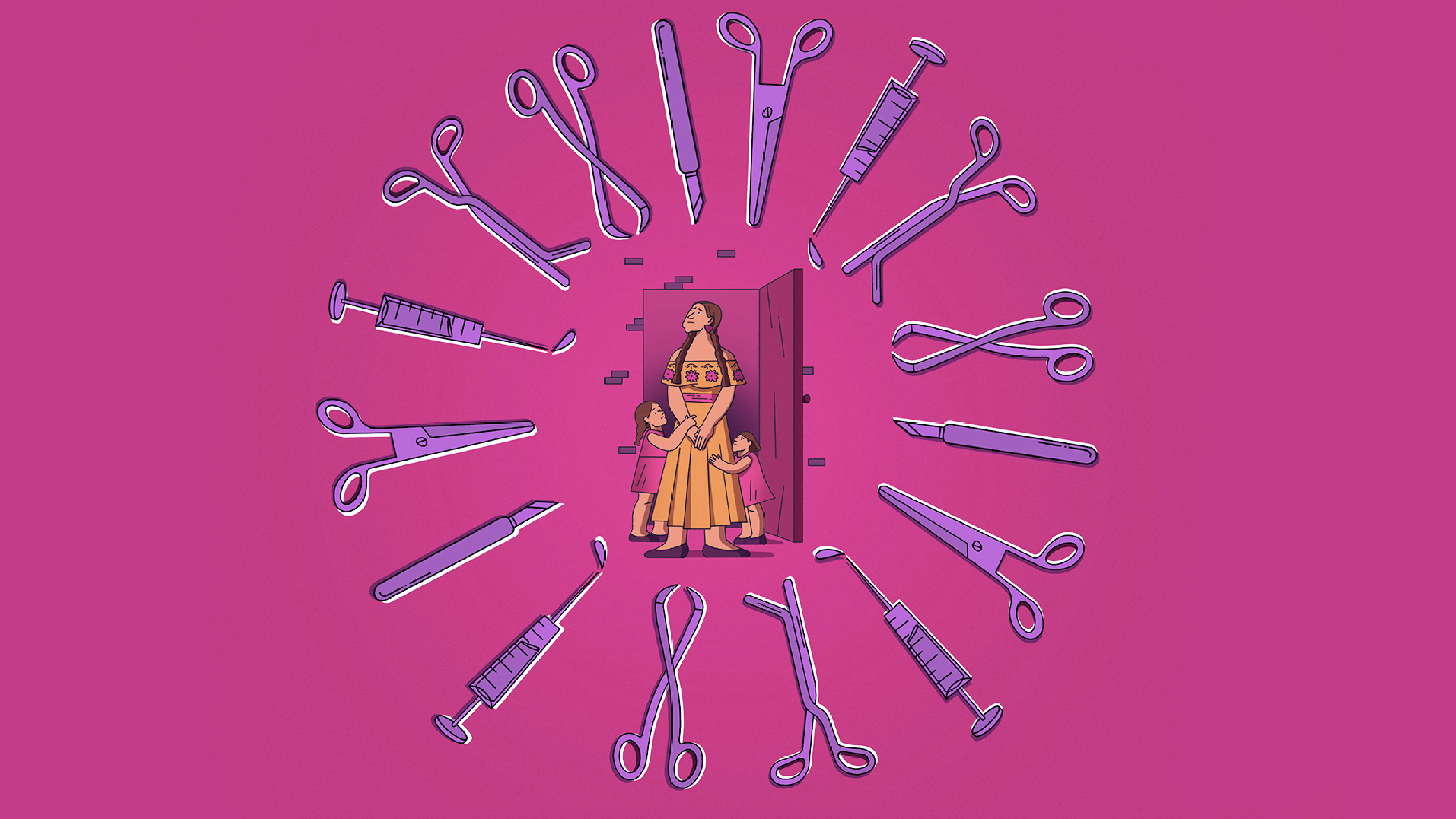
[Daniel A.]: A tubal ligation. Alberto Fujimori’s regime had launched a family planning program, and to meet its targets, health workers were promoting this procedure as one of the main methods of contraception. It’s an irreversible surgical operation that keeps a woman from ever getting pregnant again.
Alfonso, from the very beginning, didn’t agree with his sister going through with it: just a few months earlier he’d heard that a woman from another region had died during one of these operations, part of the same campaign.
[Alfonso]: Celia, be careful with this, I told her, because there’s a lady who died. It’s not, well, it’s not very reliable, I said. She told me: no, I’m not, I’m not going to do it.
[Daniel A.]: She didn’t want to, but the nurses kept up the pressure. They came back, again and again, until Celia felt she had no choice but to accept. Marisela was with her mother when she told a neighbor about the decision she’d made. She still remembers that conversation clearly.
[Marisela]: I already said yes, she says, I already agreed to have it done. Oh, Celia, how could you agree to that? Yes, because they just keep coming and coming. They show up at the house and they won’t leave me in peace. I already told them yes, but they told me it’s something really simple, not to worry, that it’s something, it’s something really easy… Like going to get a tooth pulled, and that’s it. And I’ll come right back home.
[Daniel A.]: But a tubal ligation isn’t dental surgery. It’s not that simple.
Celia wasn’t the only woman who was talked into having an operation like this. There were thousands of cases. In Piura and in different regions across Peru. What was happening was, in fact, one of the darkest chapters in that country’s history.
Our producers Mariana Zúñiga and Sara Selva Ortiz reported this story. Here’s Sara.
[Sara Selva]: On July 3rd, 1997, Celia got up early and finished the housework before heading to the health center. She sent her daughters to school. She made that day’s meal. She cleaned the house. And she left. “I’ll be back soon,” she told her mother. Her appointment was for noon.
[Marisela]: And when we got back from school, around one, maybe two in the afternoon, she wasn’t there. And my grandma kept saying: she still hasn’t come back, and she went alone. By around four in the afternoon, my grandma was already really worried, because back then, of course, there were no cell phones or anything to find out where she was, you know?
[Sara S.]: Hours had gone by and there was still no word from Celia. So the grandmother told one of her daughters-in-law to go to the health center and find out what had happened.
The doctors told her they’d had to transfer Celia to another facility. That she hadn’t reacted well to the anesthesia. And that, on top of that, they’d had to remove a cyst. They had it right there, in a plastic bag. That was what had complicated the operation. The daughter-in-law ran home to let everyone know.
[Marisela]: She came back completely, like, in crisis, you know? Crying. She said: Celia’s in bad shape. They took her to the Clínica San Miguel, in the city of Piura.
[Sara S.]: The city of Piura was about a 15-minute drive away, but the family didn’t have a car to get there. And Celia’s husband, the girls’ father, was at work: back then cell phones weren’t so common, and there was no way to reach him until his shift ended, well into the night. So they ran to call Uncle Alfonso. He lived in Piura, and he could get to the clinic.
[Alfonso]: I found out around, approximately, 5:00 in the afternoon that day. I said to myself, but what? What happened?
[Sara S.]: When he got to the clinic and asked about Celia, they didn’t tell him much. Only that she was in serious condition: in a coma.
Beyond the anguish, everything about it struck Alfonso as very strange. One of the things that stood out most to him was that they’d transferred Celia to a private clinic instead of a public one. They told him not to worry, that the State would cover the costs, but that only deepened his confusion. Why would the State just pay for it, like that, no questions asked? The whole thing seemed a little suspicious.
While Celia was hospitalized in the city, the family went back to the health center in the village. They wanted answers. They managed to meet with the head of the center. They asked for the names of the doctors who had taken part in the operation. And they asked to be given the cyst.
[Alfonso]: It was something, something like ten centimeters, a ten-centimeter sphere. They gave it to my sister-in-law, and that tumor sat in my parents’ house.
[Marisela]: And my grandma kept saying: What happened? She wasn’t in any pain, she’d been fine, she’d been healthy. How could she have had all this inside her?
[Sara S.]: Nothing seemed to add up. So the family kept going back to the health center to dig deeper.
It was an orderly who gave them more details.
[Alfonso]: And he told us there had been a lot of problems, you know?
[Sara S.]: He told them he’d heard how Celia, at one point during the surgery, started screaming in pain. And that right after, the doctors came rushing out of the operating room, upset, because they were missing medication.
[Alfonso]: He told us the medical staff were going back and forth between each other. And we need this medicine. We’re missing this, we’re missing that. Bring me this. Go buy some.
[Sara S.]: He also told them that that day, they hadn’t just operated on Celia, but on 14 other women as well. Celia was second to last. And the cyst hadn’t come from her at all. It had actually belonged to a neighbor from the same area.
After many hours, the family managed to piece together the whole story.
[Alfonso]: We started weaving together all the different versions of what had happened. The lack of medicine at that moment, you know? The staff ran back and forth, desperate. And knowing, too, that the health center was very run-down, that it didn’t have the basic equipment to handle an emergency like that. We put it all together, and I finally had a much clearer picture of what had happened.
[Sara S.]: They learned that Celia had suffered respiratory arrest during the operation, and that because of the state of the health center — which didn’t have the necessary equipment — the response had been delayed. Celia went too long without oxygen. That was what caused the coma.
Alfonso went to visit his sister at the clinic every single day. Sometimes Marisela and her sisters went too: Emilia, who was eight, and Marcia, who was five. Though they never went into the room where Celia was: the family felt it would be too much for young girls to see their mother like that. They’d stay in the park down below while their father or their aunts and uncles went up to visit her.
Marisela had the feeling that something in her life was about to change forever. But she never doubted that her mother would come home, sooner or later.
[Marisela]: So, I’d convinced myself that mom was going to come back at some point, but not the same, more like someone… I mean, my idea was someone in a wheelchair, in really bad shape, maybe unable to talk, or unable to hear, unable to walk.
[Sara S.]: The girls lived through those tense days without fully understanding what was going on. The adults told them Celia was sick and that the doctors were taking care of her so she’d get better. Meanwhile, they had to keep up their routine, going to school.
[Marisela]: So the teacher would ask me every day, right? Marisela, come here for a second. So it was like walking up to her desk… And how’s your mom doing? Fine. I mean, the answer was always fine, because of course, I didn’t have any more information than that. Ah, okay, she’d say, don’t worry, your mom’s going to get better, right?
[Sara S.]: But the days went by and Celia wasn’t getting better.
[Alfonso]: My cousin, who was a nurse, told me, she says: Alfonso, talk to her, because she can hear you. And I remember looking into her eyes, and, well, there was a moment — I don’t know if I just felt it, but there was a moment when a tear welled up, a drop in her eyes. Like a little bit of water slowly forming there in her… That affected me deeply.
[Sara S.]: A little while later, around 11 at night on July 22nd, after 19 days in a coma, Celia died. She was 34 years old.
The next day, the sisters got out of bed ready to get dressed for school. But they noticed there was a commotion in the house. This is Emilia, the middle sister.
[Emilia]: The neighbors were there, my aunts and uncles were there. I remember seeing my dad in the kitchen. They were crying, they were sad. I didn’t know what had happened. I mean, we had no idea what had happened.
[Sara S.]: Their dad didn’t have it in him to tell the girls that Celia had died. Neither did their grandmother. So it was an aunt who broke the news to them.
[Emilia]: She hugged us and told us, well… your mom got sick and went up to heaven. So that’s when we understood that our mom had passed away.
[Marisela]: They told us: your mom has gone up to heaven, she’s with God now.
[Emilia]: And right after that they took us to the house of an aunt, a relative of my dad’s who had a house. Well, next door there was this huge park with swings, so they took us there to keep us distracted.
[Sara S.]: They spent several weeks at that house, going to play at the park, getting ice cream.
[Marisela]: Everyone was watching over us, but in a way that kept us away from that pain. That’s why we never really went through grief in a strong way, like that. It was more like a moment, and then it got calmer. Though there were some very sad moments, you know? At night, I don’t know, I’d just cry, and my dad would tell me, sweetheart, I miss my wife too.
[Sara S.]: While the girls were kept apart from it all, the family arranged the wake and the burial, which drew a huge crowd. Everyone in the community adored Celia.
[Marisela]: Always laughing, always drawing people in, bringing crowds together, not just the family — she was always the one paying attention to everyone.
[Emilia]: She was like the life of every gathering. My mom was always like that, she’d always say something and everyone would laugh. She was the joy of the room, you know?
[Sara S.]: Alfonso says Celia was the one who kept the family together. She was the fifth of eight siblings. Alfonso was the third. They were four years apart and always very close. The day Celia got married, Alfonso happened to be working the night shift. He worked at the power plant in Piura, and it was a time when there were a lot of blackouts. But he made sure the celebration wasn’t left in the dark.
[Alfonso]: I mean, from my post at work, I made sure that that neighborhood, that day, wasn’t touched, that the power wasn’t cut. That way, I was with them too, at their party.
[Sara S.]: Celia was always on the go. She took part in every school activity. She helped her neighbors. She organized the cookouts, the birthdays, the Christmases. And she cooked for everyone. She loved cooking. In fact, she was building a house with her husband on a piece of land. Her plan was to open a little shop there to sell her food.
[Marisela]: She even had the name picked out, you know? She said the shop was going to be called “My Three Marías.”
[Sara S.]: In honor of her three daughters. But that dream came to an abrupt end.
[Marisela]: Everything was in pieces. Because we didn’t have a family anymore. The plan we had for the house, for the shop, it just couldn’t happen anymore. And how we were cared for, our day to day, it changed. It changed completely.
[Sara S.]: After several weeks living with their aunt, the sisters went back to their grandparents’ house. To a sad, difficult life.
[Marisela]: No family gathering was ever celebrated again, there were no more Christmases, nothing. That Christmas that year, and the ones after, the lights just stayed off. Everything was sad, everything was tears.
[Sara S.]: Jaime, the sisters’ father, wasn’t out of work for long: the girls’ schooling still had to be paid for. And it was their maternal grandmother, Baltasara, who took charge of day-to-day life. But the sisters feel that Celia’s death broke their grandmother in two. And that she poured her grief out onto them. Through scolding, demands, chores, shouting.
The joy disappeared from the girls’ childhood. Emilia remembers how a silence settled over the house. Nobody talked about Celia. Not among themselves. Not with their father. Not with the rest of the family.
[Emilia]: Because every time her name came up, my grandma would start crying, but in a way that, I mean, her pain was too much, and seeing her cry brought back so much for us. So we even stopped mentioning her, you know? It was like nobody talked about mom so my grandma wouldn’t feel bad.
[Sara S.]: Life went on. It had to. But everyone was left with the feeling that someone had to be held responsible for what had happened. Jaime didn’t wait long to file a complaint. He did it with the help of a lawyer, who was also a relative of his.
He filed a negligence complaint against the medical staff at the center: the doctors and nurses who had taken part in the operation.
The Piura District Attorney’s Office opened an investigation. Police officers went to the health center, requested documents, and took statements from several people. But within a few months, the prosecutor recommended the case be shelved. He said they couldn’t establish the cause of death. The State offered Jaime a financial settlement in exchange for dropping the case. His lawyer urged him to accept: this is the most you’re going to get, he told him. And Jaime, resigned, agreed. It was simply too painful to keep going. He was given about 3,000 dollars of that era. The lawyer kept half. Jaime chose not to take part in telling this story.
Alfonso, Celia’s brother, refused to let her death be left at that, at nothing.
[Alfonso]: And I said yes, I can do this, yes, I can do it. I’m going to spend my own money, but I’m going to do it, because I need my sister to have justice.
[Daniel A.]: We’ll be right back.
[Daniel A.]: We’re back on Radio Ambulante. Sara continues the story.
[Sara S.]: With the case shelved by the courts, Alfonso started thinking about other ways to draw attention to what had happened to his sister.
He was, perhaps, the most persistent of the siblings. The first of the eight to get a job. He’d also been a union leader. He was used to fighting for his coworkers’ conditions, and filing complaints or approaching politicians and lawyers didn’t intimidate him. In fact, he’d been laid off a couple of years earlier. In the early days of the Fujimori regime, thousands of public sector workers lost their jobs, and Alfonso was one of them. He had time on his hands.
[Alfonso]: The first thing that came to mind, I said, was the Ombudsman’s Office.
[Sara S.]: They’d just opened an office in his region, in Piura. So he sat down at his typewriter and put together an account of everything that had happened. He gathered newspaper clippings about Celia’s death. Also her death certificate. And he brought it all to the Ombudsman’s Office.
[Alfonso]: And that’s when the investigation began. And a whole case file started coming together, you know?
[Sara S.]: Actually, Celia’s wasn’t the first complaint the Ombudsman’s Office had received. That file already included hundreds of cases of women like her: from rural areas, farmworkers, poor women, many of them Indigenous, who had undergone the same operation. Some, like Celia, had died. Others hadn’t, but they had faced pressure or threats. Or complications after the surgery.
Alfonso had heard about some of these cases. The regional press was starting to cover the issue. And he knew there was something behind it. He knew the blame didn’t rest solely with the doctors and nurses.
The one most responsible, Alfonso thought, was the State.
A little over a year after Celia’s death, in 1998, the Ombudsman’s Office published its first report on the case file. It described how the Fujimori government had driven massive sterilization campaigns. It said that tubal ligation, a radical form of contraception, was offered without ever mentioning that other options were available.
Health workers, the report showed, were required to recruit patients, the way they’d done with Celia. In other words, they had quotas to meet: operate on a set number of women each year. The press even managed to publish some of the directives health centers received. In one, for example, every staff member was required to recruit at least two women a month. If they fell short, they were penalized. And there are doctors from Piura who described being forced to carry out more than 250 sterilizations in just four days. Those quotas explained why health workers pressured and pursued women the way they did. And also why the operations were carried out in such precarious conditions. What mattered wasn’t so much how it was done, but how many.
[Alfonso]: And there were recommendations saying that these kinds of procedures shouldn’t be carried out in facilities as run-down as the one in La Legua, a health center that didn’t have an adequate level of care. It didn’t have the infrastructure, the conditions, the medication — it didn’t have even the bare minimum.
[Sara S.]: But it wasn’t just that. Many of these operations were also carried out without consent. In some cases, women didn’t even know they were going to be operated on: they were sterilized during childbirth, for instance. In others, they did know. According to the State, Celia signed a document consenting to the operation. Many women did. But it’s been shown that, in many cases, they signed without being properly informed. Without understanding the risks or the consequences.
In its report, the Ombudsman’s Office asked the State to reform the program to put an end to these irregularities and to investigate the deaths and the pressure campaigns. But almost nothing changed. The sterilizations continued. And no one took responsibility for the deaths of these women. Not even for Celia’s.
But Alfonso never stopped seeking justice for his sister.
[Alfonso]: I said: well, it can’t be that the State just says nothing, right? She has three little girls, and the State doesn’t say a word about, well, we’re going to take responsibility, or we’re going to support the family. But no. She died, she died, and that was it.
[Sara S.]: He started writing to members of Congress, meeting with them. Some even traveled to Piura to understand what was going on. He met with journalists, with anyone interested in the case. He also traveled to Lima often. He wanted to knock on every door he could.
[Alfonso]: Congress, the Ministry, the Ombudsman’s Office — and I was practically on my own.
[Sara S.]: It was hard. He didn’t have the resources to spend much time in the capital. And it was on him that the weight of the fight fell. At the sisters’ house, no one talked about Celia. Her death was still a taboo subject. The three girls grew up without explanations, without knowing how to process their loss. Sometimes they’d remember her with their dad. And he’d tell them about the mole Celia had next to her mouth, the one that made him fall for her the first time he saw her. Every Mother’s Day, they’d go to the cemetery with him to leave flowers. But that was all.
[Emilia]: Not even the three of us, I mean, we never sat down together to talk about it and say, what happened? How do you remember it? Never, because it was, it still is, a really painful subject. It’s very, very hard for us to talk about.
[Marisela]: What we’d say was: your mom? Oh, my mom died because of medical negligence. That’s it. They gave her something, the anesthesia, that made her sick. I think she was allergic, and she got really sick, and, well, they kept her hospitalized and she never got better, and she died. But we didn’t know there was this whole bigger context, like, a program run by the State. We didn’t know that. That information just wasn’t something we had.
[Sara S.]: Their uncle wasn’t asked too many questions either, but at a certain point, he did start telling them he was seeking justice for Celia.
[Marisela]: My uncle would talk to us and tell us, and we’d think, well, what? Against the doctors, right? He’s fighting against those doctors who did something wrong, so they have to pay, or they have to do something, right? For us it was more like, mom’s gone already, so, I mean, what’s the point?
[Sara S.]: What’s the point? She had died. Why stir it all up again?
But Alfonso kept pushing for the institutions to keep investigating.
And that’s what happened. In 1999, the Ombudsman’s Office published a second report. This time, even more detailed. It spoke specifically about Celia’s case and confirmed that her death had been a direct consequence of the sterilization.
But there were also many testimonies from women who had gone through the same process. Horrific testimonies: they described being bribed with clothes, medicine, or food if they agreed to the operation. Or being threatened with being taken to the police, or told they wouldn’t get their children’s birth certificates unless they submitted to sterilization. Women who were operated on while pregnant, or who suddenly woke up having had their tubes tied, without ever having consented to anything.
What Alberto Fujimori’s regime was after with this program was reducing poverty. And, according to different human rights organizations, the solution they came up with was to make sure poor women, most of them Indigenous, stopped having children: essentially, that poor people stopped being born.
The family planning program came to an end in the year 2000. That was also Alberto Fujimori’s last year in power. In total, starting in 1996, close to 300,000 sterilizations were recorded. Vasectomies were also performed, but far fewer: around 20,000. And that despite the fact that the procedure is much simpler. The institutions tallied 44 deaths.
In 2001, with Fujimori now out of power, Congress created a commission to investigate what had happened. It concluded that what the State had done — sterilizing Indigenous women from poor, rural areas — could be considered genocide. The intent, according to the members of Congress, was to eliminate a specific segment of Peru’s population.
[Alfonso]: A very well-written report was produced, and I had hoped that it would lead to some kind of resolution, even a political one.
[Sara S.]: In other words, that politicians would acknowledge their responsibility. But Fujimori — and his supporters — always denied that forced sterilizations had ever taken place. They claimed that all they’d done was offer women every available contraceptive option, including tubal ligation. And that women had always been free to choose.
Members of Congress pushed for a formal complaint, and in 2002, the District Attorney’s Office opened an investigation to determine the responsibility of Fujimori and his health ministers. It was a massive, complex case file. With thousands of cases, including Celia’s and those of other women who had died.
That investigation felt like a boost for Alfonso. But time went by and nothing moved forward. No one was really held accountable, and there were no culprits. Years and years of impunity went by.
[Alfonso]: I could already see that finding justice was going to be a very complicated thing.
[Sara S.]: In 2009, more than a decade after Celia’s death, the District Attorney’s Office shelved the case. The victims’ legal defense argued that these were human rights violations: crimes that never expire under the statute of limitations. But the prosecutor’s office said no, that these were ordinary crimes: medical negligence. And that, given how much time had passed, the statute of limitations had already run out. They couldn’t be prosecuted.
That’s when Maria Ysabel Cedano came into Celia’s family’s life.
[María Ysabel]: Once that first shelving happened, and we saw how much power Fujimorismo still held within the Attorney General’s Office, we knew there wasn’t going to be justice at the national level.
[Sara S.]: María Ysabel is a lawyer and works with Demus, a feminist organization that defends women’s rights in Peru. By that point, she’d already spent years fighting to prove the State’s role in the forced sterilizations. They went through the list of victims, decided to reach out to Alfonso, and traveled to Piura to meet him.
[María Ysabel]: I mean, we found a man, Alfonso, who shared our thirst for justice in the face of a State’s abuse, of an authoritarian regime’s abuse.
For us it was admirable, you know? Because he had gone out, he had knocked on doors, and he had made sure his sister’s case wasn’t forgotten, it wasn’t just another case among many.
[Sara S.]: María Ysabel offered Alfonso the organization’s resources: the experts, the lawyers. For Demus, it was clear the fight had to continue.
[Alfonso]: I no longer felt alone, I finally felt like I had legal support. I said, no, this is different now, now we’re going to do what’s needed to get the truth out.
[Sara S.]: By that point, around 2009, Celia’s daughters were already in their twenties. Marisela was studying biology. Emilia, nursing, in Lima. And Marcia, the youngest, was about to finish school. Their uncle Alfonso decided it was time for them to start becoming part of the process.
[María Ysabel]: He tells us: miss, I feel like I’ve already come a long way on this. And I need my nieces, who are grown now, to also fight for justice — for their mom, for their grandmother, for themselves.
[Sara S.]: But for the sisters, taking that step after so many years of silence was an enormous challenge.
[Marisela]: At first it was no, because we’d be reliving all of this, and we didn’t want to, we were like, we’re okay, you know?
For all sorts of reasons, right? Time, we’d have to go to meetings. No, we don’t get it. It was like a rejection of what the process meant, but I think, deep down, it was really about not wanting to touch the subject of mom…
[Sara S.]: Their uncle kept insisting, and eventually they agreed to a meeting with Demus. And once they started talking with the lawyers and understanding the case, they discovered the scale of it all… They realized it went far beyond them and their family. And far beyond a simple case of medical negligence.
[Marisela]: We started realizing there were so many women whose stories were so similar… women like my mom, I mean, women who went through the same thing, with young kids, but who lived through, and have lived, such a hard life, full of pain, of suffering. A life completely destroyed by what happened to them, you know?
[Sara S.]: Traumatized women. Because of the experience, because they’d been robbed of the chance to have children. Many of their husbands left them once they found out they could no longer get pregnant. All of this deeply affected the sisters, and they decided they had to get involved.
[Emilia]: We understood that it wasn’t just about mom, you know? And that really made us feel like, well, we have to do this for her, and for all those other women too.
[Sara S.]: Little by little, with the help of the organization’s psychologist, they began putting into words what had happened to their mother, and what they’d lived through during those summer days of 1997. The nurses’ visits. The day of the operation. The earthquake that followed within the family.
[Marisela]: We had to go through this process of opening up, opening something we didn’t want to show, that we didn’t want to bring out. And putting on the table things we’d kept hidden for so long.
[Sara S.]: Little by little they felt more confident, more prepared to speak out about the lack of accountability, and to face reporters’ questions. They wanted to read everything they hadn’t read over all those years about what had happened to their mom. They wanted to speak with authority, to understand the legal terms, the technical details. They were afraid of not living up to the expectations of Demus, of the other victims, of their uncle. But they soon realized there was already a legal team behind all of that. All that was being asked of them was to talk about their memories, about what their mother’s death had meant in their lives. To do all the psychological work they hadn’t done over the years. That, in itself, was already valuable.
That’s how they became the public face of the case. Alfonso, of course, was still there — after so many years, it was hard for him to let go.
Together, they tried to draw attention to Celia’s death. They demanded that the District Attorney’s Office reopen the investigation. But nothing was moving in Peru. That’s when, in 2010, Demus made the family a proposal:
[María Ysabel]: A case can be brought before the Inter-American system, because justice isn’t being found here.
[Sara S.]: They could keep pushing in Peru, or they could turn to international bodies.
[Marisela]: So we said, well, let’s go to the international bodies, then.
[Daniel A.]: We’ll be right back.
[Daniel A.]: We’re back on Radio Ambulante. Sara continues with the story.
[Sara S.]: With the family on board, Demus, the organization helping them, took things a step further and brought Celia’s death before the Inter-American Court of Human Rights. This is, essentially, the last legal resort: an international tribunal that can be approached when a state violates human rights and that country’s justice system is unable — or unwilling — to respond.
It’s a slow process, one that usually takes a long time to reach a ruling.
The Court studied the case for several years. Meanwhile, the sisters started working, built families, and had children. And Demus kept fighting in Peru: doing everything possible to keep the case alive in that country’s courts. But there was always something holding it back.
[Journalist]: The Supraprovincial Criminal Prosecutor’s Office determined that former president Alberto Fujimori and his former ministers, Alejandro Aguinaga, Marino Costa Bauer, and Eduardo Yong Motta, bear no criminal responsibility in the case of the forced sterilizations…
[Sara S.]: At the prosecutor’s office, the investigation was opened and shelved, over and over again.
[Journalist]: Prosecutor Marcelita Gutiérrez shelved the investigation against former president Alberto Fujimori and his former ministers for the second time…
[Sara S.]: They kept saying there hadn’t been any systematic forced sterilizations. That Fujimori and the ministers weren’t to blame. That the ones responsible were the doctors who had carried out the operations.
[Journalist]: A prosecutor found that the former Peruvian president is not responsible for the campaign of forced sterilizations…
[Journalist]: In this case, the prosecutor will only bring charges against six doctors…
[Sara S.]: The case moved through different prosecutors, but the outcome was always more or less the same. This, again, is Maria Ysabel Cedano, the lawyer for Celia’s family.
[María Ysabel]: Why? Because Fujimorismo, even though it was no longer in power, still had far too much political influence within the Attorney General’s Office and the judiciary.
[Protesters]: We are the daughters of the peasant women you couldn’t sterilize…
[Sara S.]: The activists, María Ysabel among them, spent hours outside the prosecutor’s office. They wore polleras, the traditional skirts worn by Indigenous women.
[Protesters]: Forced sterilizations, a crime against humanity.
[Sara S.]: There was some progress. Meaningful, at least in terms of memory and visibility. In 2015, a registry of victims was created. And thousands of women signed up. And in 2021, Fujimori came close to standing trial as a defendant. A judge did open a criminal case against him, but that ruling was also overturned.
Then came 2020. The Inter-American Court of Human Rights was still reviewing the case when the Peruvian State tried to reach out to Celia’s family. It happened twice. But the approach was so clumsy that it felt, more than anything, like a mockery.
For example: one day, Marisela got a phone call. It was a staff member from the Ministry of Justice.
[Marisela]: It was like: Hi, um, I’m calling from the Ministry of Justice. I’m calling about your mom’s case. Um, and how old is the lady? Like that. And I was like… what lady? I was completely confused. I said, you must have the wrong person. I told her: my mom passed away. Oh, okay. Yes, yes, yes, okay. Yes. I have it here, um. Like she was only just then looking at the information, and she said: oh, okay, but what year, what year did she pass away?
[Sara S.]: In other words, they hadn’t even looked into the case. It was absurd.
On another occasion, the grandmother, Baltasara, got a visit at her house. Some officials came by to ask how she was doing. And they offered her psychological support. More than 20 years after her daughter’s death, suddenly, the State wanted to offer some kind of reparation. The family accepted anyway. The grandmother really did need it. They agreed the visits would happen twice a week. But they never came back.
With situations like these, they had no hope the process could move forward in Peru. But they did trust that a response would come soon through the international system.
And it did. The Inter-American Court finally took up the case in 2023. Twelve years after Demus first filed the petition. And 26 years after Celia’s death. It had taken an enormous amount of effort, but no case of forced sterilization had ever gotten this far.
The Court set the public hearing for May 22nd, 2025, in Guatemala City. All three sisters would go, of course. As would representatives of the State. Both sides would also bring experts — witnesses with specialized knowledge, as they’re called in legal terms. It was time to prepare.
The three sisters were going to travel to Guatemala. But they decided Marisela would be the one to represent them: she was the one who held onto the most memories.
[Marisela]: What was really hard for me, what really hit me hard, was, I mean, knowing that I wasn’t just responsible for representing my sisters, but for representing this huge group of women victims. I mean, that really was… that’s when I got super nervous.
[Sara S.]: On the morning of May 22nd, 2025, the team arrived early at the university in Guatemala City where the hearing was being held. It was also going to be livestreamed, so anyone could follow it online. Alfonso would watch from Piura. And a group of women, victims and activists, would gather at Demus’s offices in Lima. There was a lot of anticipation.
[Marisela]: When I heard that all the women had come together, that they’d traveled from the provinces to Lima to watch the hearing together, I felt like: wow! This isn’t just about me, my sisters, and my family. This is for so many… I mean, it’s… And I think that fear, in some way, turned into strength.
[President]: Good morning, everyone. This public hearing is now open.
[Sara S.]: Marcia and Emilia, who was seven months pregnant, watched their older sister from the audience. They say their hearts were in their throats.
[Court Clerk]: Marisela del Carmen Monzón Ramos, good morning.
[Marisela]: Good morning.
[Sara S.]: Marisela was sitting at a small table off to one side of the room, near the judges. She was nervous too, but as soon as the first questions from her lawyer, María Ysabel, began, her answers started coming easily.
[Demus Lawyer]: Marisela, do you remember where you were living in July of 1997?
[Marisela]: Yes, at that time I was living with my family in the village of La Legua, which is part of the district of Catacaos, in Piura, Peru.
[Sara S.]: Marisela told the story we already know. The memories she has of those summer days in 1997. The impact her mother’s death had on her family. And the impunity with which, in her view, those responsible had acted.
[Demus Lawyer]: What do you hope for from this process before the Court? What does it mean to you to be here today, before the Court?
[Marisela]: My sisters, my family, we hope — after nearly three decades since mom passed away — we hope the truth is known, that the truth of what happened is recognized.
[Sara S.]: It was an enormously important moment for all of them. Here’s Emilia again.
[Emilia]: She did really well, honestly, it moved so many people. We saw people who had nothing at all to do with mom’s case, students, who were crying, I mean, it was really powerful, it hit hard.
And it also felt like a weight had been lifted off us, you know? I felt that too.
[Sara S.]: And here’s Alfonso…
[Alfonso]: I felt so proud, you know? And I said, this is the result of my work too. I mean, I felt satisfied.
[Sara S.]: Afterward, it was the State’s turn. Their strategy was to bring in an expert witness who would try to show that the surgery had been carried out with Celia’s consent. And that, therefore, it couldn’t be considered a forced sterilization.
And to back up that argument, three days before the hearing, past the deadline, the State unexpectedly submitted a new piece of evidence: a document, supposedly signed by Celia, in which she agreed to undergo the operation.
The family knew this document existed. But not because Celia had ever told them about it. As we mentioned, the Ombudsman’s Office reports referred to it. But even though the reports mentioned it, the family had never actually seen it. The State always had an excuse. They said it was lost. Buried among thousands upon thousands of papers. Or destroyed with time.
But right at that moment, in a crucial hearing, nearly 30 years after Celia’s death, the document turned up. And it was, in fact, the core of the State’s defense. This is their expert witness.
[Expert Witness]: As Annex Two of my report, you can see the informed consent form, on the right-hand side, okay?
It reads Celia Ramos Durán…
I voluntarily request and authorize the Gynecology and Obstetrics Department to… to perform a tubal ligation operation, clearly understanding that this is the treatment that will prevent future pregnancies. And below, we can see Celia Ramos Durand’s signature.
[Sara S.]: Alfonso, watching from Piura, couldn’t believe it.
[Alfonso]: For a document to surface that, through the whole process — the shelving, the reopening — had never once been presented. And what a coincidence that it exists on this very day, at the hearing before the Court. No, that’s a lie, plain and simple.
[Sara S.]: He thought that maybe the whole process could be ruined. As soon as he saw it, watching from Piura on the livestream, he wrote to the Demus legal team on WhatsApp.
[Alfonso]: And the Demus lawyer told me: yes, this is a low blow the State is pulling… And we’re not going to let it stand.
[Sara S.]: The lawyers were furious, convinced the State had acted in bad faith. They believed it had wanted to withhold that information to catch them off guard, so they wouldn’t have time to react. But what they did instead was try to show that the analysis of the document had clear flaws. Here’s one of the team’s lawyers questioning the State’s expert witness that day.
[Lawyer]: Did you know Mrs. Ramos?
[Expert Witness]: Unfortunately, no.
[Lawyer]: Then how do you know the document was signed by Mrs. Ramos?
[Lawyer]: Did you compare Mrs. Celia Ramos’s signature to the one that appears on the document?
[Expert Witness]: Unfortunately, that falls outside my area of expertise. I’m not a handwriting expert either.
[Sara S.]: The lawyers managed to turn that surprise document to their advantage. They conceded that yes, Celia had likely signed a paper agreeing to the surgery. But even if she had signed it, the document never explained the consequences of the operation. It never said it was irreversible. It never mentioned the risks she faced. It only authorized the procedure. It wasn’t, then, proof of prior, full, free, and informed consent.
The legal team held their ground. And the judges seemed to agree. In fact, the sudden appearance of the document struck the tribunal as strange too. This is one of the judges, questioning the State’s lawyer.
[Judge]: Where did this document — this supposed consent from the alleged victim in this case — come from? Why now? I think we’re a bit confused here.
[State Lawyer]: The investigations led us to the Ombudsman’s Office, in order to retrieve it and bring it into the proceedings, that’s exactly it.
[Sara S.]: When the hearing ended, the family and the legal team walked away with a good feeling. Really, just the fact that they’d been able to tell their truth before the judges of an international court was already an achievement.
[Marisela]: I mean, for me it was like, phew, okay, it’s done, it’s over… And happiness… knowing that we’d done it well.
[Emilia]: And yes, happy, because seeing the Peruvian State’s defense, it was like there’s no way the whole world can keep believing that nothing happened, right? I mean, there’s no way they can be that blind and not rule in our favor.
[Sara S.]: But they didn’t know what the judges would decide. And they wouldn’t know for quite a while. The ruling could take months.
For the sisters, going back to their routine while they waited for the verdict wasn’t easy.
But life had to go on, had to pick back up where it left off, until the ruling came and everything got stirred up all over again.
[Marisela]: We wanted to know, like, what? What? What? More or less. And even the lawyers didn’t know. And they said, no, this is really… I mean, it’s the day of the reading. That day, we’ll find out.
[Sara S.]: That day was March 5th, 2026, ten months after the hearing in Guatemala. The Court summoned all parties for the public reading, over video call.
Marisela and Marcia agreed to watch it from Demus’s offices in downtown Lima, in a room set up for the team. María Ysabel was there too, after decades of fighting for a moment like this. And in another room, right on the floor below, a group of women, also victims of forced sterilization, gathered together.
Emilia was at home, and Alfonso watched the whole thing from work.
[President]: Good afternoon. We will now proceed with the notification of the ruling in the case of Ramos Durán et al. versus Peru…
[Sara S.]: The reading of the ruling began at 5 in the afternoon.
[President]: The Inter-American Court of Human Rights, in its ruling, declared the international responsibility of the Peruvian State for the forced sterilization…
[María Ysabel]: When they started reading the ruling, it was one of those moments where you just can’t believe it’s happening.
[President]: The Court found that the State violated the rights to life, personal integrity, personal liberty, and private life.
[Alfonso]: It was a real satisfaction for me that the Court assigned full responsibility to the Peruvian State.
[President]: The State will move forward with the investigation to determine the circumstances of Mrs. Ramos Durán’s death.
[Alfonso]: 100% responsibility.
[Court Clerk]: I certify that the ruling issued by the Inter-American Court of Human Rights has been formally notified…
[Marisela]: So, when it was all over, everyone applauded… And you could hear the voices from downstairs, like when there’s a goal, you know, that kind of noise. And everyone: yes, justice for Celia! I was just in shock.
[Sara S.]: The lawyers hugged each other. And so did Marisela and Marcia.
[Marisela]: I felt like my mom was right there. Like she was saying: Yes, I’m here, and it’s over now. It’s done. This happened. It was this energy. I swear I could picture her standing right there beside us. Like there were three of us hugging, not just Marcia and me. I’d never felt that before. Never, ever.
[Sara S.]: The Court had ruled in their favor. It was proven that there had, in fact, been systematic forced sterilizations. That they had, in fact, targeted poor and Indigenous women. That they had been carried out without consent, through pressure and coercion. That this amounted to reproductive violence. And that the State had driven all of it.
[María Ysabel]: To have it recognized that this was a State policy that no one can deny anymore. They can try, but we now have an undeniable historical, legal truth. The world knows now.
[Sara S.]: The ruling required the State to move forward with the investigation into Celia’s death. To bring those responsible to trial and to hold a public event acknowledging the government’s responsibility. It also called for compensation for the family and for a public policy to be adopted so this could never happen again.
[Emilia]: Wow, I felt like, finally, right? Of course, there are losses that will never be repaired. No one, no one is going to give us our mother back. No one is going to give us back all this time we’ve spent without her, no one is going to give us back our childhood, but it’s still a huge achievement.
[Sara S.]: Now they know the truth. And so did the rest of the world.
[Daniel A.]: The fight of the Ramos family and their lawyers isn’t over: now they have to make sure the State complies with the Court’s ruling. In Peru, the judicial investigations are still ongoing. The case remains in the hands of the prosecutor’s office. With Keiko Fujimori as president, the case’s future is even more uncertain. Keiko, like her father, has always denied that forced sterilizations took place.
Thanks to Vanesa Restrepo for her help producing this episode. Also to Daniel Titinger, for letting us use his studio to record the interviews.
Sara Selva Ortiz is a producer at Radio Ambulante and lives in Madrid. Mariana Zúñiga is a producer at Radio Ambulante and lives in Caracas. This story was edited by Camila Segura, Luis Fernando Vargas, and me. Bruno Scelza did the fact-checking. Sound design is by Andrés Azpiri, with music by Ana Tuirán, Rémy Lozano, and Andrés.
The rest of the Radio Ambulante team includes Paola Alean, Adriana Bernal, Aneris Casassus, Diego Corzo, Emilia Erbetta, Camilo Jiménez Santofimio, Germán Montoya, Samantha Proaño, Natalia Ramírez, Juan Pablo Santos, David Trujillo, Elsa Liliana Ulloa, Luis Fernando Vargas, and Franklin Villavicencio.
Carolina Guerrero is the CEO.
Radio Ambulante is a podcast from Radio Ambulante Estudios, produced and mixed on Hindenburg PRO.
If you liked this episode and want us to keep making independent journalism about Latin America, support us through Deambulantes, our membership program. Visit radioambulante.org/donar and help us keep telling the region’s stories.
Radio Ambulante tells the stories of Latin America. I’m Daniel Alarcón. Thanks for listening.