
Six Thousand Meters High | Translation
Share:
► Click here to return to the episode official page, or here to see all the episodes.
♥ We live in difficult times. We are a non-profit media, and our permanence depends on listeners like you. If you value our work, join Deambulantes, our membership. Help us elevate Latino voices and tell the story of our communities. Your contribution is directly invested in our journalistic work and makes all the difference.
►Do you listen Radio Ambulante to improve your Spanish? We have something extra for you: try our app, designed for Spanish learners who want to study with our episodes.
This podcast is the property of Radio Ambulante Studios. Any copy, distribution, or adaptation is expressly prohibited without prior authorization.
The following English translation was generated with the assistance of artificial intelligence.
[Daniel Alarcón]: This is Radio Ambulante, I’m Daniel Alarcón.
[Gabriela Cavallaro]: The Tupungato is very tough. I always recommend going to Aconcagua first and then to Tupungato, even though it’s lower in altitude, you know?
[Daniel A.]: She is Gabriela Cavallaro, a mountain guide in Mendoza, Argentina. Tupungato is a volcano about 6,570 meters high in the Andes mountain range, a giant of ice and stone that has half its body in Chile and half in Argentina.
[Gabriela C.]: Here we are alone. You look around, kilometers in every direction, there’s no one. We are absolutely alone.
[Daniel A.]: And there, in that immense solitude, was Gabriela with another guide and two tourists, one afternoon in January 2024, when this story begins.
They had been on the trek for several days, guided by a muleteer and accompanied by a couple of mules. They had started the ascent in Chile, on the north face of the volcano, the most commonly used route to climb, but on the fourth day they found that the place where they needed to advance was blocked.
[Gabriela C.]: There had been avalanches and it swept away part of the face we had to climb and it was inaccessible for the mules.
So, well, the muleteer who was going a bit ahead couldn’t find a way through.
[Daniel A.]: And they, Gabriela, the other guide and the tourists, didn’t know which way to continue either. The muleteer, who knew the volcano well, suggested they go another route that would take them to the west face.
[Gabriela C.]: So, well, we said if the muleteer knows it, if it’s accessible up to there, let’s continue to that place. And well, from there we’re going to have to read the mountain to see where we’re going to climb it.
[Daniel A.]: Reading the mountain. Deciphering its signals, anticipating danger, taming fear. Things Gabriela has learned in the 15 years she’s been climbing and descending thousands of meters in Mendoza and in other parts of Argentina, Latin America and the world.
But when they got there and had the west face before them, already at 5,400 meters altitude, they knew it was impossible.
[Gabriela C.]: We really saw it as impractical. It was a face with rock, with parts with snow, with ice. So we decided to go around the west face. Go in traverse, traverse means going straight, let’s say, without gaining much altitude. From the west to the south.
[Daniel A.]: They knew that there, on the south face of the volcano, there was a known route, already traveled several times. It was a difficult path, somewhat hostile.
[Gabriela C.]: The thing is that from the south you enter a glacier. And when you enter a glacier you have to respect certain schedules because of the conditions of the snow, of the ice. You can’t… You can’t… enter so late because conditions start to change. Things start falling from above because it starts melting. So sometimes there are… rocks fall, ice blocks fall…
[Daniel A.]: Still, they were going to try. Carefully. But when they reached 6100 meters altitude, not so far from the summit, one of the tourists began to lose their rhythm.
At that altitude, with extreme cold and little oxygen, the body enters survival mode. Continuing forward, without favorable conditions, can be very dangerous. So they decided to stop to have something hot, rest and calculate the next steps. It was then that the other guide pointed to something he saw in the distance.
[Gabriela C.]: So he calls me, I approach where he is and he says: What do you see there?
[Daniel A.]: Gabriela looked where he was pointing: about 30 meters above them, on the glacier…
[Gabriela C.]: And you could see a backpack with something yellow that at that moment seemed, I don’t know, it really seemed like skin. At first impression it looked like a hand, a head…
[Daniel A.]: You may have heard stories of bodies found on mountain paths like Everest or Aconcagua. It’s not unusual in mountaineering, less so in such extreme places. For Gabriela it was, initially, disturbing, but from where they were they couldn’t really see clearly what it was. And although she was very curious, she couldn’t get closer either.
[Gabriela C]: And to be able to go to that place because it was kind of resting on the glacier. I would have had to take out a rope, put myself… It wasn’t so accessible.
[Daniel A.]: So she took some photos from afar and marked the place on GPS, while the other guide continued toward the summit. She had already decided to go down with the other tourist, who was very tired. When they met again at one of the camps a few hours later, he had more information.
[Gabriela C.]: There he tells me look, it was a backpack and the yellow thing we saw isn’t a body, it’s a yellow insulating mat.
[Daniel A.]: An insulating mat to put on the ground, under the sleeping bag, to protect it from the cold. In the backpack, he told her, there were some other things: some tools, a video camera, some clothes, but no identification. Nothing that, at first glance, indicated whose it was or how long it had been there.
[Gabriela C.]: The backpack stays there. Why? Because imagine this backpack was an expedition backpack but at first glance you could see it was very large and that weighed at least more than 20 kilos. It was impossible to bring it down.
[Daniel A.]: And although there was no body, it was obvious that behind that backpack was lost in Tupungato, who knows since when, there was a story. And Gabriela wanted to find out.
Our producer Emilia Erbetta continues the story…
[Emilia Erbetta]: It took Gabriela three days to come down from Tupungato and a few more to get home to Mendoza. On the way, she couldn’t stop thinking about anything other than the backpack. She was intrigued to know whose it was and how long it had been there.
So when she was back home, she started doing some research.
[Gabriela C.]: Well, I say, I’ll have to investigate. And yes, of course, with discretion, because we don’t know whose it was, we don’t know what it’s about. Of course there’s a family behind this, for sure… So nothing, there, like keeping it quite private.
[Emilia E.]: With the little information she had, she started the search.
[Gabriela C.]: This backpack seems to be from the 80s, from the 90s. Well, who went through this face, who didn’t come back, who didn’t return? What happened? So you start talking with people who know a lot about the history of mountaineering and asking them ‘look, we found this. What do you think it is?’
[Emilia E.]: Although the backpack had stayed on the mountain, the other guide did bring down certain things: a Super 8 video camera, some film rolls, and an iron ice axe, those used to break ice. Although the metal was somewhat rusted by the wind, cold and years, it was still possible to distinguish a name engraved: Zabala.
The ice axe was a pretty good clue: talking with other guides and searching for information on the internet, Gabriela discovered that Zabala was the surname of an old manufacturer of mountain tools from the city of Tandil, a mountain range area in Buenos Aires province.
With that information, she continued investigating: she reviewed names of mountaineers from Tandil and searched for specific information about expeditions to Tupungato in which climbers from that city had participated. But she was missing a first name. Something that would guide the search a little better. It was her boyfriend, who is also a guide, who first proposed it. They were chatting about the topic when he told her: Hey… could it be Guillermo Vieiro’s?
Gabriela knew who he was talking about. Guillermo Vieiro is a very well-known name in Argentine mountaineering, one of the heroes of national climbing. And although he lived in Buenos Aires, he often worked with the Tandil Andean Club. They called him ‘the tamer of Aconcagua,’ because he made TK ascents to that 6961-meter mountain, the highest in South America, and even slept at the summit to acclimatize for the Himalayas.
[Gabriela C.]: When you start getting into this sport you start reading and start investigating and you learn, right? About who made the first ascents to emblematic mountains. Who opened a new route…
He was famous in the mountains.
[Emilia E.]: He was famous for his adventures. Even the last one: climbing Tupungato via the east face, a very difficult epic that no one has ever repeated. Vieiro died in an accident in January 1985 while descending from the volcano via the south face. The same one where they found the backpack. He was going with another mountaineer, a 19-year-old boy named Leonardo Rabal, who also died. Their bodies, tied together by a rope, were rescued a month later.
Gabriela googled Guillermo Vieiro and the first thing she found was a blog that told his story. Accompanying the text, there were some photos.
[Gabriela C.]: And of course, when I see the photo it was the backpack, there was the yellow insulating mat, it was the red and black backpack and the same insulating mat. I say, No, it can’t be.
[Emilia E.]: Because seeing the photo on the screen, she started to understand the value of what she had found. Because if the backpack really was Guillermo Vieiro’s, then it had been lost on the mountain for 40 years.
[Gabriela C.]: I tried to obviously say well, let’s see Gaby, calm down a bit. Cover your emotion a little, like your emotion as a mountaineer that you’re finding something that is part of the history of Argentine mountaineering. So well, slow down that emotion a bit and put yourself in the family’s place. It’s about a person who died there. So well, of course, approach it differently, approach it with all respect and from there, eh, what the next steps would be, what they were.
[Emilia E.]: Asking around, she learned that when he died, Vieiro had 3 children: a 7-year-old boy, a 4-year-old girl and a baby of just 9 months. Gabriela didn’t even have time to look for them. They found her first. Because news like the backpack found in Tupungato travels fast in the mountain world, and the rumor had already reached Vieiro’s children through another guide.
It was Guadalupe, the youngest of the three, who first contacted Gabriela. This is her.
[Guadalupe]: We didn’t know there could be a backpack. You know? We never even asked ourselves that. None of the three of us. I think I never thought there could be something of my dad’s in that… in that mountain, on that volcano.
[Emilia E.]: So, at first it was hard for her to believe. But when Gabriela sent her the video of the backpack that they had recorded with a cell phone on Tupungato…
[Guadalupe]: And I see it and I say yes, I mean, I had already seen it in other photos. I send it to my mom, I tell her: Hey, this is dad’s backpack. Yes, she tells me. I mean, 100% sure it’s your dad’s backpack. And there a craziness starts, a craziness of contacts, of networks, of I don’t know, I don’t know. People started appearing, people I had never talked to in my life and who had been on that same expedition back then.
[Emilia E.]: But all her dad’s friends started telling her no, that wasn’t his backpack…
Like saying ‘It’s impossible, right? Your dad didn’t have a super eight camera. He didn’t have a video camera.’ They tell me no, no, no. How is the backpack going to appear? Like everyone, you know, saying no.
[Emilia E.]: Guadalupe had a few moments of anguish: she had told Gabriela that yes, it was her dad’s backpack. And now other people were telling her no, that it was impossible… She didn’t know what to believe.
And while the backpack remained on the volcano, there weren’t many ways to know. Only one clue remained to explore. The film rolls they had found inside. So Gabriela had them developed and digitized.
Then, she sent the video to Guadalupe. Sitting in her house, suddenly a window to the past opened before her on her computer screen: it was several minutes of images without sound, in which you see a young man dressed in thick mountain clothes and a red wool hat. He’s sitting and writing in a notebook with his hands wrapped in gloves. Guadalupe recognized him immediately, because she had already seen his face in photos.
[Guadalupe]: Of course, if it was Leonardo who was at the summit, I mean, you could clearly see it was them, let’s say, there was no confusion…
[Emilia E.]: In the image you see Leonardo Rabal, the 19-year-old who died with her dad descending from the volcano. The one filming, then, had to be him, Guillermo. In the video, the camera pans across the snowy and cloudy landscape of the summit. So they had managed to reach it, something that had never been confirmed.
And there they were, one on each side of the camera. Two men on the frozen summit of Tupungato, the last day of their lives. A scene that had been locked in that backpack for almost 40 years.
That image opened for Guadalupe and her siblings a door to a past they had always approached cautiously… With a mixture of fear and curiosity. Because until that moment, their dad’s story, his life and his death, had been almost a forbidden topic for them.
[Daniel A.]: A pause and we’ll be back.
[Daniel A.]: We’re back on Radio Ambulante. Emilia continues the story.
[Emilia E.]: For Guadalupe and her siblings, Azul and Rodrigo, everything that had to do with their dad was always surrounded by an aura of pain and secrecy.
[Guadalupe]: My mom always talked very little. And the truth is that, many times not in the best way, because she has a very sad and painful memory. I mean, she feels it was stupid to lose your life that way, right? And to miss out on your family today and well, on us and etcetera. So like well, she always talks very much from pain, sometimes from anger…
[Emilia E.]: And it’s because the Tupungato expedition was supposed to be Guillermo’s great last ascent. Upon his return, the entire family would move from Buenos Aires to Entre Ríos province, where a new position in a telecommunications company was waiting for him, as he was an engineer. His wife had quit her job and was waiting for him to start that new life together.
She, who specialized in Art History, didn’t like climbing and was afraid of her husband exposing himself like that. After his death, she couldn’t forgive him for giving his life to the mountain, leaving them alone. And that’s why she never talked about him. She didn’t do it with us either.
[Azul]: It was like a disrespect to my mom to talk about my dad.
[Emilia E.]: She is Azul, the middle sister. In ’85 she was 4 years old.
[Azul]: My dad’s figure wasn’t well regarded, like he was a person who had abandoned us and who had chosen something else that wasn’t his family.
[Azul]: It was a bit every man for himself. It was a quite complicated situation economically and above all things, emotionally for everyone, right?
[Emilia E.]: But that didn’t mean their dad wasn’t present, in some way.
[Azul]: I always thought about him. Always.
[Emilia E.]: She didn’t just wonder who her dad had been, why or how he had died, but, above all, how he had lived.
[Azul]: I had no idea about my dad’s life, what he had done, which institutions he had been part of…
[Emilia E.]: Their dad’s life was almost a mystery. Pure absence.
[Azul]: How did I live my life? I didn’t have a father. He was a person who had killed himself on a mountain. No. That was all I knew. I wasn’t going to know more about him. Everything about him was negative, let’s say. His life wasn’t honored, I wasn’t told who he was…
[Emilia E.]: And her siblings felt something similar. And so, they grew up like that, without knowing much about the weight the Vieiro surname had in the history of Argentine mountaineering. And at the center of all that silence, there was something especially forbidden.
[Emilia E.]: An almost unspeakable word. In front of their mom, they couldn’t talk about anything related to the mountain without triggering a fight. But they needed to know more. So, each in their own way, they sought that information they couldn’t find at home. When he finished school, Rodrigo decided to travel to Mendoza to meet some of his dad’s mountaineer friends and visit the camps at the base of Aconcagua.
[Emilia E.]: Later, in their adolescence, Azul and Guadalupe approached the Buenos Aires Andean Center, which their dad had been part of. They found out about his expeditions, his achievements… They wanted to know what he was like as a mountaineer.
But that curiosity came with consequences. And brought big conflicts with their mom. And when Guadalupe and Azul went to the Buenos Aires Andean Center, their mom warned them: if they started climbing, she would never speak to them again.
[Emilia E.]: But over time and despite their mom’s warnings, the girls also went out to the mountains. Guadalupe studied psychology and moved to Bariloche, a city in southern Patagonia, at the foot of the mountain range, and there she started rock climbing. Azul became a lawyer, and stayed in Buenos Aires, but traveled several times to the mountain range to make ascents with guides.
And although each one later had different experiences, in those first approaches to the landscape that had fascinated their father, the two felt the same thing…
[Guadalupe]: I always have a very ambiguous relationship with the mountain, like love and terror.
[Emilia E.]: Azul had that same mixture of feelings.
[Azul]: Absolute fear. But a beautiful thing at the same time. And it seemed to me something… It was like… it blew my mind to get to the foot of a mountain and the silence. It’s indescribable, I can’t describe what the mountain generates in me, but above all things, fear…
[Emilia E.]: And that fear accompanies Azul in many other parts of her life, not just in the mountains.
[Azul]: I grew up living with a lot of fear, to this day I still fight with that fear because I don’t understand what fear is reasonable and what isn’t, because I have a fear that goes through everything. If my dad, such an experienced person, dies on the mountain, I said, no one is safe in life.
[Emilia E.]: Beyond those approaches to their dad’s world, for the three of them he continued being a diffuse presence, without clear edges. A figure at times almost ghostly.
The appearance of the backpack completely transformed that: without expecting it, they were faced with a material trace of their dad’s passage through this world. It was a huge shock.
[Azul]: I mean, I didn’t know how much I needed him to appear until he appeared. So, well, it’s fantastic because I realized how much I needed him to appear on the plane of reality. Not in my head, let’s say like, ‘Well, I have a dad who exists…’ At some point, I always felt that he existed. But I needed, deeply, a greeting here in reality. And it was through his backpack. So I interpret it like he finally appeared. He’s real. He existed.
[Emilia E.]: This unexpected reappearance didn’t bring them calm, on the contrary.
[Guadalupe]: The news, let’s say, fell like a bomb in my family. It was a bomb on all levels. Right? Like, happiness on one side, like feeling that my dad was talking to us again, was appearing again. But well, it also generated a lot of chaos, because my family was already quite broken, let’s say, it was already kind of hanging by threads and well, this ended up cutting the threads.
[Emilia E.]: The relationship between the family had never been easy, there had always been fights and misunderstandings. And all that became even more tense when they had to make a decision: would they go or not to look for the backpack on the volcano?
[Daniel A.]: A pause and we’ll be back.
[Daniel A.]: We’re back on Radio Ambulante. Emilia continues the story.
[Emilia E.]: From the moment she found the backpack on Tupungato, Gabriela, the guide from the beginning of this story, became obsessed with the idea of going back to get it. She proposed it to Guadalupe shortly after meeting her. She also asked if she and her siblings didn’t want to participate. It wasn’t going to be easy, because Tupungato is a very challenging volcano, but they could try even if they didn’t reach the backpack itself.
[Gabriela C.]: So what we can do is put together a team of people, an advanced team, so to speak, who are going to go to the back pack. The rest of the group can stay in camps at lower altitude, safer there.
[Emilia E.]: Guadalupe immediately said yes. And although she tried to explain it to her mom, the decision cost her one more fight with her, which lasted several months.
[Guadalupe]: I was able to talk about understanding a bit that this was something mine and that I needed to do and that I understood her fears. But that was something I needed to do for myself. No, no, no, it didn’t have to do with her.
[Emilia E.]: She not only understood her fear but also her anger, because even though her mom didn’t want to talk about the subject, everything that was happening had to do with her story. And if she had chosen to block all that, that was fine. But for her it was the opposite.
[Guadalupe]: I, on the contrary. I mean, I want to deeply connect with this, right? And besides, I said: How am I not going to go? Do you understand what happened? I mean, do you understand that a backpack appeared in the middle of nowhere, 40 years later, at 6000 meters altitude? I mean, how not? If that’s not a calling, let’s say it is. I mean, like I had to go.
[Emilia E.]: Not only that: Guadalupe wanted to try to reach the backpack, which was at 6100 meters altitude. She had been living near the mountain range for several years and although the maximum she had climbed was 4500 meters, she didn’t see it as physically impossible. What did scare her was something else.
[Guadalupe]: I always felt a bit exposed to this idea of well, I could die, I could die, I know I could die. My dad died doing this, but well, like trying to fight against that ghost and that fear that presents itself to me. Obviously not every time I go to the mountains, but in situations that are more complex or of higher technical difficulty, this is always there.
[Emilia E.]: But the difficulty of Tupungato was much more than technical. Going up to look for the backpack was also going to be an emotional feat. Azul knew it, which is why at first she had many more doubts than her sister.
[Azul]: It actually seemed crazy to me. No, I don’t want to go die on the volcano where my dad died. I don’t want my sister to die, who always wanted to go from day 1. She was: I’m going. I was like: Are you crazy? No… And then, over time, I started thinking that maybe it was a good idea to go.
[Emilia E.]: Seeing her sister’s enthusiasm, Gabriela’s confidence, all that encouraged her. But she still had reservations.
[Azul]: Actually, above all I wanted to warn the guides that I was going. I wanted to warn the guides: look, I’m going to slow down the expedition, I’m going through a grief I never went through, I’m not emotionally stable.
[Emilia E.]: The expedition had a tentative date: the summer of 2025, between January and February, when the weather conditions were the best.
Although Gabriela and the other guides wouldn’t charge for their work, there were still many things to pay for: the mules, the food, the equipment. So they started a fundraising campaign and searched for sponsors.
The expedition was going to last about ten days, because Azul and Guadalupe would need to stop at camps at lower altitude to acclimatize and get their bodies used to the pressure changes and lower oxygen amounts. So, in addition to raising money to pay for all that, they also had to prepare physically.
And although they both knew it well, they delayed starting to prepare. As if training was putting into motion machinery already impossible to stop, a first concrete step on the path to reuniting with their dad.
Guadalupe started only in November.
[Guadalupe]: It was very hard for me, let’s say, basically to take responsibility for that decision, right? I think also emotionally it was a whirlwind. It was very hard for me to connect with the idea of going. So I said I’m going to go like this, I’m going to trust my body, I’m going to trust my genes too, because I said I must have inherited something from all this.
[Emilia E.]: Something similar happened to Azul. Although she had decided to go, she wasn’t thinking of climbing too high, maybe she could even stay at base camp, so she trained a few times with a guide from the Buenos Aires Andean Club but nothing more. She was more focused on the logistical part of the expedition, especially on fundraising.
[Emilia E.]: The expedition began on February 15 on the Chilean side of the volcano. There were ten people in total: Azul and Guadalupe, Gabriela, a documentarian, a cameraman, three other guides and two assistants, plus the muleteers with the mules. It was a sunny summer day, hot.
[Emilia E.]: On mountains like this, the ascent must be slow, with breaks to get the body used to the altitude, so they started with a couple days of walking.
[Emilia E.]: The first night they spent in a refuge called Agua Buena, where upon arrival, the guides set up the tents, prepared mate, and cooked dinner. For a while, they sat on some stones to relax a bit and talk about what was coming. While everyone chatted, the documentarian Melina Tupa was recording. What you’re going to hear is material from that day and the following days.
[Guide]: Azul!
[Guadalupe]: It’s hard to do what one wants…
[Gabriela C.]: Leaving the comfort zone…
[Azul]: Terrible…
[Gabriela C.]: Here in the mountains that phrase is literally… we’re going to spend ten days without bathing, a lot of things that maybe we’re a bit more used to and for you they’re going to start being a lot of new situations, the fact of going to sleep cold and taking a while to warm up…
[Emilia E.]: The next morning, very early, they continued on their way.
[Gabriela C.]: So we went into the mountain. The next day we go to another camp a bit higher, at 3200, where the Tupungato refuge is. And from there you start to see Tupungato, because from when we left Mendoza we didn’t see it again until we got to that part.
[Gabriela C.]: What do you imagine it is?
[Guadalupe]: No, seriously, that’s already El Tupungato? Wooow, tremendous…
[Gabriela C.]: Nice, right?
[Guadalupe]: Yes…
[Gabriela C.]: I imagine your emotions, because it moves me to see it every time I’m here…
[Guadalupe]: I’m going to cry…
[Gabriela C.]: You’re here, look…
[Guadalupe]: Incredible.
[Emilia E.]: For the girls, being in front of that silent and imposing silhouette, that place made of stone and ice, where their father had died, was a first revelation.
[Guadalupe]: And at that moment when I see Tupungato, I don’t know those things that can’t be explained or put much into words. But at the moment we saw Tupungato for the first time with my sister, it was like, breaking point, crying, it was something kind of crazy, Tupungato, there’s my dad, that’s my dad, I mean, I don’t know…
[Emilia E.]: They advanced between 700 and 800 meters of altitude per day, sleeping in camps at 1500, 2000, 3000, 3500, 4000, 4500 meters altitude. Each of the sisters had an assigned guide who accompanied her closely. Gabriela led the group and set the pace.
[Gabriela C.]: Don’t forget to get the snacks… Today we have…
[Azul]: How many stops…
[Gabriela C.]: We’re going to have… more or less it’s 9 kilometers, and in hours on average it’s between 3 and 4, 4 and a half, so it’s equivalent to 4 stops…
[Guadalupe]: How much elevation gain…
[Emilia E.]: Azul, from the beginning, had thought of climbing to 4,000 meters at most. But when they reached the refuge at that altitude, she felt quite well, better than she expected. So she decided to continue a bit more.
[Azul]: I ended up climbing a bit by chance, carried by the group’s energy. I was always reluctant to advance and in the end I ended up advancing because they basically took me up. It was the energy of the people who organized it that carried me. Literally I was carried by them, like I completely surrendered.
[Emilia E.]: The landscape was beautiful, but Azul couldn’t disconnect her head to appreciate it. She thought about her dad, about what it meant for her to be there, what it had cost her physically and emotionally. She was surrounded by people but at the same time, in solitude.
[Azul]: I always tell Gaby that actually she carried a tremendous backpack, because it wasn’t just that she, Gabriela, carried the expedition, they carried a backpack that was our anguish, our grief. But raw, because I had it right on the surface of the mountain, I couldn’t fake anything. It was… I was with my heart in my mouth. So they carried an anguish and pain that was there alive for the first time, right? The pain, seriously, of connecting with his death.
[Emilia E.]: At the next refuge, when they reached 4500 meters, Azul started to feel the altitude. The lack of oxygen, the change in atmospheric pressure. It was already harder to sleep, to keep walking. So they decided it was time for her to stop.
At that camp, Guadalupe told her sister about a dilemma that had been tormenting her for days.
[Guadalupe]: I was very bad the last few days, very bad internally. I mean, in fact there was a day that I almost didn’t talk to anyone, that I was very introspective, right? Like, very inward, because internally I was debating whether to continue or not continue.
[Emilia E.]: It was a fear that had grabbed her hard and wouldn’t let go. She knew that fear to keep going, to take risks, she had felt it other times on the mountain.
[Guadalupe]: When we got to one of the camps, at one point I asked my dad to give me a sign of whether I had to climb up to the backpack or not, let’s say not wanting to, also not wanting to make the decision myself. And of course, there’s a collapse on the west wall of the volcano. I mean, if I have to interpret this, it’s like don’t go.
[Emilia E.]: Azul tried to get her out of that mental spiral. Bring her back to the present: to why they were there, together.
[Azul]: What I really emphasized to her is ‘hey: but it doesn’t matter what dad would want, what sign he would give you to go up. I mean, do what you want to do. Connect with who you are, with your desire. I’m here because I ended up wanting to come. I don’t know if dad would like it or not, if he likes me being here or not, I don’t ask him for things.’
[Guadalupe]: And that’s when I said, well, it’s true, this is me living this experience. I’m not living it through my dad, this is mine, this is something I want to do and well, it’s not repeating history.
[Emilia E.]: On the contrary: it’s living hers.
[Azul]: Thanks for everything…
[Guide]: You’re welcome… See you in a few days…
[Azul]: See you in a few days, hopefully tomorrow or the day after…
[Emilia E.]: The next day, Azul stayed at the camp with a guide, at 4,650 meters altitude, while her sister and the rest continued forward.
They walked another two days to 5,500 meters. As they climbed, animals disappeared and vegetation became much scarcer. Around them, the landscape was already different. And upward, getting closer and closer, the ice of the glacier.
It was there that Guadalupe started to really feel the altitude.
[Guadalupe]: From the 5,500 meters, I felt like a person was grabbing my neck, pressing. I felt a pressure here on the neck, on the head, that was killing me…
[Emilia E.]: She could no longer stand the taste of the juice she had to drink to stay hydrated and with enough minerals. She wasn’t hungry either, and only ate when the guides insisted. The backpack was less than 500 meters of altitude away, only one more day of walking remained. But the doubts had returned.
[Guadalupe]: I had to go with them to a camp at 5,400 meters altitude and then decide if I was going to go to the backpack at 6,000 meters altitude. And this for me is the place of the accident. That was the place of the accident. So. Well, it really terrified me.
[Emilia E.]: That something would happen, that an accident like the one her dad had in that place would repeat itself.
[Guadalupe]: Like my idea was: what if something happens to the five guides who are going with me and I’m left alone on the mountain, like that’s my fear.
[Emilia E.]: Now she realizes it was a bit irrational. The conditions under which she climbed the mountain were very different from those her dad experienced 40 years ago: she was going with five guides and today’s location techniques are very different and much more precise than they were before. But at that moment none of that mattered. The night before she couldn’t sleep. They had decided to stop to rest and she spent almost all day alone, in the tent.
[Guadalupe]: It was like a very intense internal debate and in the end I didn’t even decide it. I went, I simply went.
[Emilia E.]: She got up at 4 in the morning with the rest of the group and after drinking with some mate, they left walking toward the GPS point that Gabriela had marked a year before, when she had seen the backpack. If everything went well, they would arrive around noon, with enough time to return to camp still with daylight.
After a few hours, Guadalupe started to feel very tired, the weight of all those days of ascent fell on her body.
[Guadalupe]: And when we got more or less to the altitude of 6,000, I saw that there was like a super comfortable rock. I said I’m staying here. I can’t anymore.
[Emilia E.]: A bit further ahead, the glacier began. Although they couldn’t see it from there, they calculated they were about 100 meters from the backpack. Guadalupe sat down and watched as Gabriela and two other guides put on their crampons to walk on the ice. She wasn’t alone: a guide and the cameraman who had accompanied the expedition from the beginning stayed with her.
A few minutes later, while advancing over the glacier, Gabriela couldn’t stop thinking about one thing.
[Gabriela C.]: It was like that little ghost in my head telling me: Hey, you’re organizing all this and it’s not there, and what happens if it’s not there? And what happens if it’s not there?
[Gabriela C.]: We didn’t know if someone else had been there. I had taken it. We didn’t know if maybe it had fallen through the glacier. It might not be there.
[Emilia E.]: While Gabriela and the others advanced, a drone moved ahead over their heads. It was controlled remotely by the cameraman who had stayed with Guadalupe.
Suddenly they saw that the drone had stopped.
[Gabriela C.]: And that moment was really emotional because it starts signaling us with the drone going up and down, like saying up to here. And we were going straight there, so it was all perfect.
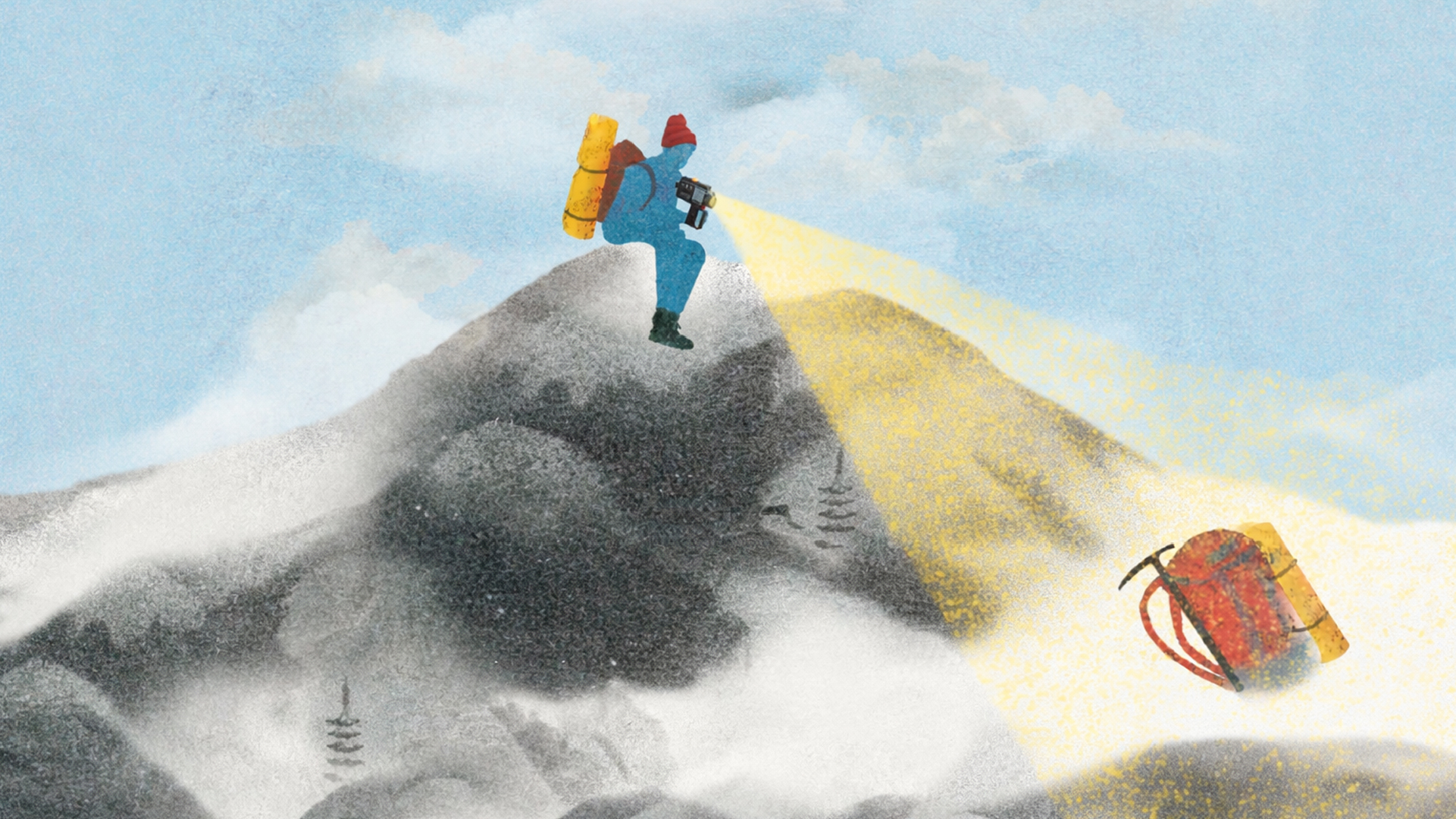
[Emilia E.]: And then, a few minutes later, they saw it: in the distance, a tiny red, yellow and black spot that stood out in the middle of the white blanket of the glacier. It was in the same place where Gabriela had seen it a year before. Resting on the ice as if someone had simply forgotten it there.
[Emilia E.]: They walked in that direction at a slow pace, hearing only the sound of the crampons entering and exiting the snow. It was a very sunny day, and the light bounced across the entire surface of the glacier.
[Gabriela C.]: The snow is great…
[Emilia E.]: After a long while of maneuvers on the ice, they managed to reach the backpack. They had precise instructions on what to do.
[Gabriela C.]: It wasn’t a matter of arriving, touching it, you know? No. First, before touching, we take photos, we document well how it was. From there we put it in a safe zone and well. And there yes, we needed to rearrange it to be able to bring it down.
[Guide1]: Hey, what if it gets away from us?
[Guide2]: It’s not going to get away from us.
[Gabriela C]: No, we’re holding everything…
[Guide2]: It’s really caught…
[Emilia E.]: They secured it with ropes and started to move it.
The backpack had its own ropes and other ice axes attached on the outside, so they put them in, so that nothing would be hanging. Then, they put it in a large plastic bag.
[Gabriela C.]: And there we started the return. And as soon as we got to where Guadalupe was, that moment, the truth is my eyes filled with tears, with emotion…
[Guadalupe]: I don’t know, I almost died, I almost died. I mean, I don’t know where I got the strength to run out. Imagine I ran out to receive them and I hugged them, obviously everyone crying, I mean, I hugged the backpack. I mean, the first thing that came out was to hug the backpack. It was incredible. It was an immense joy.
[Gabriela C.]: That moment of literally handing the backpack into his daughter’s hands, Guadalupe’s, was like wow!… it was all worth it.
[Emilia E.]: Meanwhile, one of the guides communicated with the camp where Azul was…
[Guide]: We are going back to the camp. We found the bag. We found it!
[Azul]: Come on!
[Guide]: Just one second, please… Because Azul is coming to hear the news, one second…
[Guide]: Yes, Azul for the camp…
[Guide]: She is copying Azul for the camp. Azul is super excited…
[Guide]: Let’s keep the radio open, because when they all arrived Guada and Azul could talk…
[Guide]: It’s copied.
[Emilia E.]: Although she was dying too, Guadalupe resisted the curiosity to open the backpack at that moment. She wanted to share it with her sister Azul, who was waiting at one of the refuges with the rest of the expedition. The walk there lasted one more day.
When they arrived, they placed the backpack on a table and together they began to take things out. One by one.
[Azul]: Let’s open it…
[Guide]: See if it has marks, if it has something.
[Guadalupe]: It has dirt, ice.
[Azul]: It has ice, yes… I can’t find the mark.
[Azul]: It was kind of hard to do. But I dissociated a bit at that moment because it seemed to me it was his privacy. You understand? I mean, something very intimate is opening someone’s backpack.
[Azul]: You know what was here? The photo camera…
[Guadalupe]: Yes, that…
[Gabriela C.]: That was on the outside…
[Guadalupe]: That we supposed…
[Azul]: Because there’s a photo of him that has this with the camera… wait, I don’t want everyone to see me…
[Emilia E.]: Around them, as if waiting for the revelation of a treasure, was all the rest of the expedition.
[Azul]: I feel we put on a show at that moment. Like, well, we had to take things out, show them. But well, it was a moment where I had to make an effort, no, because I didn’t really feel like showing at that moment, like I wanted to do it in private and see what… what he kept.
[Guadalupe]: It was weird because we were all very expectant. I mean, everyone. I mean, there were many people and they were all looking and we were all very expectant. And we like, maybe that would have been good, for it to be a bit more private.
[Azul]: It wasn’t discussed, but we understood, my sister and I, I didn’t know she had also felt that way… In fact, I thought she had already done it willingly but, nothing, it was hard to see his things. The last things he had touched. Right?
[Emilia E.]: But everyone had worked so hard and so much, that the girls felt that was what was appropriate.
[Guadalupe]: Here are the videos, I’m going to put them here, I knew they had to be there…
[Guide]: I think they’re unused…
[Guadalupe and Azul]: Oh!
[Guadalupe]: Cutlery, cafiaspirin.
[Azul]: Spoon, matches…
[Guadalupe]: Matches… What’s this? Ah, a magnifying glass. A can opener haha
[Emilia E.]: Also a sleeping bag, jacket, vitamins, a couple of ice axes, a thermometer. Azul and Guadalupe took out each object delicately, with the feeling that entering into contact with them was entering into contact with their dad.
[Guadalupe]: I was really impacted to see inside the backpack a bottle of vitamin C. Before it came in a glass bottle and it was all broken. I mean, it was shattered, the bottle. So I say, well, it must have been an important fall.
[Emilia E.]: They were looking in those objects for clues about how his death might have been…
[Guadalupe]: I even see my dad’s death certificate. Obviously it says: Polytrauma and everyone tells you instantaneous death, but you also never know, right? And that’s also always been in my head, right? How would they have been? A bit alive, right? I mean, would it have been. Would he have suffered?
[Emilia E.]: How those last minutes of consciousness might have been… There, in that backpack, were captured their dad’s last moments. Some moments of which they didn’t know, don’t know, too much. What happened to Guillermo and Leonardo that January day in 1985 when they were trying to descend from Tupungato is something no one will know. What there are are hypotheses, the most solid is that one of the two slipped or fell while descending through the glacier and in the fall dragged the other, because when they found the bodies they were roped together. Who fell, why, how someone as experienced as Guillermo could die in an accident like this, is a secret kept forever in the volcano.
[Emilia E.]: During all these years, the three siblings searched in his death for the meaning of their dad’s life.
Because, as it happens to many of us with our own fathers, for them understanding his decisions and choices has been the work of a lifetime.
Each of them went through their own process, in their own way and pace and largely solitary and silent.
[Guadalupe]: I went through many stages, of anger, of saying: What an idiot, you killed yourself and left a family alone. But at some point I went through that part of saying: Well, you went and killed yourself on the mountain, Come on. I mean. What do you need? And then I understood it was an accident. I mean, it was his passion and it was an accident.
[Azul]: I was always at peace with my dad. It never grabbed me like: Why did you abandon us? It’s like he had a passion, that passionate people can’t have children because maybe they die. In fact, there were people who told me. But how? Your dad went to the mountain and left you guys, like insisting that I get angry. And it was like, yes, well, that’s fine. No, no, no. I’m never going to get angry with him.
[Emilia E.]: On his headstone at the Mountaineers’ Cemetery of Mendoza, the children’s mother, his widow, left a record of this love with one line: You will remain on the mountain as you always wanted.
After the expedition, everything unsaid, unspoken, the pending issues, ultimately, the shrapnel of a grief too long and too solitary, swept away what remained of the family.
[Guadalupe]: People think oh, surely, it reunited them as a family. I think it was such an individual process for each one that at some point it was necessary that… that this broke somehow, right? Like obviously I would have preferred to have my mom’s support, nobody fight and everything be in terms of happiness. But I think this was something, such an individual process for each of us that we needed to go through it this way.
[Emilia E.]: Recovering the backpack, somehow, was for them like answering a call or receiving an unexpected letter. A way of communicating with him when they no longer believed it possible.
[Guadalupe]: It’s like feeling him alive again somehow. And I think it was a bit of that. Reuniting with his objects, reuniting with him through his objects.
[Emilia E.]: Objects like the down jacket, which Guadalupe, and later her brother Rodrigo, tried on and were intact. Or the sleeping bag in which Azul felt for the first time her dad’s lost smell. Common things, everyday for any mountaineer, that Guillermo put in that backpack thinking about seeing them again and that were preserved for 40 years by the cold of the volcano, as if waiting for them.
[Daniel A.]: Emilia Erbetta is a producer for Radio Ambulante and lives in Buenos Aires. This story was edited by Camila Segura and by me. Bruno Scelza did the fact-checking. Sound design is by Andrés Azpiri with music by Ana Tuirán, Rémy Lozano and Andrés.
The rest of the Radio Ambulante team includes Paola Alean, Adriana Bernal, Aneris Casassus, Diego Corzo, Camilo Jiménez Santofimio, Germán Montoya, Sara Selva Ortiz, Samantha Proaño, Natalia Ramírez, David Trujillo, Elsa Liliana Ulloa, Luis Fernando Vargas y Mariana Zuñiga.
Carolina Guerrero is the CEO.
Radio Ambulante is a podcast by Radio Ambulante Estudios, it’s produced and mixed in Hindenburg PRO.
If you liked this episode and want us to keep doing independent journalism about Latin America, support us through Deambulantes, our membership program. Visit radioambulante.org/donar and help us continue narrating the region.
Radio Ambulante tells the stories of Latin America. I’m Daniel Alarcón. Thanks for listening.