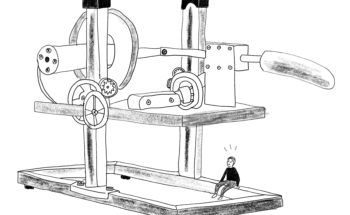


Argentine Antology | Translation
Share:
► Click here to return to the episode official page, or here to see all the episodes.
🚨Latino communities are under attack in the United States. And while this is happening, independent media are losing funding. Telling our stories with rigor, dignity, and empathy has become essential. To keep doing it, we need your support. Join Deambulantes, our membership program. This journalism exists because people like you decide it matters. Our goal is for 5,000 people to support us before the end of the year. DONATE TODAY. Your contribution makes ALL the difference. Thank you in advance.
►Do you listen Radio Ambulante to improve your Spanish? We have something extra for you: try our app, designed for Spanish learners who want to study with our episodes.
The following English translation was generated with the assistance of artificial intelligence.
[Daniel]: This is Radio Ambulante. I’m Daniel Alarcón.
Today we’re bringing you something different. Since this is our fifteenth season, it seems like a good reason to look back, to travel back in time to some of our earliest stories—those we published in what feels like an ancient era, more than a decade ago.
Our way of telling stories has changed a bit. We grew, and that gave us the ability to be more ambitious, to investigate more, to take more time with each episode and include more characters. But in the ones you’re going to hear today, you can find, of course, the essence of what Radio Ambulante has always been: narrating surprising, human stories from our region.
So in this episode, you’re going to hear three of our favorite stories from those times, all from Argentina.
We start with “Another Country,” which we originally published in April 2013.
[Alejandra]: Do I have to say my last name too? Just my first name?
[Daniel]: You can say “I want to be called María,” “I want to be called…”
[Alejandra]: OK, Alejandra. My name is Alejandra and I’m going to tell you how I got an apartment in Buenos Aires…
[Daniel]: Well, that’s only part of the story, but not all of it. To begin with, her name isn’t Alejandra. And you’re about to understand why she prefers not to use her real name.
[Alejandra]: And I was thinking, OK, I have to use this situation to my advantage. Because I have to get out alive, I have to get out with money, and I have to get out without going to jail or without any mark on my record.
[Daniel]: As you can see, this is going to get a bit complicated. We’re in Buenos Aires, 2002. This is Camila Segura.
[Camila]: Alejandra moves from her hometown, Seoul, in South Korea, to Buenos Aires, where she had spent much of her childhood and adolescence. It was the first time she was going to live in Argentina as an adult, without her family, and like anyone, she needed an apartment to live in.
A Korean friend tells her he has an apartment that might work for her: spacious, nice, and, what’s more, cheap. The friend, however, warns her that if she’s superstitious, she might not want to live there. Curious, Alejandra asks what it’s about, and her friend tells her that recently an Asian immigrant had been stabbed to death in this apartment.
[Alejandra]: But since I’m a person who—I think I’m quite educated and beyond that type of superstition—plus, I was pretty desperate to find an apartment because I already needed a place to live… and I said, it’s all good.
[Camila]: So she decides to see it one day at dusk. There was no electricity and there was very little natural light. She likes it anyway and decides to take it. But when she comes back a few days later with her things, ready to move in, she sees everything she couldn’t see that afternoon when she decided to rent it. The apartment was covered in blood. In the bedroom, in the bathroom, in the kitchen…
[Alejandra]: Since the guy was murdered and I don’t think anyone wanted to clean, I had to clean everything. But there was a problem—the mattress… was smeared with blood. So I said, OK, I’m going to clean it the best I can with bleach and then I’m going to cover it with one or two sheets, and that’s what I did.
[Camila]: And not just that. As nice and cheap as it was…
[Alejandra]: There was no electricity. At night I was sleeping with the type of light you use when you go camping, right? The whole atmosphere in general was… yes… pretty unsettling.
[Camila]: And yet, she stays. She decides to settle into an apartment that had been the scene of a crime. Her, in the dark, sleeping on her blood-stained mattress.
Welcome to Buenos Aires.
Once the issue of where to live was solved, Alejandra needed to find a job. She had a small scholarship from her university, but it wasn’t enough. One day a Korean guy from her new neighborhood told her that there was an Argentine man who had a job for someone like her.
[Alejandra]: And he didn’t tell me specifically what the job was about. He told me they needed a person with my profile… so I was thinking about teaching at a school or something like that…
[Camila]: Alejandra agreed to meet with them. The Korean guy, the Argentine gentleman, and about two or three other people got together for an asado. They were all partners, and that night they talked about politics, about Argentine society, about food… In short, about general topics, but behind it all was the job, her job, which they always referred to as “the project.”
[Alejandra]: And that’s the word they used—a project… They obviously wanted to set up a bigger project, start something, and they wanted me to be part of it. So, talking a lot about the future, about possibilities, etc., etc.
[Camila]: But without saying what exactly it was about. At the beginning they didn’t talk about payment. Nobody told her “your job consists of this and that.” No. With a glass of wine and a plate of meat, the Argentine gentleman gave her an almost philosophical speech, focused, above all, on one specific topic:
[Alejandra]: There are many problems with borders, etc. But really, when you think about it, there shouldn’t be national borders… which I obviously totally agree with—all that kind of discourse. And then talking about how… right… It’s good to help people, and especially in this case—and obviously directing himself to me—a person who is capable of helping people.
[Camila]: The ability that seemed to interest them most was her command of several languages. Korean and Spanish, of course, but also English and Mandarin. Finally, they at least told her they were going to pay her pretty well, so they toasted to the project and Alejandra accepted. A woman who sleeps on a mattress covered in blood doesn’t worry too much about accepting a job without knowing exactly what it’s about. What’s more, the mystery was precisely what attracted her.
This is what she tells me about her first day:
[Alejandra]: A bit nervous, but at the same time, well, I’m not a super nervous person, so I was fine… We were in a car with two men in their thirties, Chinese, me, the Korean guy…
[Camila]: Another older Korean gentleman, somewhat enigmatic, and the Argentine gentleman, the one from the asado. Together they headed to Ezeiza, Buenos Aires’ international airport. Alejandra realized that her job had to do with the two Chinese men.
[Alejandra]: They didn’t speak Spanish or English, so I thought I was more like a tour guide… that they were accompanying them to Ezeiza so they’d be there, do all the procedures—customs, their passport—and bye, have a good trip, and that’s it.
[Camila]: Alejandra found it somewhat strange.
[Alejandra]: Because first, why were they in Argentina? Because I asked them, “Oh, did you come to visit Argentina? What did you see?” etc., etc… the Recoleta cemetery, I don’t know what, and they saw absolutely nothing… which is super suspicious. And then they didn’t seem like Chinese people who had the luxury of traveling… which you realize quickly by their way of speaking Mandarin… so it seemed to me that… everything wasn’t right.
[Camila]: At Ezeiza, Alejandra gets out with the Chinese men, and the others stay waiting for her. And everything’s fine, easy. She accompanies the Chinese men while they go through customs, until they board their plane and they leave. But everything seems somewhat disconcerting to her.
[Alejandra]: So I asked them when I got to the car, the Korean guy and the Korean gentleman, “What is it? Tell me… really, right?” And the guy was kind of quiet, kind of looking at the clouds, and then the gentleman told me, “Look… It’s a very important job, really, because we’re helping the Chinese,” etc., etc.
[Camila]: That is, helping them emigrate illegally to the United States. And Alejandra, according to the Argentine, was the one who could help them. Of course they didn’t speak in terms of illegality. What they were doing was something else: facilitating travel.
[Alejandra]: Yes, facilitating—that’s the word he used. Facilitating. I’m not stupid, although naive, yes, but not stupid. So I realized, “Oh no, what I’m doing is trafficking, right?”
[Camila]: One of the illegal routes from China to the United States at that time went through Brazil, with a stopover in Buenos Aires to get fake documents, and from there to Canada. No wonder the Chinese men hadn’t done any tourism. No wonder they hadn’t seen Recoleta or had left their sad neighborhood.
[Alejandra]: …so I told them, “Look, this is something illegal. I’m not Argentine. They can deport me too.” And then the guy says, “Nothing happens, nothing happens. I’ve been doing this for, I don’t know, 5 years. The gentleman, I don’t know, for something, for 15 years, I don’t know what, how many…”
[Camila]: There, sitting in the car, Alejandra remembers that they have her passport. She had handed it over to them before starting work, something she herself recognizes as naive. Somehow, she was already compromised.
[Alejandra]: And I was thinking, OK, I have to use this situation to my advantage. Because I have to get out alive, I have to get out with money, and I have to get out without going to jail or without any mark on my record. So it was a pretty complicated situation, but I always had an excuse—I didn’t know anything.
[Camila]: But she wasn’t innocent. Not exactly. Alejandra decided to continue in the job. Or rather, in the “project.” It was very well paid and required minimal effort. Every two weeks she spent three hours with the Chinese migrants. She translated for them and trained them for their brief interview at Ezeiza customs. They asked her for advice. “What do I do if they ask me at the airport where I’m from and why I’m in Argentina?” And Alejandra helped them make up answers.
But the migrants weren’t the only ones making things up. Alejandra herself, to protect herself, reinvented herself every time she had to enter the airport.
[Alejandra]: So I started putting on disguises—wigs, glasses, different types of clothing. Not exactly Mission Impossible-style disguises. And in a way, I don’t know if I have to be thankful because since there’s a lot of racism and people think all Chinese people look the same, in quotes, that also helped me. So I didn’t have to be that creative either.
[Camila]: Over the next two months, Alejandra had to accompany more than twenty Chinese migrants on their illegal departure through Ezeiza. One day she dropped off three Chinese men, and when she was already leaving, someone stopped her. It was an airport employee. They took her to an office at the back, with no windows.
[Alejandra]: And then a guy, a gentleman, opens the door and tells me, “OK, come in.” I went in and they started showing me different photos of me. With different people, with different travelers. Obviously photos they had taken from the beginning to about two months. And I thought, “Wow, I’m in a movie.”
[Camila]: They asked her the basics: Who are you? Who do you work for? Who are these Chinese people you’re accompanying? And just as she had planned, she played dumb.
[Alejandra]: I’m just a tour guide, I’m a translator, because I’m Korean and I live in Argentina now for my work, but since I speak Chinese, I’m helping those travelers, those tourists, right? And he tells me, “Well, I’ll let you make some calls.” So I call the Korean guy and the Korean gentleman, speaking in Korean, saying that I’m here and there’s a problem. And the Korean gentleman tells me, “Well, wait a moment,” and after an hour a call comes. They receive a call—I don’t know from whom. Then I realized it’s the Argentine gentleman or someone who knows the Argentine gentleman, and they let me go.
[Camila]: But that’s not where it ends. Upon leaving, one of the security agents shakes her hand to say goodbye and discreetly passes her a little piece of paper. Alejandra doesn’t read it until she leaves the airport. The agent had set up a meeting with her.
To get more entangled in this, or not. That was the question. At what point should you quit? And how do you know that if you don’t get out now, later it won’t be too late? Her bosses, her colleagues, tell her to go, but they have their own interests. Alejandra doubts it, but when the day comes, she decides to go. The agent had arranged to meet her at a café with quite a few people, on the corner of a very busy street. That, at least, put her at ease.
[Alejandra]: So I met with the guy and the guy tells me, “Hey, I know what you guys are doing and it’s all good… I don’t have any problem, but obviously, you know, I have a family, I have two little girls, with the situation here in Argentina… It’s very complicated.” Obviously asking for money.
[Camila]: Alejandra didn’t deny it. There was no reason to either, if the guy already knew everything. She explained that she couldn’t make any decisions about the bribe, that it was something she had to discuss with her bosses, and the agent changed the subject.
[Alejandra]: Saying that since he saw me on the camera, he was super attracted to me. In a few words, saying that he wants me to sleep with him, and if I sleep with him, he’s going to help us, etc., etc. Obviously I wasn’t up for that, but I also wasn’t going to say no to him at that moment, so I told him, “Oh yes, interesting, oh yes I…” la la la… not saying yes or no.
[Camila]: Alejandra had already learned to speak the evasive language of her colleagues and corrupt police and was able to handle him. But this conversation scared her. Leaving the café, she called her Korean colleagues and told them what the agent had asked her for. The money, the bribe—that was easily solved. The other issue—that he wanted to sleep with her—was something more complicated.
[Alejandra]: They started laughing, saying he was a perverse guy and they have a fantasy about an Asian woman…
[Camila]: The Koreans had a solution, which they proposed with astonishing coldness. They would pass a Chinese woman to the agent, one of the immigrants that Alejandra was going to accompany.
This was the line that Alejandra wasn’t willing to cross. That discourse of supposed solidarity with the immigrant vanished in that instant. It’s one thing to help migrants cross borders that you consider essentially fictitious, but…
[Alejandra]: Another thing is to prostitute a person, right? Force her… so I said no, that’s wrong. That’s completely wrong. I can’t go any further. Let’s end this.
[Camila]: And so it was. Alejandra abandoned the project discreetly. She made up excuses and didn’t commit to anything. As far as she knows, they didn’t prostitute anyone, or at least not on her account.
When I asked her why she did it, why she participated in this project, Alejandra answered like this.
[Alejandra]: Because I liked the transgression. Obviously it’s not justified, but since I’m a person who doesn’t believe in identities, I also don’t believe in national borders, and I have very little faith in the law too, because the law is something that the poor have to obey, not rich people, right? Rich people can always escape.
[Camila]: And so could she. One day, without telling her colleagues, she left Buenos Aires and left Argentina. To make a living, not in her country, but in another.
[Daniel]: This story was produced by Camila Segura and me. Camila is the Editorial Director of Radio Ambulante. We used music by Argentine composer and percussionist Marcio Doctor. You can find more of his music on his website: marciodoctor.com. Recommended.
Let’s take a break and we’ll be back.
[Pause]
[Daniel]: We’re back. Today’s second story is about two brothers, a dream, and something everyone thought was impossible.
Here I leave you with “We Are Manufacturers.”
Let’s begin today in Cavanagh, Argentina. A small town in a rural area of Córdoba province…
[Elio Zampelunghe]: I’m Elio Zampelunghe. I was born on April 2nd, 1933. My profession is farming. As for school, I made it to third grade; third grade, elementary school.
[Daniel]: Elio and his brother Jorge Zampelunghe grew up during the thirties, and there, in the middle of nowhere, they dedicated themselves to inventing machines.
Our producers Ariel Placencia and Luciano Daniele visited Elio—who today is over 80 years old and lives in the same house and has the same workshop as always. Luciano Daniele tells us more.
[Luciano Daniele]: When I arrived at Elio’s house, he was about to leave for mass. He asked me to wait and told me that his house and shed were open, that I should feel free to look around and take whatever I wanted…
[Luciano]: Without hesitating, I went into the workshop and found the summary of what the Zampelunghe brothers’ life had been: not only the inventions and artifacts they had built since they were kids, but also thousands of pieces of iron, wood, pulleys, many tools—some rusty and others not—and that rustic but faithful engine that gave shape to many of the inventions.
When Elio came back from mass, he found me examining the entire workshop and tried to explain to me that that same curiosity was what started him on the path of inventions. Despite his shyness, when I asked him about his childhood, he began to describe the town where he grew up.
[Elio]: Yes, it was very sparsely populated. There were few houses, very, very few, then it got bigger. A nice little town, very quiet. I always liked Cavanagh.
[Luciano]: In the countryside where they lived, there was no electricity. The town is about two kilometers away. They lived—and still do today—off agriculture and livestock. Even today there’s no running water—they get it from a well—and back then they didn’t have access to the radio. Very occasionally a newspaper from the capital of Córdoba would reach them.
It was the beginning of the forties. The only contact with the outside world was the small school Elio attended with his brother.
Not having anything to entertain themselves with, Elio spent his time lying in the grass watching the crop-dusting planes go by… He became obsessed with airplanes:
[Elio]: When I was 7 or 8 years old, it got into my head that I wanted to build a plane. My greatest passion was to build the plane. It wasn’t so much the desire to fly, but to build it and see it fly. And when my brother was older, I mentioned it to him, and he was much more enthusiastic about building the plane than me, who was the one who had started it.
[Luciano]: The brothers found out that there was an American magazine called ‘Popular Mechanics,’ and they begged their parents to get it for them. This magazine existed since 1902, and its idea was to introduce readers to ‘do it yourself,’ emphasizing how science and technology could be applied to daily life.
The Latin American version began to be available in Argentina starting in ’47 and was one of the few reading materials that reached the Zampelunghe brothers:
“Modernize yourself, build a plane,”
“The metal plane you can build,”
“You too can travel to space”;
[Luciano]: Headlines like these sparked the inventiveness that Elio recognizes having since he was young and that he was passing on to his brother…
But that affection for propellers and turbines wasn’t easy to put into practice. They had to learn everything themselves. Building the plane had several challenges, but one main one: money. The Zampelunghes solved it by opening a small mechanical workshop on their farm.
[Elio]: When we made some pesos, we went in search of an engine. We went to an aero club. The one who attended us—I don’t know if he was the President of the aero club or the owner of the engine—and he asked us: “What are you going to use it for?” – “We want to build a plane,” – “But are you engineers?” – “What engineers” – “And if you build it, you don’t expect it to fly?” We left there quite discouraged.
[Luciano]: That experience began a complicated relationship with the plane and its future… The brothers realized that by telling the truth about their plans, people made fun of them, so they decided to lie and say the engine was to build a boat.
[Elio]: And there we could get it more easily. But the one who sold us the engine wasn’t very convinced. He wanted to come to our farm, and there he verified that we were building a plane, not a boat.
[Luciano]: He even managed to convince them to abandon their work. And so it was, for a couple of years, until one day they decided to continue with the construction. The problems of lack of resources, electricity, and even the absence of blueprints were solved little by little.
[Elio]: There were no blueprints, there was nothing like that. Magazines, yes, but measurements and all those things—there was nothing. I didn’t have the measurement of how long a plane is. We did all the calculations ourselves. That was done with chalk on the ground or by means of sticks, and I marked the shape of the plane, nothing more than that.
[Luciano]: The news that the Zampelunghe brothers had returned to the plane project didn’t take long to spread through the town…
[Elio]: And when we went through town, people—some of them—made fun of us. They said: “With pliers and a hammer you expect to build a plane? Impossible.” But how people discouraged us. They might have been right, I don’t know, but they discouraged us a lot. “That it wasn’t going to fly, that it wasn’t going to fly.”
[Luciano]: Graciela Bártoli, a neighbor of the brothers, remembers well the divided opinions people had:
[Graciela Bártoli]: Yes, I remember it was quite an uproar, a… it wasn’t simple to say: well, he built a plane and it’s going to fly. Some people believed it and others said: “Well, no, that’s going to crash to the ground, it’s going to nosedive.” And others, well, knowing them as they were, the two of them, bet that it would.
[Luciano]: After two years of hard work, the craft was finished. Elio was 30 years old and Jorge was 20.
[Elio]: But then came the big problem: Who was going to fly it? Neither of us were pilots.
[Luciano]: They had to find someone willing to take the risk of flying a homemade plane… According to Elio,
[Elio]: Two pilots from a neighboring town found out. They were José Araya and Líbero Biondi, and they came. When they saw it, they saw it was so well finished that they had a lot of faith that it was going to fly well.
[Luciano]: Líbero Biondi, a professional pilot, still remembers that moment, although in his version, the Zampelunghes were the ones who looked for him and convinced him to pilot the plane.
[Líbero Biondi]: And there weren’t many aviators at that time. I was one of the few. So they came looking for me and convinced me. One day they invited me to eat an asado and, while they were at it, fly the plane. And they told me that they were hopeful that the plane would fly, that they wanted to see if it flew or didn’t fly.
[Luciano]: Líbero, neither slow nor lazy, dared to accept flying it.
[Líbero]: I remember I told him, “Look,” I said, “Zampelunghe, I’m not responsible if I break it when landing.”
[Luciano]: But Líbero assures us that he didn’t accept the challenge out of bravery…
[Líbero]: No, I was always rather cowardly. It was the age—I was young, that awkward age perhaps. And so back then one liked anything. And I must have been 25, 27, 28 years old.
[Luciano]: After the asado, came the key moment: to see if it flew or not…
[Líbero]: Well, in truth it wasn’t that easy, because there was a pig pen, and to take off they took out the wire fencing. And when taking off, the first attempt, the engine stalled. And I go back again and the second time too. So I realized that I had, for example, 10 liters of gas or 15, and when changing position to take off, gas wasn’t getting to the carburetor. And it stalled and fell.
[Luciano]: So they decided to put in 20 liters of gas to see what would happen…
[Líbero]: And there it did work, yes.
[Elio]: They grabbed it and took it outside. They took it to the end of the field, and there they revved it up. What joy for us when we saw it in the air!
[Luciano]: But the fear was very great…
[Líbero]: No… when I was up there I was a bit worried. I was afraid of breaking the plane when landing, so I didn’t have time to look where I was going. And yes, I was afraid.
[Líbero]: I made a big turn, and I remember that when I wanted to turn, the plane went off, and I was a bit worried. So I made a turn and aimed for the field, and I was able to land it with a lot of luck without breaking the plane, the landing gear, nothing.
[Elio]: When it landed, it’s something that can’t be told…
[Líbero]: The Zampelunghes—for them it was a spectacular day because they were crying. Then people came from this town, Cavanas, and they came and congratulated me for the trip I made over Cavanas. And it turns out I got a surprise—I didn’t even know I passed over Cavanas because of how worried I was to be able to land and not break the plane. I don’t even know where I went. And that’s when I found out that yes, I had flown over Cavanas.
[Luciano]: The newspaper clippings that still decorate the Zampelunghes’ shed revive the feat. “And it even flies!” was the headline of the most important newspaper in the region. It was March of ’64, and the few media outlets of the time fell at the feet of Elio and Jorge.
For the people of Cavanagh it was a great event… but not all the inhabitants believed that the brothers’ plane had flown, so they demanded a second flight.
[Elio]: So the following year a pilot came from the city of Venado Tuerto, and I told him: “Make a loop around the town so everyone sees it.”
[Luciano]: Venado Tuerto, he said. That’s what the city the pilot came from is called. Everyone saw the plane fly that Elio had built with his brother.
Reaching this moment had consumed everything in Elio and Jorge’s lives. The dream Elio had when he was barely 7 years old materialized at 30. In a place like Cavanagh, in the 60s, a man his age already had a wife and children. Elio already felt too old.
[Elio]: Look, if I had so much passion for building a plane that I was afraid of getting married. Let’s say if some girl happened to look at me, but if I have some woman who goes against the plane, the dream is over. Then at thirty years old, the plane flew. Well, let’s look for a girlfriend—nobody looked at me anymore. I had to continue alone.
[Luciano]: That ‘continuing alone’ for Elio is actually continuing side by side with his brother, spending days on the farm with their parents, agriculture, and mainly in the workshop, dedicating many of his hours to new mechanical creatures.
[Elio]: We made a turbine—more than 20 years to perfect it. When we saw that it more or less had the power to push, well, we designed a four-wheeled carriage for it and put it on top. It went 40 or 50 kilometers, but the noise was very loud. And one night we decided to drive it around town, and people weren’t aware that we had made this turbine. It was late at night and almost everyone was already sleeping. They got out of bed and started looking up thinking it was a plane, but no, it wasn’t a plane.
[Luciano]: Today, there are two helicopters they invented that still rest in the shed, but nobody dared to pilot these either. However, Elio didn’t want to be left wondering, and he remembers that, on his own, he decided to tie the helicopter to a tree and, as if it were a marionette, he operated the controls remotely and managed to make it take off.
[Elio]: One, yes, I got on top and operated it, but I didn’t release it. I couldn’t release it. First, to test it, I would tie it outside [rooster crows] and I would operate it all with ropes and I would rev it up and lift it.
[Luciano]: Elio’s affection for inventions always kept him somewhat isolated from the community. He constantly fought with everyone, but he always had his brother on his side. Elio and Jorge against everyone who told them they couldn’t achieve their goals, since they were kids.
Today, Elio, with his eighty years, has to battle with one of his cruelest opponents: the loneliness of his days. Because a year ago his brother Jorge passed away.
[Elio]: It’s a lot of bitterness. It hurts, it hurts like crazy. What can you do? But in life you shouldn’t love yourself so much. I don’t know if in a catechism it says: “You have to love yourself a lot.” No, I don’t believe that, because if you don’t love yourself so much, you don’t feel so much. But when you do love, yes.
[Luciano]: But Elio keeps working in his workshop and keeps dreaming of his machines. He fights the pain of his arthritis by working. And although he doesn’t tell us much about his new project, he lets us know he’s making a carriage and wants to surprise Cavanagh once more.
[Elio]: If it works, it’s going to be very nice. I want to drive it through town.
[Luciano]: It’s six in the evening when I tell Elio it’s time for me to go, but Elio seems to want to delay me and extend our Sunday. He tells me:
[Elio]: I have an instrument…
[Luciano]: He’s talking about an accordion his father gave him when he was 30 years old. He tells me that after the plane flew, he took private lessons. He takes it out, and I’m surprised when those rough fingers that have manipulated a hammer of up to 5 kilos start to make it sound.
Elio saved for the end the last great surprise: the only chords he remembers by heart are those of a waltz called ‘The Airplane.’
[Daniel]: This story was produced by Luciano Daniele and Ariel Placencia in 2013. Both are journalists and live in the city of Rosario, Argentina. Elio Zampelunghe died in 2022 at 88 years old.
This story was edited by me, Daniel Alarcón, and Camila Segura. Many thanks to Sokio from Punk Productions.
Let’s take a break, and we’ll be back with today’s last story.
[Pause]
[Daniel]: We’re back at Radio Ambulante. The next story is about a superhero who lived in Argentina. His name is Menganno, and his superpower is calling attention.
Here’s the episode.
[Menganno]: Well, I am… First, I’m a person just like anyone else… and luckily I have a bit of free time.
[Daniel]: This is Oscar Natalio Lafose, but he prefers that we call him… Menganno…
He lives in Lanús, a city south of the province of Buenos Aires. And he wants to make something very clear…
[Menganno]: I feel the need to say I’m not crazy. I’m not crazy…
[Daniel]: Welcome to Radio Ambulante. I’m Daniel Alarcón. Today, The Superhero… The story of a man, his costume, and his fight against crime. From Argentina, Agustina Grasso tells us the story.
[Agustina Grasso]: Menganno is 43 years old, weighs 105 kilos, is 1.80 meters tall, and has a double life. On one hand, he lives with his wife, his two children, and owns a private security company. But on the other hand, several nights a week, he puts on a suit and roams the streets of Lanús fighting against crime—in disguise.
[Menganno]: And well, with that I go out on my motorcycle and go around, and I do little things, from helping a grandmother carry her bags, moving a garbage bag that’s in the street, pushing a car…
[Agustina]: Wait a minute. To understand this well, you have to try to visualize this suit.
[Menganno]: Many who see it think it’s similar to Captain America, because I have the shield, but the shield was because I said, if I’m going to be good on the street, there are going to be bad guys, so the shield makes me feel a bit calmer.
[Agustina]: His first suit consisted of a black bulletproof vest over an Argentina jersey. His face was hidden under a blue helmet and a gray mask.
[Menganno]: And well, then the suit kept changing each time until the one I have today, which is much more advanced. I have things—I already look like a superhero: night vision, a bunch of nice accessories.
[Agustina]: And his name? Menganno? Where did it come from?
[Menganno]: It means anyone, or whoever. That is, anyone can do what I do. So I had to choose between Fulano, Zutano, Mengano. I went with Menganno. I don’t know why [laughs].
[Agustina]: It happened one summer afternoon in 2010. Menganno—who was preparing to become Menganno—was painting the shield of his future suit in the back of his house in Lanús, when suddenly…
[Menganno]: There was a general power outage in the neighborhood. Two thieves entered the house, and well, this and that, we talked, and I grabbed the gun with my hand, and it blew off this finger—my left thumb.
[Agustina]: Menganno took his finger, which was still hanging and had blue paint stains, put it in a jar with ice, and called a friend to take him to an emergency room. There, they put a couple of splints on it to straighten it and sent him home.
[Agustina]: A month later, he decided not to give up to crime and began to patrol around Aldo Bonzi, the town where he was born.
[Menganno]: I went with a friend, I remember, the only one I told, a friend I hadn’t seen for 20 years. I told him, “Come, I’m going to do this thing of spreading good and achieving a result,” to the neighborhood where he lives and where I was born… It was like a little town, you know, like in western movies. There’s the sheriff and a superhero arrives to say I’m here to help with security.
[Agustina]: But as would happen with Batman, Superman, or any superhero, not everyone trusted Menganno. Imagine: a man in a costume walking the streets. Some people were afraid of him and complained to the police.
[Menganno]: It was obvious. No matter how much like a clown I was dressed, in disguise, they chased me. I looked like Zorro… I couldn’t be around. If they chased me with the patrol car, they wanted to catch me.
[Agustina]: Until one day…
[Menganno]: They captured me [laughs]… and I had to really play crazy. I took off my helmet, I showed them my ID, and I said, “But what are you going to take me in for—a background check—if I have my ID here?” They forgave me that day. They let me go, because I told them I was coming now [laughs], and I left.
[Agustina]: But this wasn’t the only conflict Menganno had to overcome. He also had to face an unexpected arch enemy: his own wife.
She was tired of him leaving his house every night to patrol the streets. Until one day she threatened him:
[Menganno]: And she tells me she was going to throw out my whole suit and set it on fire. She was really angry.
[Agustina]: In June 2010 they separated. He was sad and didn’t want it all to end, so he made a master move. He asked for help from the radio, from a local program called “Perros de la calle.”
[Archive soundbite]
[Host]: Would this separation be Menganno’s kryptonite?
[Menganno]: Yes, right now, yes. You know what? Yes.
[Host]: Now Silvia, I’m going to ask you a question: Doesn’t it give you a thrill? Don’t you feel protected with Menganno?
[Agustina]: This voice is Menganno’s wife.
[Silvia]: Obviously yes. I’m super proud of him, and I always supported him to death, and well, obviously I love him…
[Agustina]: It worked. Menganno and his wife reconciled. He returned to his neighborhood patrols, walking the streets in his very special suit… But something had changed. It seems that a lot of people heard the radio program, and almost without realizing it, Menganno became famous.
[Menganno]: I got calls from all the channels you can think of—Brazil, Venezuela, United States, China, front page of a newspaper in France…
[Agustina]: The figure of Menganno reached new limits. He recorded a video for Coca-Cola and, among other media, gave interviews for Argentine television, the BBC in London, and a Colombian channel.
[Archive soundbite]
[Colombian channel]: “And to talk about the phenomenon that the topic of superheroes has been in the world, we can’t fail to talk about Menganno, a patroller and superhero of the Argentine streets who is with us…”
[Agustina]: After all this commotion, his Facebook followers multiplied. The page “Menganno, your superhero” came to have 30,000 followers. But the popularity wasn’t only virtual. In Lanús the police asked him for autographs, and he even had dolls made of himself, which he offered for sale through his Facebook page…
He had changed the meaning of his character. He participated in charity campaigns, fought for stray dogs. And he wasn’t content with being a media figure. No. He decided to take advantage of his fame and found a school.
[Menganno]: I inaugurated the only superhero school in the world, which many say, “A superhero school? What? Do kids jump there and fly?” No, I teach them to use a fire extinguisher, to call 911, what to do if a little old lady falls, if her blood pressure drops. It’s really simple.
[Agustina]: Menganno’s school operated in a plaza in Lanús. He would gather the children and give them a mask and a cape. It was his dream: dozens of superhero children walking the streets. Little Mengannitos patrolling his new Gotham city.
A few weeks after our interview, in February of this year, everything changed. Menganno shared a very surprising image with his 30 thousand fans on Facebook. In the photo you could see his car’s windshield riddled with bullets with an inscription that said: “this is how they left my car.”
The next day, he explained that he had been the victim of an attempted robbery and gave an interview to a local news program:
[Archive soundbite]
[Journalist]: “Three guys come, one from each window and one from the front, already in a garage that you could see. They pointed guns at us quickly from all three sides, and I had the gun on top of my thigh. So it seems one saw that movement and shot me a shot that hit the hood. So I threw myself on top of my wife. I shoot up at the window. The guy shoots too. He fired about eight shots…”
[Agustina]: Let’s listen carefully to what he said. “I had the gun on top of my thigh.” And this is the detail: not just anyone can carry a gun in Argentina. The media echoed the matter, and the authorities found out.
A prosecutor charged Menganno with illegal possession of a weapon of war. For the first time, after three years, journalists began to ask who this character really was.
[Archive soundbite]
[Journalist]: “This man worked at a security agency…”
[Agustina]: And so, overnight, the dream of being a superhero ended.
All this time he had managed to keep his identity hidden. No one knew his face or his real name. Now Menganno became Oscar Natalio Lafose, a former inspector officer of the Argentine Federal Police, whose authorization to carry weapons had expired in February 2012. To put it more clearly: for more than a year, when he was in civilian clothes, he was carrying an illegal weapon.
Thus, he became the only one charged in the robbery he himself reported.
A few weeks later, Menganno announced his retirement for what he called “psychiatric reasons.” He disappeared from public life, stopped going out on patrol, and stopped giving interviews to the media. There were months of silence. Everything indicated the end of his story. Until he reappeared and agreed to be interviewed again. He wanted to tell his version of events.
A few weeks before he was assaulted, in our interview in January 2013, I asked him how he imagined his future. He answered like this.
[Menganno]: And if you think about it, all superheroes… I don’t say I’m a superhero, but all superheroes have problems with the police and the media. It’s for sure. And I got, like, depressed, for like two months or more. I didn’t want to go out.
[Agustina]: He tells me that the intensity of the scandal took him by surprise. That the treatment the media gave the news affected him.
[Menganno]: They wanted the story. They were all at the door, right? You couldn’t even go out. What should I do? I’ll stay here for three days. I go out, I face it, I put on the mask, and then they start doing the story. Everything’s fine, and then I see they’re shaking me up: He was a criminal, debtor, a crazy guy who shoots, who has an illegal weapon. That was the message that remained.
[Agustina]: He clarifies that, actually, he fired inside his house, not outside, and that that managed to separate him from the case. However, he still doesn’t have permission to carry weapons again.
I notice him sad, subdued, very different from the man I met months earlier. And I remember something he told me the first time we talked.
[Menganno]: I always said: The only power I have is calling attention.
[Agustina]: Is that your superpower?
[Menganno]: Yes, that’s what I always said. If I don’t say that, then I really am crazy.
[Agustina]: But calling attention is no longer in Menganno’s plans. Not like before. However, some neighbors comment that they still see him in disguise… roaming the streets of Lanús.
[Daniel]: There is little news about Menganno. Last year he presented previews of a fiction film about the character, but no release date has been given.
Agustina Grasso is an environmental journalist and freelance chronicler. She collaborates with different media outlets in Argentina and Latin America and lives in Buenos Aires. She also has a program that streams called Hilo Verde. You can look for it on YouTube.
This story was edited and produced by Camila Segura and me, Daniel Alarcón.
The music from the last two stories is by Andrés Azpiri, Rémy Lozano, and Ana Tuirán.
The rest of the Radio Ambulante team includes Paola Alean, Adriana Bernal, Aneris Casassus, Diego Corzo, Emilia Erbetta, Camilo Jiménez Santofimio, Germán Montoya, Samantha Proaño, Natalia Ramírez, Lina Rincón, Bruno Scelza, David Trujillo, Elsa Liliana Ulloa, and Luis Fernando Vargas.
Carolina Guerrero is the CEO.
Radio Ambulante is a podcast from Radio Ambulante Estudios. It’s produced and mixed in Hindenburg PRO.
If you liked this episode and want us to keep doing independent journalism about Latin America, support us through Deambulantes, our membership program. Visit radioambulante.org/donar and help us keep narrating the region.
Radio Ambulante tells the stories of Latin America. I’m Daniel Alarcón. Thanks for listening.