

The Glass House | Translation
Share:
► Click here to return to the episode official page, or here to see all the episodes.
♥ We live in difficult times. We are a non-profit media, and our permanence depends on listeners like you. If you value our work, join Deambulantes, our membership. Help us elevate Latino voices and tell the story of our communities. Your contribution is directly invested in our journalistic work and makes all the difference.
►Do you listen Radio Ambulante to improve your Spanish? We have something extra for you: try our app, designed for Spanish learners who want to study with our episodes.
This podcast is the property of Radio Ambulante Studios. Any copy, distribution, or adaptation is expressly prohibited without prior authorization.
[Daniel Alarcón]: Before we begin, a warning. This episode contains explicit language. Listener discretion is advised.
[Daniel Alarcón]: This is Radio Ambulante, I’m Daniel Alarcón.
Today we begin with a move. It’s a Saturday in January 2000. Daniella Tobar is 20 years old and in her third year of theater school at the Universidad de Chile. She’s about to leave the house where she lives with her mother and two siblings in La Florida, a peripheral neighborhood of Santiago, to move to the city center.
[Daniella Tobar]: And at that moment it seemed super, super cool to me. Like, fun. I’m going to be living on my own, you know? It’s like…
[Daniel A.]: The dream of any college student: having a space of their own to do whatever they wanted. She was happy, and she wasn’t the only one.
[Daniella T.]: I had my closest friends at the time who were happy, delighted, they said Dani, we’re going to come visit you, we’re going to throw parties and we’re going to have a great time.
[Daniel A.]: That Saturday, early in the morning, Daniella began gathering all her things.
[Daniella T.]: It was summer so, light clothing, dresses, shoes. I remember also bringing my, back then I had my radio to listen to CDs, and I brought my radio with my favorite CDs.
[Daniel A.]: Madonna, Cindy Lauper, also some Rafaela Carrá and Alejandro Sanz. The house she was moving into had a patio. So she also grabbed one of those plastic pools, to set it up as soon as she arrived.
[Daniella T.]: In summer it gets very hot in Santiago. So I said, well, I’ll be able to take a little dip.
[Daniel A.]: When she finished packing everything, a van came to pick her up and they headed to Daniella’s new house… It was located on the corner of Moneda and Bandera streets, a few meters from the government palace, in the middle of banks and right across from a church.
[Daniella T.]: And I arrived at the house and it was a big surprise because I had imagined it a little bigger — it was very small.
[Daniel A.]: Very small. A rectangle of approximately five meters by two, the size of a shipping container.
[Daniella T.]: So you walked into this rectangle and you immediately had, well, you had everything together. It was like one single room. And I remember the lock was very peculiar because it was kind of low on the door, but down low.
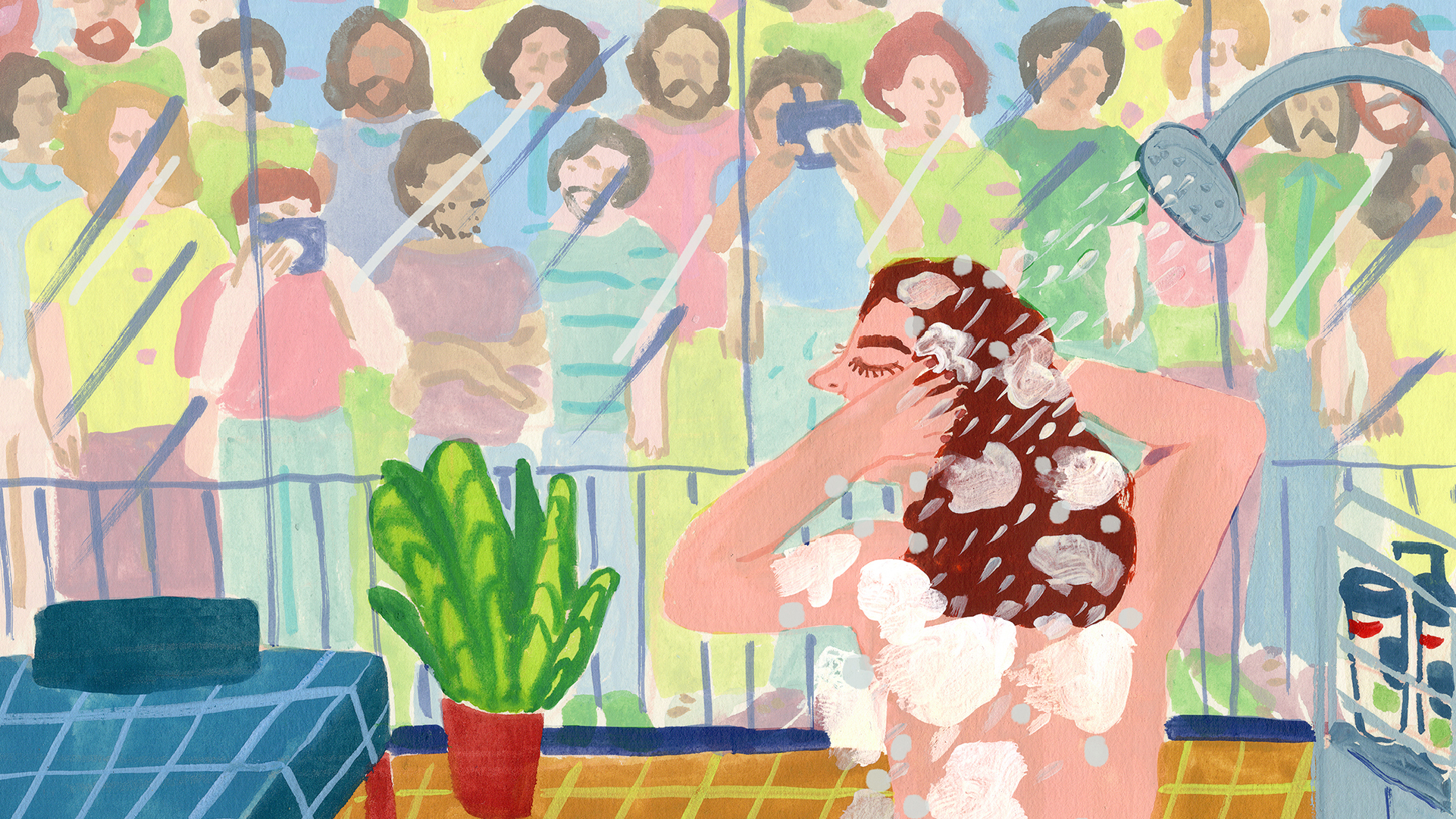
[Daniel A.]: But that wasn’t the only strange thing about this house. It was definitely not an ordinary house. Because, in reality, it was a kind of experiment: a glass house, completely transparent, even the bathroom.
There, Daniella would live her life in full view of everyone. Anyone passing by could see her doing what we all do: sleeping, cooking, showering. Everything she did inside the house would be exposed to public scrutiny.
And that, in the early 2000s, in the prehistoric era of reality shows and social media, in a conservative Chile that had only recently returned to democracy, would not go unnoticed at all. Just a few days after the move, the scandal would explode.
Our producer Aneris Casassus reported this story. Here’s Aneris.
[Aneris Casassus]: Before continuing, I want to tell you how Daniella came to live in a glass house in the heart of Santiago.
It all started with a notice she saw on a bulletin board at the university.
[Daniella T.]: I think it said exactly: actress needed to live in a glass house.
[Aneris C.]: The notice also had the logo of Fondart, the National Fund for Cultural and Arts Development, a public competition that at the time fell under Chile’s Ministry of Education. Daniella thought that if Fondart was involved, the job would be paid.
[Daniella T.]: Like any student from a modest family, I never had a lot of resources and I was interested, especially because I wanted to go on vacation. And since summer was approaching I said, well, I’ll go and present myself and see how it goes.
[Aneris C.]: That notice had been posted by Arturo Torres. At the time, Arturo was a recently graduated architect who worked at a university office and who, during his years of study, had become obsessed with a topic: glass houses. Constructions that since the early 1900s had sought to integrate their inhabitants with their surroundings. This is Arturo:
[Arturo Torres]: And suddenly it clicked for me with what I had seen in France.
[Aneris C.]: When he was a teenager, Arturo lived three years in Lyon because of his father’s work. He arrived at a new school, with a new language. But that wasn’t what surprised him most.
[Arturo T.]: The first thing that caught my attention was that the bathrooms had no walls at the high school. So you could see someone urinating from the hallway. So, well, I guess that’s how it is. You have to get used to it, I suppose. But then I began to understand that this was part of a much more complex policy.
[Aneris C.]: Because it wasn’t just at the high school. In many restaurants the bathrooms were mixed-gender and the urinal was in plain sight. And when he went to the beach he saw how people took off their clothes, were completely naked, and then put on their swimsuits. Public nudity, which to Arturo seemed almost scandalous, was completely normalized.
[Arturo T.]: Those two ideas clicked for me, the idea of glass houses and French policy, and I said: Ah, I’m going to use the glass house, like the history, the canon of glass houses, to raise a topic in Chile, which is the topic of the penalization of the body and the Judeo-Christian culture that controls all of our ways of living.
[Aneris C.]: He dreamed of doing a project about that but had no way to fund it.
[Arturo T.]: At the university they told me that kind of thing was idiotic, you know, it made no sense.
[Aneris C.]: Until, in 1999, an opportunity would appear for Arturo…
[Nivia Palma]: Because we decided to create an area that didn’t previously exist within the Culture Fund, called Integrated Arts.
[Aneris C.]: She is Nivia Palma, coordinator of Fondart at the time. Until that point, the categories had focused on more traditional areas like music, theater, dance, literature, visual arts…
[Nivia P.]: But there wasn’t a more specific space where diverse artistic languages were combined…
[Arturo T.]: So I said, here we go. I can argue that this is integrated arts. I’m mixing theater, visual arts, and architecture, and it would be fundable, you know. And that’s what I did.
[Aneris C.]: Arturo put together the project to enter the competition in just two weeks. He titled it: “Nautilus: the new transparent house to assemble on your suburban lot.”
[Arturo T.]: The goal was, as I was saying, to generate a shock — just that, a cultural shock between ideas of human transparency. And, you know, Chilean idiosyncrasy, which was extremely, let’s say, hypocritical at that moment.
[Aneris C.]: The project arrived at the Fondart offices along with about a hundred other proposals. The jury in charge of evaluating them consisted of five people, all with extensive backgrounds in the world of culture and arts. When it came time to choose a winner, they selected Arturo’s project unanimously.
[Nivia P.]: There was no doubt. I mean, according to the jury members at the time, of all the projects submitted, it was by far the best project.
[Aneris C.]: The project was very original.
[Nivia P.]: It proposed the intervention of a public space in the city center where a person — it didn’t specify man or woman — would live their daily life and would be completely transparent.
[Aneris C.]: Something that for Nivia was particularly timely.
[Nivia P.]: It raised several topics: how in Chilean society public debates had been privatized, and private matters were becoming public.
[Aneris C.]: She gave me an example… At that time, she said, many tabloid programs were talking about the sexual orientation of certain public figures who had not come out of the closet…
[Nivia P.]: But debates as relevant to Chilean society as divorce, for example, those were prevented from taking place in the appropriate public space, and instead were settled and contained in the homes of parliamentarians together with the Catholic Church.
[Aneris C.]: Fondart gave Arturo about $10,000 USD at the exchange rate of the time to execute the project. But, according to Arturo, the materials alone cost four times that. He tried to find sponsors, but the project was too controversial — no one would support it. So the rest of the money came from Arturo and the group of 40 friends who had joined the idea; among them architect Jorge Christie, who began designing the glass house together with Arturo.
They were lent a space at the university to begin construction. In that workshop they assembled the entire structure, but the glass panes, being very heavy, would be mounted directly on whichever site they secured.
Arturo had thought it would be ideal to have the house running for a year, but the money wouldn’t stretch to renting a space for that long.
[Arturo T.]: So then I changed the project, I said okay, let’s do it for a month. Let’s do a month, which isn’t ideal, because my original idea was for a person to be living inside for so long, so long, that eventually it would become normalized and nobody would talk about the thing anymore.
[Aneris C.]: They set about finding the site. The condition was that it be in an area with a lot of foot traffic.
[Arturo T.]: And what we did was make a list of vacant lots — I think there were 12 or 10 — and we started looking up the owners’ details and negotiating immediately in parallel.
[Aneris C.]: The one that interested them most, because of its location, was a vacant lot belonging to an insurance company. It was a block from La Moneda — the Government Palace — and on a street full of banks…
[Arturo T.]: There was a miracle there, which was that the manager of that site said: “Yes, perfect, sounds good to me.”
[Aneris C.]: And that was that. They signed a contract to rent it for two months, accounting for the roughly 15 days they would need to set up the work and another 15 to take it down.
[Arturo]: And with that we got that site, which was the best. Without a doubt it was like the… it was where things really heat up, exactly.
[Aneris C.]: Because in addition to being in the political and financial center, there was another feature that made it even more interesting… It was right across from a church: the Church of the Augustinians. A closed temple on one side, and a transparent house on the other. Two completely opposite symbols separated by just a few meters.
They already had the site and construction of the house was underway. Now they would need to find the person who would live inside. At first they thought about the possibility of it being someone from the team, but then decided it would be better to have an actress or actor, so they wouldn’t be overwhelmed by being so exposed. And that’s how they started posting notices at all the arts schools in Santiago.
[Arturo T.]: It said: person sought to live in a transparent house, and in large letters it said actress, and another said actor.
[Aneris C.]: That’s when Daniella saw the notice on her university’s bulletin board. She called the phone number listed and was summoned for an interview. When they gave her the details of the project, she was even more interested.
[Daniella T.]: The social and political symbolism that the idea of the glass house gave me was very powerful. And I found it super interesting, symbolic, necessary. I found it super necessary.
[Aneris C.]: Super necessary in a society where the ghost of the dictatorship was still very present and where democracy was only just beginning to consolidate itself.
In addition to Daniella, only two other actresses had called about the notice. One of the candidates was a painter and the other had her hair dyed lilac.
[Arturo T.]: In the end we chose Daniella because she was the most normal, she looked like a normal person and wasn’t going to do anything too strange in the house that could link it to the traditional idea of art.
[Aneris C.]: A few days after the interview, they called Daniella to let her know she had been selected. She was happy, they would pay her nearly $400 USD for the work, and with that she could fulfill her dream of going on vacation. The instruction they gave her was very clear.
[Arturo T.]: The script was: “This is your house, do whatever you feel like.”
[Daniella T.]: What they were most interested in was complete naturalness, that I be myself.
[Aneris C.]: She could go out to class, to her play rehearsals, to do shopping, and receive visitors at the house.
So, a few weeks later, there was Daniella… Entering on a hot Saturday in January into her new house, the glass house, the scene with which we began this story.
[Aneris C.]: As soon as she arrived she put away her things and then sat down to study the script for the play she was rehearsing. Since it was the weekend, there was very little activity in the area. In the evening she received a group of musician friends, they made dinner and had some beers.
[Daniella T.]: Everything very calm, very relaxed, enjoying this opportunity I had to be alone in my own space. Because that’s what it was, right? Being in my house, in my bathroom, taking off my clothes, getting in the shower. Peeing. You know? So it was like very natural. Really, on that first day, I don’t think it stirred up much in me. I don’t have strong memories from that first day.
[Aneris C.]: The house was surrounded by railings with a metal gate. At all hours, even at night, someone from Arturo’s team remained behind those railings in case any problem arose. They wanted to make sure all the house’s facilities were working well and to assist Daniella in case she needed anything. They also wanted to document the reactions of people passing by.
On Sunday, Daniella’s mother came for lunch. Then they set up the plastic pool and filled it with water. Later they went out to buy a few things and the day ended normally.
On Monday, with the banks opening and the typical movement of a weekday, there began to be more activity in the area. Early in the morning, office workers hurried past to get to work…
That day Daniella got up and, as she does every morning, got into the shower…
[Daniella T.]: Right, and at first there weren’t many people, and then when I finished the shower there were a few more curious onlookers, and well.
[Arturo T.]: People walked by outside, didn’t dare look, something very curious, it was like they passed by like this, glancing sideways, as if they didn’t understand what was happening.
[Aneris C.]: Arturo and his team tried to listen to what people were saying… Those passing by speculated with all kinds of theories. Some even came to think it was a shampoo advertisement.
When she got out of the shower, Daniella continued with her usual routine: she left the house and went to rehearse her play. She came back in the afternoon, had dinner, and went to sleep.
But on Tuesday everything began to change… A journalist from the newspaper “La Segunda” had heard a rumor that a glass house had suddenly been erected on the corner of Moneda and Bandera, so he went to the site to confirm it. And sure enough, there was the house with Daniella inside. The newspaper is an evening edition, so that same afternoon they published an article with several photos of Daniella, including one in the shower.
[Arturo T.]: And it exploded, it exploded like that, it appeared everywhere, the television trucks started arriving.
[Aneris C.]: By Wednesday there wasn’t a single outlet in Santiago that wasn’t talking about the glass house.
[Arturo T.]: It had become like a 24/7 show on all channels, on all channels. It was incredible.
[Journalist]: It’s like a glass house where a person is living…
[Aneris C.]: And with such widespread coverage, hundreds of curious onlookers started arriving at the site.
[Daniella T.]: I don’t think anyone at any point imagined or foresaw coverage at that level, nor the savage reaction.
[Aneris C.]: Because both the curious public and the media seemed to care about only one thing: when Daniella was in the bathroom…
(Soundbite – Chilevisión Archive)
[Journalist]: A woman was bathing completely naked without caring about the number of people watching her.
[Man]: She got into the bathroom, into the shower, she bathed, dried herself, put on powder, cream. Then she apparently has her period — she put on a sanitary pad.
(Soundbite – Canal 13 Archive)
[Host]: Tell us, tell us
[Reporter]: Paulina, what happened is that she got up, went to the bathroom, brushed her teeth, and showered!
[Reporter]: And as you can see there’s no curtain in the bathroom, and everyone who was here, of course, when she started showering turned to look.
[Host]: And most of them are men.
[Reporter]: Most of them are men, look for example right here. Did you turn to look?
[Man]: But of course.
[Host]: But where is this?
Anchor: This is on Bandera at Moneda (chords of “You Can Leave Your Hat On”)
[Reporter]: Bandera at Moneda, exactly — the onlookers stretch all the way to the next block, Paulina.
[Chorus]: It’s incredible!
[Daniel A.]: And very soon everything would spiral completely out of control.
A break, and we’ll be right back.
[Daniel A.]: We’re back. Aneris Casassus continues the story…
[Aneris C.]: From going almost unnoticed in the first few days, the glass house had suddenly become the topic of conversation on nearly every program in Chile. For Arturo, the project’s author, a kind of Russian nesting doll phenomenon was taking shape…
[Arturo T.]: There were people watching the work from the street. Then there were television trucks watching the people watching the work, and then there were international channels watching the television channels that were filming the work. So this crazy amplification thing happened.
[Aneris C.]: This, for example, is a report from the international Associated Press agency.
(Soundbite – AP Archive)
[Journalist]: In downtown Santiago, something strange is going on. In her specially built house of glass, the entire domestic world of actress Daniela Tobar is on public view. It’s the peeping toms ultimate dream.
[Aneris C.]: “Something strange is going on in downtown Santiago,” says the journalist. “In a glass house specially built for her, the domestic life of actress Daniella Tobar is on public view. It is the voyeur’s ultimate dream,” he concludes.
Because in fact, the onlookers weren’t only those passing by. People also started arriving from other cities to see with their own eyes what they had already seen on television… Everyone had an opinion…
[Man]: A very interesting project, this is the future. This in three million, I don’t know, in a thousand years, two thousand years from now, this will be the future, these kinds of houses will all be made of glass.
[Woman]: I don’t like it much, because you lose the privacy of a home, no, I don’t like it.
[Aneris C.]: And many had no shame in confessing what they had come to see…
[Woman]: We wanted to know what time she showers…
[Man]: You don’t see this every day.
[Journalist]: Did you go home and tell people?
[Man]: Yes, I went home and told them and got scolded.
[Aneris C.]: Daniella had no television inside the house but she could hear the shouts and see the equipment from all the channels stationed at the site.
[Daniella T.]: What started happening was very, very intense. Like the huge crowd of people outside waiting for the moment of the shower.
[Arturo T.]: The shower and also the bathroom. I mean, Daniella would use the toilet there. All those, all those images were amplified to 1,000% on television with zoom.
[Daniella T.]: I felt violated by that, violated by the shouts from outside.
[Men shouting]: Take a shower! Take a shower!
[Arturo T.]: Once Daniella didn’t shower and people called her filthy.
[Aneris C.]: Daniella’s mother, who was watching her constantly on television programs, called her on the phone, very worried…
[Daniella T.]: By that point I think my family in general was a little, a little rattled, I think, a bit worried too, and so was I.
[Aneris C.]: What bothered her most was the angle the media was giving the story…
[Daniella T.]: Reducing this whole great project to the moment of the shower. That produced a lot of outrage in me. That this had come to focus on whether Daniella had more or less of a butt — “poto” is the word for butt in Chile — or good boobs or bad bo— you know what I mean, so… for me it was an offense, a lack of respect.
[Aneris C.]: The glass house, or rather, the scant few minutes when Daniella was in the bathroom, had unleashed a kind of collective catharsis…
[Daniella T.]: So many things opened up there in terms of what we also were as a country. With respect to so many years of dictatorship, of repression, of punishment for for sexuality, or taboo subjects that came out there, I think, came to light.
[Aneris C.]: Here again is Nivia, the then-coordinator of Fondart…
[Nivia P.]: I think it was a brutal expression of machismo, because 90% of those watching were men, and watching from a place of lasciviousness, from an attempt to control a woman’s body. So that dynamic practically prevented any substantive conversation about what the project actually was.
[Aneris C.]: As we said, Arturo wanted to ignite a conversation around the idea of transparency in a society that, in his own words, was hypocritical. But of course no one, neither in the media nor in the public, was giving it that interpretation… All anyone talked about was the shower…
With such media repercussions, Arturo’s phone wouldn’t stop ringing… As soon as the scandal broke he got a call from the manager of the company that had rented him the site.
[Arturo T.]: And he says: “Hey, Arturo, you have to stop the project.”
[Aneris C.]: You have to stop the project. Arturo reminded him that he had informed him in advance of what the project was about… That there was no way he was going to stop it. He also told him…
[Arturo T.]: “This kind of work is about that. It’s a Dadaist work, or neo-Dadaist, where whatever happens is what has to happen, you set a detonator and it can develop in any direction,” and he says, “No, you’re not understanding me, you have to stop the project.”
[Aneris C.]: Arturo had studied the rental contract inside and out, he knew the manager couldn’t demand that of him, but the manager insisted…
[Arturo T.]: Then he says: “No, you’re not understanding me: the owner is going to fire me if the project isn’t stopped he’s going to fire me.” “But how can he fire you if you’re the manager of the company?” you know. He says, “The owner, man, get it? It’s the owner who’s going to fire me.” “But who is the owner?” I say. “Agustín Edwards, man, get it?” “And I… Agustín Edwards, son of a…”
[Aneris C.]: Agustín Edwards was the owner of the newspaper El Mercurio, which had had close ties to Pinochet’s dictatorship.
[Arturo T.]: Damn, I had no idea. I had stepped in it, in the horse’s mouth itself.
We were poking one of the most powerful people in Chile where it hurts, and things had started to get dangerous. Really dangerous.
[Aneris C.]: Fondart, which had partially funded the project, also found itself in the eye of the storm.
[Arturo T.]: A lot of people appeared in the press speaking out against the project and asking how Fondart could have funded this, how our taxes could be used to fund such an abomination, you know.
[Nivia P.]: And a lot of people felt it was like spending the whole country’s money on this.
[Aneris C.]: Nivia’s phone was also burning up. Around that time, she received a call from a senior government official.
[Nivia P.]: And he says: “Nivia, this is very complicated. I think this should be suspended. It’s generating a lot of controversy.” So I told him to put it in writing and send it to me. He said to me: “You know these things can’t be put in writing.” Well, I told him, whoever wants to. Whoever wants to make a case and has arguments to suspend this will have no problem putting it in writing.
[Aneris C.]: Nivia knew no one would put this in writing because it would be an explicit act of censorship against an artistic work. That was her trump card. And of course it wasn’t the first time she had used it…
[Nivia P.]: There will always be, whatever the political leanings of the governments, whether left, center, right, whether coalitions, there will always be some authority that will want to censor.
[Aneris C.]: Nivia knew how to handle that kind of pressure. And she was willing to resist once again, even if it cost her the position.
[Nivia P.]: I was completely clear that what we were facing was a cultural battle, that there could not be forbidden subjects, that there had to be respect for the freedom of creation, and that from art and culture there was also a wild horse, an earthquake, building a democratic culture.
[Aneris C.]: And so, amid unprecedented press coverage and the first waves of pressure, Wednesday came to an end. Though things would not be any calmer the next day.
On Thursday morning there were hundreds of people pressing against the fence around the house.
[Arturo T.]: You practically couldn’t get in, meaning there were so many people outside that you couldn’t get close to the door, the access door to the site.
[Aneris C.]: The police had arrived to cut off traffic because the street was in chaos. When Daniella wanted to go in or out, Arturo and his team had to form a kind of security cordon.
[Arturo T.]: Daniella would call us to say: I’m going to go out, okay. So we were prepared for her to leave. Or, I don’t know, I’m ten blocks away. I’m heading there. I’ll be there in 15 minutes. So we’d get the situation a bit ready so she could go in and out.
[Aneris C.]: But the security arrangement soon became overwhelmed.
[Arturo T.]: Because the harassment started, they started kind of groping Daniella when she approached the door.
[Aneris C.]: Here, for example, you can hear Daniella while she was trying to leave the house…
[Daniella T.]: Hey, watch it, careful about grabbing my butt, please. Okay, move, everyone move back please.
A large number of people, men mostly, I think, trying to, to, to touch me, to grab me, to take a little piece of me. And I felt it that way, it was savage, it was super, super savage.
[Aneris C.]: Around that time, Daniella was told something that horrified her…
[Daniella T.]: About a girl who had been nearby, I think, a pack, I’ll say it like that, a group of men mistook her for me and I think they left her almost naked. You know? So we are really talking about savagery, about a total loss of control. And I think no one ever imagined it would, that it would go that far.
[Aneris C.]: Later that same day, Daniella had to leave the house escorted by the special forces of the Carabineros, those who carry shields and helmets.
[Daniella T.]: And I had to leave the house with them because at that point there were fears for my safety.
[Aneris C.]: Faced with this situation, the team decided to hold an emergency meeting. Arturo, Daniella, and several others met at a restaurant near the glass house.
[Arturo T.]: And there we said, look, we need to implement, you know, if things get rough, if things get difficult. We’ll get Daniella out and she won’t come back.
[Aneris C.]: They would watch closely what happened in the next few hours to make a decision. After the meeting, Daniella went to her play rehearsal hoping everything would calm down. But they were far from that. Because as if all of this weren’t already enough, conservative groups appeared at the site… A man, representing a group called El Porvenir, spoke before television cameras.
[Man]: It is a lack of respect that that crystal house has been placed right — in front of one of the oldest and most traditional churches in Santiago, which is the church of the Augustinian convent…
[Aneris C.]: At first glance, the conservatives seemed to be the antithesis of the voyeurs… but in reality it was all about the same thing.
[Daniella T.]: Some want to see it to, I don’t know, gratify their deepest, most instinctive animal desires, you know, and the others, the rejection of the body, sin. But it was the same subject. The subject was the body.
[Aneris C.]: The truth was that the atmosphere was growing ever more dangerous. A man even approached the house to deliver a direct warning to Arturo, face to face…
[Arturo T.]: And he says: 25 young patriots are going to come and destroy everything.
[Aneris C.]: Arturo had already been receiving so much pressure that at this point he couldn’t know whether the threat was coming from Agustín Edwards, from the conservative groups, or from both… But in the end that was the least of his concerns.
[Arturo T.]: What we did was prepare ourselves for it to happen. In the Dadaist logic we said: let’s set up some cameras so that when the 25 young patriots come and destroy the work, it stays like that, it gets recorded as part of the work.
[Aneris C.]: It would also be a way to identify the aggressors. But the threat had been forceful enough for Arturo to also go and file a report with the Investigation Police.
Meanwhile, very strange things kept happening at the house. At some point, while Daniella was already out, someone had jammed the lock on the outer door. They had stuck a matchstick in the lock and neither Arturo nor anyone else on the team could get in. Everyone was by now too frightened…
[Daniella T.]: I think they were genuinely afraid for my safety. Because of course, even if however many people stayed through the night, if a pack of savages came wanting to get in, they would get in and could easily rape me, tear me apart, and maybe eat me too, you know? Because the level of savagery was at that point.
[Aneris C.]: She had spent just five days in the glass house. But it had been more than enough. Daniella, Arturo, and the rest of the team held an emergency meeting and decided she would not return to the house.
[Aneris C.]: That night she slept at her mother’s house and then decided to go rehearse for a few days in Valparaíso with her theater company, to escape the press siege.
Up until that point, the so-called “patriots” had not arrived, so the glass house still stood. Standing but uninhabited. So now Arturo and the team would need to decide how to move forward.
And the answer would be found in a letter.
[Daniel A.]: We’ll be right back.
[Daniel A.]: We’re back on Radio Ambulante. Aneris Casassus continues the story.
[Aneris C.]: After the scandal, the glass house stood empty in the heart of Santiago. Arturo and the team were debating what to do with the project. They said nothing to the press about Daniella’s departure. Everything had spiraled out of control and they didn’t want that to happen again. So they took a few days to think. And that’s when they remembered something…
[Arturo T.]: We had received a congratulatory letter from Víctor Hugo Ogaz, who is an actor — more of a theater actor, but he’s known a bit for doing advertising — a very, very beautiful letter, you know, congratulating, like, thank you, I don’t know.
[Aneris C.]: Víctor Hugo had found out about the project when he walked past a newsstand and saw photos of the glass house on the front page of the newspaper “La Segunda.” This is Víctor Hugo:
[Víctor Hugo Ogaz]: And there was the photo of the girl Daniella Tobar, who I thought was beautiful. I imagined her in that space, navigating. Anyway, it moved me deeply, that photograph.
[Víctor Hugo]: So much so that I get home and I write a letter. The next day I go to where the glass house is located, I toss that letter inside because Daniella wasn’t there, two days pass, and the creators of the project call me.
And they say: Víctor Hugo, I want you to come and live in the glass house because Daniella has left.
[Aneris C.]: Víctor Hugo was the perfect candidate not only because he was fascinated with the project but also because he was a man…
[Víctor Hugo]: There were women who said: well, why don’t they put a man in there? They told them, said it publicly. So here’s the man, a bit old, a bit potbellied, ugly, but here’s the man.
[Aneris C.]: After talking with his wife and two children, Víctor Hugo accepted the proposal… A few days later, he packed his things and entered the glass house with the same instruction they had given Daniella: to live completely normally.
[Arturo T.]: And now women would gather, there weren’t as many people as when Daniella was there, let’s say there were about 20 or 30 people outside.
[Woman 1]: Interesting, because the men already had their chance now it’s the women’s turn.
[Woman 2]: Good, because it belongs to us too, we can do a little window-shopping.
[Aneris C.]: But it was nothing compared to what had happened with Daniella…
[Víctor Hugo]: I could go out calmly because I never caused the sensation that Daniella caused. Because I was a man and I was old.
[Aneris C.]: Not really that old: he was 46 at the time. But he was twice Daniella’s age… Nivia also remembers very well what happened with Víctor Hugo.
[Nivia P.]: And right away the level of attendance at the site dropped. The level of interest from the press dropped.
[Aneris C.]: And everything calmed down. Víctor’s days in the house went by with much less notice. He ended up staying for less than a week, but he fulfilled the goal Arturo had wanted: for the project to end as it had been conceived, with an inhabitant inside the glass house.
Days later, the house was dismantled and the corner of Moneda and Bandera once again looked as it had before… But this would not yet be the end of the story…
[Arturo T.]: Because afterward they sued us with a criminal complaint, which would have meant, would have entailed prison, for an offense against morality and public decency.
[Aneris C.]: The controversy continued. Now in the courts.
A lawyer from El Porvenir had filed a lawsuit based on Article 373 of the Penal Code, which states — and I quote — “those who in any way offend public decency or morals with acts of serious scandal or consequence shall suffer the penalty of lesser confinement in its minimum to medium degrees.” To translate: sentences of up to three years in prison for violating public decency and morality. An article that remains in force to this day.
[Roberto]: It was an excess and an absurdity, you know.
[Aneris C.]: He is Roberto Celedón, a human rights defense attorney, today a member of parliament. Roberto knew the project very well because he had helped Arturo establish the legal framework for the work.
[Roberto Celedón]: It was a university and academic experience that had a completely different intention from public outrage, from good customs.
[Aneris C.]: When he found out about the lawsuit, Roberto immediately took on the defense of the case. Arturo remembers he said:
[Arturo T.]: If we manage to win a trial, we’re going to change legal precedent and that will change. If the law changes, the culture changes, in a sense.
[Aneris C.]: The lawsuit, filed in the Second Criminal Court of Santiago, was directed specifically at Arturo and his team. Here is Nivia again:
[Nivia P.]: They went after them because they were young guys, barely out of university, who were just starting out with this project. I mean, they were even cowardly about it, to put it one way, because if they had gone after the Ministry, the strategy would have been very different.
[Aneris C.]: The Ministry of Education, which Fondart fell under at the time, was not named in the lawsuit. Because of course, everyone knows how hard it is to win against the State. But all the other parties involved would have to give testimony.
[Arturo T.]: All the members of the core team, I named them, I said: Look, these are the people you’d want to question, if you want, so they can see how it went, because really there’s nothing sexual about the work.
[Nivia P.]: I truly believe that in them there was never any intention to treat Daniella as an object, as a sexual object, as an object to be possessed. No, no, I don’t think that idea was ever there.
[Aneris C.]: But in this context, they had to convince the Justice system of this. The first to testify was Arturo…
[Arturo T.]: I remember that the commissioner who took my statement showed me, I don’t know, fetuses, for example, very strange things he had there in the office, like I don’t know, I think he was trying to verify whether I was a psychopath or not, whether I seemed fascinated by what he was showing me, whether I seemed destroyed, because in fact he showed me terrible things, he showed me photos of rapes. Very strange.
[Aneris C.]: Daniella also had to testify but they didn’t show her those macabre things, instead they asked her very silly questions.
[Daniella T.]: Right, the questions were: how did you shower? Well, I took off my clothes and turned on the shower and got in and got wet, soaped up, and rinsed off — how else would I shower? Like every other day.
[Aneris C.]: Víctor Hugo also had to go through it…
[Víctor Hugo]: And how do you shower? How does any person shower? We’d like details. Okay, so I answer them rudely. Well, I washed my balls, I put my hand up my ass, man, whatever…
[Aneris C.]: But the transcription of that declaration was not word for word…
[Víctor Hugo]: And so the secretary’s write-up says that I performed “a thorough cleaning of myself.”
[Daniella T.]: For the people conducting the interrogation, for the clerks, who are the ones who write up the statements and everything, for them it was like a very amusing case. I don’t know if amusing, but anecdotal, entertaining.
[Aneris C.]: For them it was anything but. Not entertaining at all. There were months of giving testimony, of filing papers… Until, finally, the judge made a decision…
[Roberto]: The judge dismissed the case definitively. He said: there is no crime here.
[Arturo T.]: The fact that the judge was more or less progressive, let’s say, ensured it was ruled in our favor. But it wasn’t obvious. It was quite hard.
[Daniella T.]: It would have been too absurd to have been in prison for that. But well, in Chile there are absurd things. So it could have happened too.
[Aneris C.]: But there was another reason to celebrate. Because in the ruling the judge made an important distinction.
[Nivia P.]: Between when you use the body in pornographic terms or abusively toward another person, and when you use it as artistic expression.
[Aneris C.]: That distinction, just as the lawyer had envisioned, could set legal precedent for the future.
[Nivia]: Ultimately the artist not only creates a work — they are also constructing new paradigms, putting existing ones in tension, right? There is a symbolic dimension there that is very important, even in some productions or works that appear small, minor.
[Aneris C.]: The glass house turned out to be a kind of antechamber to everything that came afterward.
[Arturo T.]: Something happened there that, I don’t know if it’s promising with regard to Big Brother, you have to consider that Big Brother is Orwell. It comes from a book that is a critique of visual control, right? And here the Big Brother phenomenon had been produced through television.
[Aneris C.]: The first edition of the famous reality show had aired just a few months earlier, at the end of 1999, in the Netherlands. But it would only arrive in full force in various Latin American countries in the years that followed. It didn’t reach Chile until 2023, though throughout all these years there had been dozens of similar reality shows. The first was “Protagonistas de la fama,” in 2003, in which aspiring actors and actresses lived in a house under surveillance 24 hours a day.
And after the reality shows, what we all already know: social media, which fosters a culture of overexposure of personal life and the consumption of other people’s intimacy. A kind of collective exhibitionism and voyeurism… But even though we’ve been living with that for years, I wonder whether the reaction to a hypothetical glass house, with a real person inside, appearing suddenly in the center of any Latin American city would today provoke something very different from what it generated 26 years ago in Santiago…
I also asked Daniella.
[Daniella T.]: And sometimes I ask myself: but well, Daniela, what reaction were you expecting? That a sociological debate would emerge? About how we are, how we see ourselves, how we’d like to be? This is like asking for the impossible, you know.
[Aneris C.]: Something has changed but not everything.
[Daniella T.]: Today I think there is a group, a generation much more empowered about their bodies and about defending their gender and their femininity. So, even though that is changing. I think today it would still cause a stir, there are things in human beings that don’t change.
[Aneris C.]: Like that unstoppable temptation to watch a naked body, live. And even more so when it is a woman’s.
[Daniel]: Weighed down by the debts the project had generated, Arturo and his team sold the glass house to photographer Roberto Edwards, brother of Agustín Edwards, the owner of the newspaper El Mercurio. Roberto had supported the project from the very beginning. Today it is installed in a coworking space in the commune of Providencia, in Santiago, Chile. On the lot where the house was set up, a small shopping center was built.
As part of the benefits of belonging to Deambulantes, our membership program, Jeff Oxley will read the credits for this episode.
Here’s Jeff.
Hello, Ambulantes. I’m Jeff Oxley, from Portland, Oregon, United States, and along with my wife, Jeane DeLaney, we’ve been Deambulantes members for two years.
I started listening to your stories to help me learn Spanish, and over time, it has gone from being a tool to becoming a companion that takes me to places I’ll never go and tells me the stories of people I would otherwise never have the pleasure of meeting. If you want to help them keep narrating Latin America, visit radioambulante.org/donar.
Here are the credits for today’s episode.
Aneris Casassus is a producer at Radio Ambulante and lives in Buenos Aires. This story was edited by Camila Segura. Bruno Scelza did the fact-checking. Sound design is by Andrés Azpiri with music by Ana Tuirán, Rémy Lozano, and Andrés.
The rest of the Radio Ambulante team includes Daniel Alarcón, Paola Alean, Adriana Bernal, Diego Corzo, Emilia Erbetta, Camilo Jiménez Santofimio, Germán Montoya, Sara Selva Ortiz, Samantha Proaño, Natalia Ramírez, Juan Pablo Santos, David Trujillo, Elsa Liliana Ulloa, Luis Fernando Vargas, Franklin Villavicencio, and Mariana Zuñiga.
Carolina Guerrero is the CEO.
Radio Ambulante is a podcast by Radio Ambulante Estudios, produced and mixed in the Hindenburg PRO program. Radio Ambulante tells the stories of Latin America. I’m Jeff Oxley. Thank you for listening.